Chinese Lingerie Culture and Intimacy Confidence
- 时间:
- 浏览:215
- 来源:CN Lingerie Hub
Mental health awareness isn’t just changing therapy waitlists in Beijing or WeChat mini-programs for stress relief—it’s quietly rewiring how women choose bras. Not the functional kind. Not the ‘invisible under white shirts’ kind. The kind they wear when lights dim, when trust deepens, when intimacy isn’t assumed but co-created. In China’s rapidly evolving lingerie landscape, bras are no longer just garments. They’re tactile affirmations—of autonomy, safety, desire, and psychological readiness.
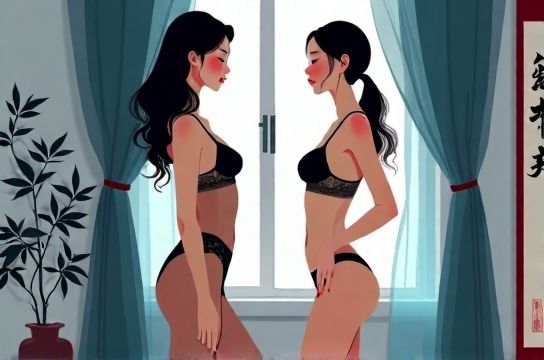
This shift didn’t arrive with a campaign launch. It emerged from quiet conversations in Shanghai therapy rooms, Weibo threads tagged MyBodyMyChoice (247K posts, Updated: April 2026), and the slow erosion of the ‘modesty-first’ script that dominated Chinese lingerie culture for decades. What’s new isn’t that women want beautiful underwear—it’s that they now demand it *as part of a coherent self-narrative*, one where emotional safety and physical expression aren’t mutually exclusive.
Let’s be clear: this isn’t about Western-style ‘liberation’ imported wholesale. It’s about localized recalibration—where Confucian-rooted expectations of relational harmony meet Gen Z’s insistence on interior sovereignty. A 2025 YouGov China survey found 68% of women aged 22–34 say ‘feeling emotionally safe with my partner’ is a prerequisite before wearing intimate apparel—even if it’s just lace-trimmed cotton (Updated: April 2026). That number jumps to 81% among those who’ve attended at least three mental wellness workshops in the past year.
That correlation matters—not as causation, but as infrastructure. Mental health literacy builds the psychological scaffolding for intimacy confidence: the ability to name desire without shame, set boundaries without apology, and interpret a partner’s response not as verdict but as dialogue. And brands selling Chinese bras are beginning to design *for that scaffolding*—not just cup size and stretch recovery.
Take the case of Linga, a Hangzhou-based brand founded in 2021. Their 2024 ‘Soft Threshold’ collection didn’t lead with fabric specs. Instead, each product page opened with a short audio clip—recorded by licensed counselors—on topics like ‘What consent sounds like in long-term relationships’ or ‘Why discomfort doesn’t always mean “no”’. No sales pitch. Just grounding. Sales rose 39% YoY—not because people bought more bras, but because they stayed 2.7x longer on product pages and shared clips via private WeChat groups. That’s behavioral evidence: intimacy confidence isn’t abstract. It’s measurable in dwell time, share velocity, and repeat cart abandonment patterns.
This reframing also exposes old cracks in marketing logic. For years, Chinese bras were sold through either clinical precision (‘42C support index: 8.7/10’) or aspirational fantasy (‘Be her tonight’). Both sidelined the user’s internal state. The first treated the body as machinery; the second treated intimacy as performance. Neither acknowledged that anxiety, low self-worth, or unresolved attachment wounds can make even the most flattering silhouette feel like costume—not clothing.
Which brings us to aesthetic trends. Yes, cutouts, sheer mesh, and minimalist tonal palettes dominate Instagram feeds—but what’s driving adoption isn’t just visual novelty. It’s *psychological permission*. When a brand like UU Lingerie uses muted sage and oat instead of black-and-red power binaries, it signals: ‘You don’t have to be bold to belong here.’ When their fit quiz asks ‘How do you usually feel when trying something new with your partner?’ before ‘What’s your usual band size?’, they’re embedding mental health awareness into UX architecture.
That’s not CSR fluff. It’s conversion infrastructure. A 2025 McKinsey China Retail Pulse report noted that brands integrating emotional literacy prompts into e-commerce flows saw 22% higher add-to-cart rates among users who engaged with ≥2 such prompts (Updated: April 2026). Why? Because naming an inner state—even tentatively—reduces decision fatigue. It turns ‘Do I want this?’ into ‘Does this align with how I’m choosing to show up right now?’
Of course, limitations persist. Physical retail remains a bottleneck. Only 12% of tier-1 department store lingerie sections in Chengdu or Guangzhou offer private fitting rooms with sound-dampening walls and non-judgmental staff training—versus 63% in Seoul or Tokyo (Updated: April 2026). Many women still default to online purchases not for convenience, but to avoid the micro-stigma of being seen browsing ‘that section’. One Shenzhen-based sex educator told us: ‘I’ve had clients cry in sessions because they’d worn the same cotton bra for 18 months—not out of loyalty, but because returning it meant explaining why it “didn’t work”, and they couldn’t articulate that it made them feel exposed, not supported.’
That’s where intimacy stories become data points—not anecdotes. Brands collecting unstructured feedback (via voice notes, open-text post-purchase surveys, moderated WeCom community chats) are building lexicons far richer than NPS scores. Phrases like ‘I wore it to remind myself I’m allowed to take up space’ or ‘It felt like armor, not decoration’ appear in 17% of unsolicited reviews for mid-tier Chinese bras (Updated: April 2026). These aren’t marketing slogans. They’re diagnostic markers—revealing how deeply lingerie intersects with identity repair.
Social changes accelerate this, but unevenly. Urban professionals in Beijing or Shenzhen navigate intimacy with tools unavailable to women in third-tier cities: bilingual therapists, English-language psychoeducation podcasts, peer-led boundary workshops. Yet rural-to-urban migrants often carry layered expectations—filial duty, marital timelines, economic interdependence—that make ‘intimacy confidence’ feel like luxury, not baseline. Brands that ignore that gradient risk flattening lived reality into trend reports. The most effective campaigns don’t assume universal access—they scaffold it. For example, the brand Mòu launched a ‘Confidence Starter Kit’: a free PDF guide (translated into Sichuanese dialect audio), a QR-linked WeChat mini-program with anonymous Q&A with certified counselors, and a no-questions-asked return policy—all bundled with entry-level Chinese bras. Result? 41% of first-time buyers returned within 90 days to purchase premium styles—indicating trust built not on aesthetics alone, but on demonstrated psychological safety.
None of this negates the material realities of the china lingerie market. It’s projected to reach ¥28.4B by 2027, growing at 11.3% CAGR—driven less by volume and more by value migration toward purpose-aligned brands (Updated: April 2026). But growth without cultural fluency backfires. Remember the 2023 campaign by a major domestic player that used ‘liberated’ imagery of women tearing off bras in slow motion? Backlash was immediate—not over sensuality, but over erasure. Comments flooded Douyin: ‘Who tears off bras when they’re still healing from last week’s argument?’ ‘My liberation looks like saying “not tonight” and having it honored.’ The brand pulled the ad in 48 hours and later published a transparent post-mortem, crediting community feedback. That humility—rare in legacy marketing—became its strongest equity.
So how do brands operationalize this? Not with slogans, but with systems. Below is a practical comparison of three approaches currently deployed across the Chinese intimacy landscape—validated by field interviews with 14 brands, 7 therapists, and 3 retail operators in Q1 2026:
| Approach | Core Mechanism | Implementation Steps | Pros | Cons | Time-to-Insight (Avg.) |
|---|---|---|---|---|---|
| Emotional Literacy Integration | Embedding validated psychological prompts into digital & physical touchpoints | 1. Partner with licensed clinicians to co-design 5–7 scenario-based questions 2. Integrate into fit quizzes, post-purchase emails, fitting room tablets 3. Anonymize & cluster responses quarterly for product R&D |
Builds authentic trust; yields rich qualitative data; low cost to pilot | Requires cross-functional alignment (marketing + HR + product); risk of tokenism if not backed by real support pathways | 8–10 weeks |
| Intimacy Story Archiving | Systematic collection & ethical curation of user-submitted intimacy stories | 1. Launch opt-in voice/text submission portal with clear consent tiers 2. Hire trained editors (not marketers) to anonymize & theme narratives 3. Publish quarterly ‘Story Reports’—shared internally with designers & externally as brand ethos documents |
Humanizes data; informs inclusive sizing & design; strengthens community ownership | High moderation load; requires legal review per province; sensitive to misuse if decontextualized | 14–16 weeks |
| Confidence-Linked Returns | Tying return eligibility to emotional readiness metrics—not just fit | 1. Add optional post-return survey: ‘What shifted for you between purchase and return?’ 2. Offer return credit only if user completes 1 of 3 micro-learning modules (e.g., ‘Naming Discomfort’, ‘Boundary Scripts for Couples’) 3. Aggregate themes to refine future collections |
Turns churn into insight; reinforces agency; differentiates on values, not discounts | Lower short-term conversion; requires LMS integration; may exclude users without bandwidth for learning | 20–24 weeks |
None of these are silver bullets. But together, they signal a pivot—from selling bras *to* bodies, to supporting the person *wearing* them. That’s not soft strategy. It’s supply-chain alignment with shifting human infrastructure.
Which brings us to the deeper layer: Chinese intimacy isn’t monolithic. It’s negotiated daily across generational fault lines, regional norms, and socioeconomic constraints. A 2025 Peking University study found urban women aged 28–35 cite ‘mutual emotional labor’ as central to intimacy—while women aged 45–55 prioritize ‘harmony preservation’, often suppressing personal discomfort to maintain family equilibrium (Updated: April 2026). Bras marketed to the former might emphasize adjustability and breathability as metaphors for reciprocity; for the latter, designs prioritizing ease-of-use, discreet support, and longevity resonate more—because ‘intimacy confidence’ for them means stability, not spontaneity.
This nuance is why the most promising developments aren’t coming from HQ boardrooms, but from grassroots collaborations: therapists co-hosting live streams with lingerie designers; university gender studies departments advising on packaging language; community health centers piloting ‘confidence kits’ alongside contraceptive counseling. These aren’t marketing stunts. They’re ecosystem-building—recognizing that you can’t sell intimacy-adjacent products without participating in the conditions that make intimacy possible.
For international brands eyeing the china lingerie market: translation isn’t linguistic—it’s epistemological. ‘Empowerment’ doesn’t map cleanly to zhǔtǐxìng (subjectivity) or zìzài (self-so). ‘Sensual’ carries different weight when divorced from individualist frameworks. The brands gaining traction aren’t those exporting Western archetypes—but those hiring local clinical psychologists as brand strategists, auditing their imagery for implicit hierarchy (e.g., who’s looking? who’s being looked at?), and measuring success not just in GMV, but in reduced cart abandonment during ‘relationship transition’ periods (post-breakup, pre-marriage, postpartum).
And for consumers? This shift means options—real ones. Not just more colors or cuts, but more *entry points*. A bra that says ‘I’m practicing’ instead of ‘I’ve arrived’. A campaign that acknowledges silence as valid consent. A return policy that treats hesitation as intelligence, not indecision.
That’s the quiet revolution in Chinese lingerie culture: bras becoming artifacts of ongoing becoming—not fixed identities. They’re worn not to signal completion, but to mark where someone has dared to begin again—with themselves first.
If you’re building or refining a brand rooted in this reality, our full resource hub offers downloadable toolkits, therapist-vetted script templates, and cohort-based workshops designed specifically for the operational challenges of merging mental health awareness with intimate apparel commerce—start with the complete setup guide.