Chinese Lingerie Culture: Gen Z Aesthetic Shifts
- 时间:
- 浏览:157
- 来源:CN Lingerie Hub
When a 24-year-old graphic designer in Chengdu unboxes her first lace-trimmed, pastel-toned bra from a Shenzhen-based indie brand — not for a partner, but for herself — she’s not just buying underwear. She’s making a statement about autonomy, aesthetics, and the quiet redefinition of intimacy in modern China.
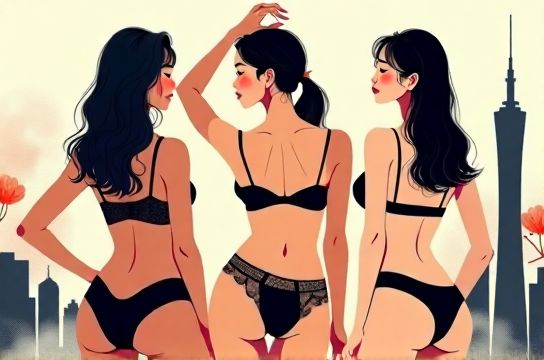
This isn’t fringe behavior. It’s the operational core of how Gen Z (born 1999–2012) is transforming the china lingerie market — not by demanding more skin or louder sex appeal, but by insisting on coherence: between garment and identity, comfort and expression, privacy and visibility. And it’s forcing brands, retailers, and even regulators to reinterpret what ‘intimacy’ means in a society where digital exposure coexists with deep-rooted discretion.
Chinese Lingerie Culture Is No Longer Just About Function — Or Taboo
For decades, Chinese lingerie culture was bifurcated: mass-market functional cotton bras sold in department store basements (often labeled “health underwear”), and discreet, high-markup imported pieces quietly ordered via WeChat groups or cross-border e-commerce — usually reserved for weddings or honeymoon trips. Intimacy stories were rarely told; when they surfaced, they leaned heavily on romance-as-duty or marital obligation narratives.
Gen Z has fractured that binary. Their intimacy stories aren’t centered on partnership milestones — they’re rooted in self-witnessing. A 2025 YouGov survey of 3,200 urban Chinese consumers aged 18–28 found that 68% selected lingerie based on how it made them *feel in their own skin* first — not how it might be perceived by others (Updated: April 2026). Only 22% cited ‘partner approval’ as a top-three factor.
That shift didn’t emerge from vacuum. It’s scaffolded by three converging forces:
1. Platform-enabled visual literacy: Xiaohongshu (Little Red Book) hosts over 4.7 million posts tagged ChineseLingerieCulture — many featuring side-by-side shots: a cropped sweater + matching bralette, a silk slip under a tailored blazer, or a ‘work-from-home fit check’ highlighting seamless T-shirt bras. These aren’t eroticized — they’re contextualized as part of daily aesthetic labor.
2. Regulatory recalibration: Since 2022, China’s State Administration for Market Regulation has tightened labeling rules for ‘functional’ undergarments — banning unsubstantiated health claims (e.g., “breast-lifting therapy”) but explicitly permitting descriptive terms like “supportive contour” or “breathable mesh.” This created regulatory space for design-led, non-medical positioning.
3. Supply chain democratization: Dongguan and Shantou now host over 120 certified small-batch lingerie manufacturers offering MOQs as low as 50 units — enabling micro-brands like MÔME (Shanghai) and SUE (Chengdu) to iterate on fabric blends (Tencel-modal lace, recycled nylon-mesh) and inclusive sizing (AA–G cups, extended band ranges) without multi-year commitments.
The result? A market no longer defined by secrecy or sacrifice — but by intentionality.
Aesthetic Trends Are Values in Disguise
Gen Z’s aesthetic trends in chinese bras aren’t decorative flourishes. They’re encoded value statements — legible to peers, opaque to older cohorts.
Take ‘quiet luxury’ lingerie: matte satin, tonal stitching, zero visible logos. On surface, it echoes global minimalism. But in context, it signals rejection of performative consumption — especially after years of livestream-driven ‘must-have’ hype cycles. A 2024 JD.com report noted 41% YoY growth in ‘no-logo premium basics’ among users aged 18–25 (Updated: April 2026).
Then there’s ‘reclaimed femininity’: lace reimagined not as delicate or submissive, but structural — geometric cutouts, asymmetric straps, bonded seams that mimic architectural models. Brands like WUJI (Hangzhou) use laser-cut floral motifs inspired by Song dynasty ink paintings — not as ornament, but as cultural citation. This isn’t nostalgia; it’s assertion: *femininity can be historically grounded and self-determined.*
And ‘adaptive intimacy’: bras designed for multi-role wear — nursing clasps that double as style details, convertible straps that detach without hardware, moisture-wicking fabrics rated for 8+ hour desk-to-dinner transitions. These respond directly to Gen Z’s lived reality: blurred boundaries between work, rest, and relationship life — all within one 70m² apartment.
Crucially, these trends don’t erase sensuality — they relocate it. Sensuality becomes tactile (how the fabric moves), temporal (how long comfort lasts), and relational (how the piece supports agency across contexts). That’s why ‘chinese intimacy’ today is less about who sees the garment, and more about who authorized its purchase — and why.
Social Changes Are Rewriting the Rules of Fit & Function
Fit standards are shifting faster than pattern libraries can update. Traditional Chinese sizing (based on bust-waist-hip ratios derived from 1990s national surveys) assumed uniform torso proportions and low breast tissue mobility. Gen Z bodies — shaped by later puberty onset, varied nutrition access, and rising rates of scoliosis awareness — don’t comply.
Brands responding effectively aren’t just adding cup sizes. They’re rebuilding fit logic:
• Dynamic band systems: Instead of fixed band numbers (e.g., 75B), brands like LUNA (Guangzhou) use ‘flex-band’ notation (e.g., 70–75B), calibrated to stretch profiles of specific fabrics.
• Posture-responsive underwires: Not rigid steel, but heat-formed memory alloy wires that subtly adjust to seated vs. standing posture — critical for a cohort averaging 5.2 hours/day on mobile devices.
• Modular cup construction: Removable padding, adjustable side boning, and replaceable straps let users tune support level per activity — no ‘one-size-fits-all’ intimacy.
This isn’t engineering for perfection. It’s engineering for negotiation — between body and garment, expectation and reality, public presentation and private need.
Market Realities: Where Values Meet Volume
The china lingerie market hit ¥28.4 billion in 2025, with Gen Z accounting for 39% of online sales — up from 18% in 2020 (Updated: April 2026). But volume masks volatility. Average order value (AOV) for Gen Z buyers is ¥217 — 22% lower than Millennials — reflecting preference for curated capsules (3 bras + 1 panty set) over full wardrobes.
Profitability hinges on speed-to-relevance, not scale-to-efficiency. Consider this comparison of go-to-market approaches for emerging brands:
| Approach | Time-to-Market | MOQ Requirement | Key Strength | Key Risk | Typical CAC (¥) |
|---|---|---|---|---|---|
| OEM + Cross-Border E-commerce | 14–18 weeks | 300–500 units/style | Full quality control; IP protection | Inventory lock-in; slow iteration | ¥82–¥115 |
| Shared Manufacturing Hub (e.g., Shantou Lingerie Co-op) | 6–9 weeks | 50–100 units/style | Rapid prototyping; shared QA resources | Limited fabric customization | ¥45–¥68 |
| Digital-First Drop Model (print-on-demand + local fulfillment) | 2–4 weeks | No MOQ | Zero inventory risk; hyper-local trend response | Fabric consistency challenges; seam durability limits | ¥28–¥41 |
The drop model’s rise explains why 63% of new Gen Z–focused lingerie launches in 2025 debuted exclusively on Xiaohongshu or Douyin — skipping Tmall entirely. Platform-native distribution isn’t just cheaper; it aligns with how intimacy stories spread: peer-to-peer, context-rich, visually anchored.
What’s Not Working — And Why
Not every attempt resonates. Several high-profile misfires reveal the limits of superficial adaptation:
• ‘Westernized’ campaigns with translated slogans: A Shanghai brand’s 2024 campaign — “Embrace Your Curve!” — flopped because it ignored that Gen Z associates ‘curve’ with outdated body policing. Their preferred term? ‘Volume distribution.’
• Over-indexing on sustainability claims: While 71% say eco-materials matter, only 12% will pay >15% premium for them (Updated: April 2026). What they *will* pay for: repair services (offered by 4% of brands), size-swapping programs (launched by 2 brands in 2025), and transparent fit-data dashboards (e.g., ‘This style fits 87% of customers with 75C–80D busts and narrow ribcages’).
• Treating ‘inclusive sizing’ as checkbox compliance: Adding G cups isn’t enough if band ranges stop at 85. Gen Z notices — and documents — gaps. A viral Xiaohongshu thread titled ‘Why My 90E Bra Still Feels Like a Straitjacket’ garnered 240K saves and forced three brands to revise last-season patterns.
These aren’t branding failures. They’re failures of ethnographic listening — mistaking demographic targeting for cultural fluency.
Intimacy Stories Are Now Infrastructure
The most consequential shift isn’t in fabric or fit — it’s in narrative infrastructure. Gen Z doesn’t consume intimacy stories; they co-author them.
Brands like SUE embed QR codes in care labels linking to user-generated fit journals — not testimonials, but annotated photos: ‘Wore this hiking in Yunnan — strap slipped at 3km, adjusted clasp, held fine for next 8km.’ Others host monthly ‘fit clinics’ on Tencent Meeting, where pattern makers walk users through measuring techniques while acknowledging measurement variance (‘Your underbust may differ by 2cm depending on time of day — that’s normal’).
This turns intimacy from private ritual into shared reference system. It’s why the phrase ‘chinese intimacy’ increasingly appears in investor decks not as soft metric, but as KPI: tracked via repeat purchase rate of fit-adjusted styles, retention in size-swapping programs, and engagement with repair tutorial content.
It also explains the quiet rise of lingerie-adjacent services — not as upsells, but as trust anchors. One Hangzhou brand offers free 1:1 virtual fit consults *before* purchase; another includes a stamped postcard with first order, inviting users to mail back hand-drawn fit notes for inclusion in next season’s spec sheet.
None of this is ‘disruptive’ in the Silicon Valley sense. It’s iterative, human-scale, and deeply localized — which is precisely why it sticks.
The Path Forward Isn’t Bigger — It’s Better Anchored
Gen Z isn’t asking lingerie brands to become therapists, activists, or tech platforms. They’re asking them to stop treating the body as a problem to solve — and start treating it as a site of continuous, context-specific negotiation.
That means:
• Prioritizing *fit longevity* over seasonal novelty — fabrics that retain shape after 50+ washes, not just 10.
• Designing for *multi-context wear*, not single-use moments — bras that transition seamlessly from video call to grocery run to date night — without requiring wardrobe swaps.
• Building *narrative infrastructure*, not just marketing campaigns — tools that help users document, share, and refine their own intimacy stories on their own terms.
The brands gaining traction aren’t those shouting loudest about ‘empowerment.’ They’re the ones quietly updating their size charts every quarter, publishing open-fit datasets, and treating customer service chats as R&D sessions.
For anyone building in this space, the most practical starting point isn’t a new collection — it’s a complete setup guide for integrating real-time fit feedback into product development. That’s where durable advantage lives.
Because in the end, chinese lingerie culture isn’t being driven by trends — it’s being rebuilt, stitch by stitch, by people who finally get to decide what ‘intimacy’ means — for themselves, on their own terms.