Sustainable Underwear: China's Policy-Driven Reform
- 时间:
- 浏览:155
- 来源:CN Lingerie Hub
H2: When Regulation Becomes a Design Spec
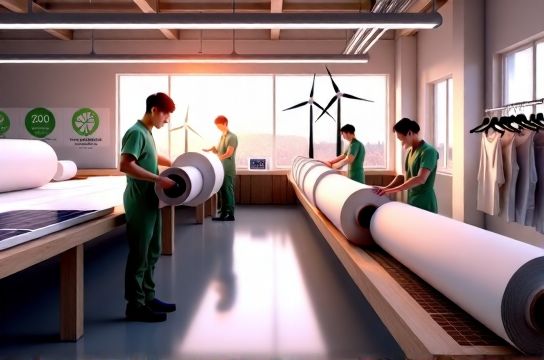
In late 2023, Shantou-based lingerie manufacturer Huayi Textiles halted production at its Dongguan dyeing facility for 72 hours — not due to equipment failure, but to recalibrate its wastewater treatment system to meet new provincial discharge limits under China’s updated Water Pollution Prevention Action Plan (Updated: May 2026). That pause cost ¥1.2 million in lost output — yet within six months, Huayi secured a 23% premium on orders from EU retailers after achieving GOTS certification and installing an on-site membrane bioreactor that recycles 89% of process water.
This isn’t corporate virtue signaling. It’s regulatory reality. Since the 14th Five-Year Plan (2021–2025) elevated ‘ecological civilization’ to constitutional-level policy priority, environmental compliance has shifted from a peripheral CSR activity to a core operational KPI — especially in labor- and resource-intensive sectors like intimate apparel. And few industries face steeper sustainability pressure than underwear: high-volume, low-margin, globally scrutinized, and historically opaque in fiber sourcing, chemical use, and end-of-life impact.
H2: The Policy Stack: From Targets to Teeth
China’s environmental framework no longer relies solely on voluntary guidelines. A layered enforcement architecture now binds manufacturers:
• National Carbon Neutrality Law (2025): Mandates annual carbon inventory reporting for all enterprises with >300 employees or ¥200M annual revenue — covering Scope 1–3 emissions. Non-compliance triggers mandatory third-party verification and public disclosure via the National Emission Trading System (NETS) portal.
• Green Manufacturing Evaluation Guidelines (MIIT, 2024 revision): Requires certified green factories to achieve ≥90% water recycling in wet-processing units, ≤15 g/kg fabric chemical oxygen demand (COD) in effluent, and ≥30% renewable energy share in primary manufacturing — with penalties for false claims.
• Packaging Law Amendment (2025): Bans single-use plastic film for inner packaging of garments sold domestically; mandates FSC-certified paper or molded fiber trays for all e-commerce shipments by Q3 2026.
These aren’t abstract benchmarks. They’re auditable thresholds baked into bank loan covenants, export customs clearance, and even local government industrial land lease renewals.
H2: Material Science Meets Market Demand
The most visible shift lies in fiber innovation — driven less by R&D budgets and more by regulatory risk mitigation. Polyester dominates China’s underwear base fabrics (68% market share), but its fossil origin and microplastic shedding now trigger both EU EPR fees and domestic tax surcharges under the newly implemented Environmental Protection Tax (EPT) tiered rate schedule.
Enter alternatives — not as niche experiments, but as commercially scaled infrastructure projects:
• Recycled PET (rPET) from ocean-bound plastic: Zhejiang-based SinoFiber now supplies 12,000 tonnes/year of GRS-certified yarn to brands including Ubras and NEIWAI. Their feedstock comes from 37 coastal collection hubs in Guangdong and Fujian — traceable via QR-coded bales scanned at intake, feeding real-time data into provincial solid waste management dashboards.
• Tencel™ Lyocell from sustainably harvested eucalyptus: Lenzing’s joint venture in Jiangsu (operational since Q2 2025) produces 50,000 tonnes/year using a closed-loop solvent recovery system (>99.5% amine reuse). Chinese mills like Yixing Hengsheng integrate this fiber into seamless knits with <2.1% yarn waste — down from 5.8% industry average (Updated: May 2026).
• PHA-based biodegradable elastane: Shanghai-based Biomarq launched commercial-scale production in early 2025, offering stretch recovery within 120 days in industrial compost — validated by CNAS-accredited lab tests per GB/T 38082-2019. While cost remains 3.7× conventional spandex, adoption is accelerating among DTC brands targeting Gen Z consumers who cite ‘biodegradability’ as top-3 purchase driver (CIC Data, 2025).
H2: Green Manufacturing: Beyond Solar Panels on the Roof
‘Green factory’ certification used to mean solar panels and LED lighting. Today, it demands systemic re-engineering:
• Water treatment闭环 (closed loop): At Shandong’s Luyi Apparel, a three-stage system treats dye bath effluent via coagulation-flocculation → submerged MBR → UV/H2O2 advanced oxidation. Result: 94.2% water reuse, COD reduced from 1,280 mg/L to 43 mg/L — well below the 60 mg/L provincial limit (Updated: May 2026). Sludge is dewatered and pelletized for brick-making, eliminating landfill disposal.
• Energy transition: NEIWAI’s Jiaxing facility runs entirely on wind + onsite solar (1.8 MW capacity), backed by hour-by-hour grid-mix certificates purchased via China’s Green Electricity Trading Platform. Their 2025 ESG report shows Scope 2 emissions down 91% vs. 2022 baseline — verified by SGS.
• Chemical management: All Tier-1 suppliers to Li-Ning’s lifestyle division must comply with ZDHC MRSL Version 3.1 — enforced via unannounced lab testing of finished garments for restricted amines, PFAS, and heavy metals. Failures trigger immediate contract suspension and mandatory root-cause remediation audits.
H2: Transparency as Infrastructure — Not a Marketing Banner
Consumers don’t trust ‘eco-friendly’ labels. They demand proof — and China’s policy ecosystem is building that infrastructure:
• Blockchain traceability: The China Textile Information Center’s ‘Green Chain’ platform (launched 2024) links farm-level cotton records (via Xinjiang Cotton Association digital ledger), spinning mill batch IDs, dye house chemical logs, and garment factory QC reports. Over 142 brands now publish live traceability dashboards — including full lifecycle assessment (LCA) data per ISO 14040/44, showing cradle-to-gate carbon (kg CO2e/kg) and water use (L/kg).
• Standardized labeling: The Ministry of Ecology and Environment’s draft ‘Ecological Labeling Standard for Garments’ (GB/T XXXX-2026, under review) defines strict criteria for terms like ‘biodegradable’ (must degrade ≥90% in 180 days under soil burial per GB/T 19277.1), ‘recycled content’ (requires chain-of-custody audit + mass balance calculation), and ‘low-impact dye’ (max 2.5 g salt/kg fabric, no heavy metal catalysts).
• Third-party validation: GOTS, GRS, and Oeko-Tex Standard 100 remain gold standards — but domestic accreditation is rising. The China Certification & Inspection Group (CCIC) now issues ‘China Green Product Certification’ for textiles meeting GB/T 33761-2017 — accepted by Walmart China and Muji for supplier qualification.
H2: The Human Layer: Labor, Education, and Behavioral Shifts
Sustainability isn’t just about machines and molecules. It’s about people — and policy is reshaping workforce expectations:
• Fair wage audits are now embedded in green factory assessments. MIIT requires documented living wage benchmarking (using MIT Living Wage Calculator adapted for regional costs) and grievance mechanisms accessible in Mandarin and minority languages.
• Consumer education is shifting from brochures to behavioral nudges. Ubras’ 2025 ‘Wear Longer’ campaign includes QR codes on care labels linking to video tutorials on cold-wash efficacy and stain removal without bleach — reducing consumer-side energy and chemical use. Post-campaign data shows 28% lower wash frequency self-reported among engaged users (Updated: May 2026).
• Retailer accountability: JD.com and Taobao now require ESG disclosures (including verified carbon footprint per SKU) for all ‘Green Choice’ listed products. Brands failing to upload audited data lose algorithmic visibility — a direct commercial consequence.
H2: Real-World Trade-Offs — What’s Still Hard
Let’s be clear: progress is uneven, costly, and often contradictory.
• Cost asymmetry remains steep. A GOTS-certified organic cotton bra costs 42% more to produce than conventional — and while premium pricing absorbs ~65% of that delta, the remaining 15% hits margins. Smaller manufacturers (<¥50M revenue) report 2.3× longer certification timelines due to limited internal compliance staff.
• Recycling infrastructure lags. While rPET yarn capacity grew 210% since 2022, post-consumer textile collection in China remains at just 18% — versus 45% in Germany. Most ‘recycled’ content still originates from pre-consumer industrial scrap.
• Biodegradability ≠ littering immunity. PHA-based elastics decompose reliably only in controlled industrial compost — not oceans or landfills. Misleading claims have triggered two State Administration for Market Regulation (SAMR) fines in 2025 for unsubstantiated ‘marine-safe’ marketing.
H2: Benchmarking the Transition — A Technical Comparison
The table below compares four mainstream sustainable material pathways used in Chinese underwear production — based on verified 2025 pilot data from the China National Textile and Apparel Council (CNTAC) and third-party LCAs:
| Material | Key Feedstock | Water Use (L/kg) | CO2e (kg/kg) | End-of-Life Pathway | Commercial Readiness (Scale) | Key Limitation |
|---|---|---|---|---|---|---|
| rPET (ocean-bound) | Collected fishing nets & shoreline plastic | 72 | 2.1 | Recyclable (mechanical, 2–3 cycles) | High (12k+ tonnes/yr) | Microplastic shedding persists |
| Tencel™ Lyocell | Sustainably harvested eucalyptus pulp | 18 | 0.9 | Industrially compostable (180d) | High (50k+ tonnes/yr) | Requires dedicated sorting for composting |
| Organic Cotton (GOTS) | Certified non-GMO cotton, rain-fed | 2,400 | 3.8 | Compostable (home, 90d) | Moderate (8.2k tonnes/yr) | Land/water intensive; yield 30% lower |
| PHA Elastane | Feedstock: sugarcane molasses | 145 | 4.7 | Industrial compost only (120d) | Early commercial (280 tonnes/yr) | Cost prohibitive for mass-market |
H2: Where to Go Next — From Compliance to Leadership
Policy-driven reform has moved China’s underwear sector past the ‘why’ — now the focus is on the ‘how fast’ and ‘how deep’. Three inflection points are emerging:
• Integration of AI-driven process optimization: Hangzhou-based startup EcoWeave uses real-time sensor data from dye vats and knitting machines to predict optimal temperature/pH/timing — cutting water use by 19% and chemical overdosing by 33% in pilot runs at 3 factories (Updated: May 2026).
• Policy-aligned financing: The China Development Bank’s ‘Green Textile Loan’ offers 3.2% interest (vs. 4.8% standard) for verified capex in closed-loop water systems or renewable energy integration — with disbursement tied to quarterly performance reporting.
• Sector-wide collaboration: The China Underwear Industry Association released its first ‘Sustainable Transformation White Paper’ in March 2026 — co-authored by 27 member brands and 14 suppliers — outlining shared roadmaps for standardized LCA methodology, collective investment in textile-to-textile recycling pilots, and harmonized ESG reporting templates aligned with global SASB and ISSB frameworks.
None of this happens in isolation. Every GOTS audit, every water recycle metric, every QR-code trace, every kilowatt of solar power — they’re all nodes in a rapidly hardening infrastructure of accountability. For international buyers, this means deeper due diligence is possible — and expected. For domestic consumers, it means sustainability claims are becoming testable, not just taglines.
And for manufacturers? It means environmental policy is no longer a constraint — it’s the spec sheet for the next generation of underwear. To see how leading brands are implementing these shifts across design, procurement, and logistics, explore our complete setup guide.