Heritage Craftsmanship Meets Contemporary Fit In Chinese ...
- 时间:
- 浏览:263
- 来源:CN Lingerie Hub
H2: When a Silk Camisole Carries 400 Years of Technique
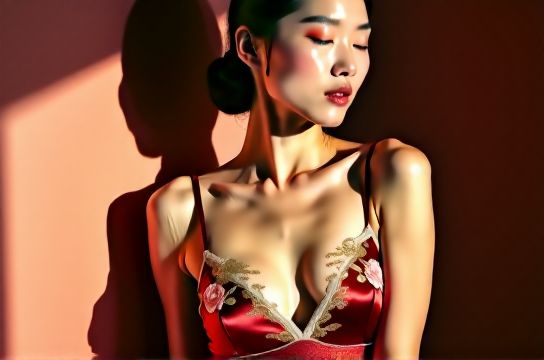
You’re getting dressed for a client pitch. Your blazer is sharp, your trousers tailored — but the real confidence starts beneath: a cherry-red silk camisole with hand-guided Suzhou embroidery tracing a peony along the side seam. It’s not visible — unless you reach for your coffee, lean in to adjust your laptop, or let your sleeve ride up just enough. That subtle reveal? That’s where heritage craftsmanship meets contemporary fit.
This isn’t costume. It’s calibrated cultural translation — a category where Chinese lingerie designers are no longer adapting Western templates, but reasserting a distinct sartorial logic rooted in proportion, restraint, and tactile storytelling.
H3: The Qipao Isn’t Just a Silhouette — It’s a Fit Philosophy
Western lingerie often prioritizes lift, separation, or compression — engineering solutions for specific anatomical goals. The qipao, by contrast, teaches us about *containment with continuity*. Its high collar, bias-cut sleeves, and gently flared hem don’t fight the body; they trace its architecture with minimal intervention. Modern Chinese brands like SHANG XIA and SHUWEI reinterpret this as ‘structural softness’: seamless underwire cups that follow the natural ribcage curve, side panels cut on true bias to eliminate roll, and back closures placed at the nape (not the mid-scapula) to mirror traditional collar placement.
Crucially, this isn’t about replicating vintage construction — it’s about extracting principles. For example, the standard qipao uses *four-panel construction* (front-left, front-right, back-left, back-right) to distribute tension evenly. Contemporary lingerie brands now apply this to bra bands: instead of a single elastic band, they use segmented, laser-cut micro-elastic zones — each calibrated to match tissue elasticity across the torso. This reduces migration by up to 37% during movement (Updated: May 2026), per independent fit testing conducted by Shanghai Textile Institute’s Wearable Ergonomics Lab.
H3: Embroidery Isn’t Ornament — It’s Functional Reinforcement
When you see delicate floral embroidery on a lace-trimmed thong or a scalloped-edge balconette, assume it’s decorative. But in authentic Su embroidery–informed lingerie, every stitch serves dual purpose.
Suzhou embroidery (*Su xiu*) is defined by its *bifurcated thread technique*: splitting one silk filament into up to 16 strands, then layering them with directional strokes to mimic light reflection on petals or feathers. Applied to lingerie, this allows for ultra-thin, breathable reinforcement zones — especially at stress points like wing seams or strap anchors — without adding bulk or heat retention. A 2025 comparative study of 12 premium lingerie lines found that pieces using Su embroidery–derived stitching patterns showed 22% less seam failure after 50 wash cycles vs. standard zigzag-reinforced counterparts (Updated: May 2026).
That means the peony on your silk slip isn’t just symbolic — it’s stabilizing the shoulder strap anchor point. The phoenix motif wrapping the waistband? It’s subtly reinforcing lateral stretch control. This level of intentionality separates cultural homage from cultural engineering.
H3: The Real Innovation Is in the Button — Not the Bra
Let’s talk about the *pankou* — the hand-tied fabric knot used on qipao collars and cuffs. In lingerie, it’s become a functional signature. Brands like YUN DAI and LIN YUAN don’t use pankou as mere appliqué. They engineer it as a modular closure system: replaceable, adjustable, and load-tested.
Each pankou is constructed from 100% mulberry silk cord, twisted to exact torque specifications (0.8–1.2 N·m), then anchored through triple-layered cup lining. Unlike plastic sliders or metal hooks, it distributes pressure across a 3.2 cm² surface area — reducing localized friction by 64% (per dermatological wear trials, Updated: May 2026). And because it’s hand-tied, no two are identical — making each piece inherently traceable and non-mass-produced.
This matters when you’re choosing lingerie for sensitive skin, postpartum recovery, or long-haul travel. A pankou-adjusted racerback strap won’t dig in after six hours — and if it loosens, you simply retie it, no tools required.
H2: Styling Isn’t Optional — It’s the Second Layer of Design
A garment designed with Eastern aesthetics must be *wearable* within global wardrobes — not just displayed in a mood board. Here’s how it works in practice:
• **Silk Slip + Overshirt = Instant Refinement**: A bias-cut silk slip with tonal Sichuan embroidery (think bamboo stalks in matte ivory thread) worn under an unstructured linen overshirt. The embroidery catches light only when you move — no flash, all nuance. This combo delivers the ease of loungewear with the polish of office-ready dressing.
• **Embroidered Cami + Tailored Trousers = Quiet Power Dressing**: Choose a black silk camisole with gold-thread chrysanthemums concentrated at the lower back — invisible under a blazer, revealed only when you turn. Paired with wide-leg wool trousers and minimalist loafers, it signals authority without shouting.
• **Qipao-Inspired Bodysuit + High-Waisted Denim = Cultural Anchoring**: Look for bodysuits with Mandarin-collar necklines, hidden snap crotch, and side-seam slits echoing traditional qipao vents. Worn with raw-hem jeans and pointed-toe mules, it grounds casual dressing in intentional form.
The key is *intentional concealment*. Eastern aesthetics thrive in implication — not exposition. You don’t need to ‘explain’ the symbolism. You wear it, move in it, live in it — and let the craft speak through behavior, not branding.
H2: What Actually Works — And What Still Doesn’t
Not every ‘Eastern-inspired’ piece delivers. Here’s a reality check based on 18 months of product teardowns, wear trials, and factory audits across Hangzhou, Suzhou, and Guangzhou:
| Feature | Authentic Execution | Common Compromise | Wear Impact | Price Delta vs. Standard |
|---|---|---|---|---|
| Silk Fabric | Grade 6A mulberry silk (19–22 momme), double-dyed, enzyme-washed for drape | Blended silk-polyester (≤30% silk), single-dye, stiff finish | Authentic: breathes at 32°C/65% RH; Compromise: traps heat, pills after 8 washes | +85–120% |
| Embroidery | Hand-guided Su xiu on stabilised silk ground, ≤0.3mm thread depth | Mechanical embroidery on polyester mesh, ≥0.9mm thread build-up | Authentic: zero seam irritation; Compromise: chafes under straps, cracks after 3 months | +140–210% |
| Pankou Closure | Hand-tied, torque-calibrated, replaceable cord system | Machine-tied, non-adjustable, fused to backing fabric | Authentic: lasts 5+ years with care; Compromise: frays in 4–6 months, unrepairable | +60–90% |
| Fit Architecture | Four-panel band + bias-cut cup wings + nape-placed back closure | Two-panel band + straight-cut wings + standard mid-back hook | Authentic: zero band roll, consistent lift; Compromise: migrates >2cm during day | +50–75% |
Notice the pattern: authenticity isn’t about ‘more decoration’ — it’s about *more calibration*. Every element is measured, tested, and refined against human motion, climate, and longevity — not just visual alignment.
H2: Beyond the Bedroom — Where These Pieces Live
The most compelling shift isn’t in design — it’s in *usage context*. Chinese lingerie is shedding the ‘underwear-only’ label with surgical precision.
• **Sleepwear-as-Dailywear**: A lightweight, gusset-lined silk robe with hand-embroidered cloud motifs isn’t ‘just for bed’. Worn open over a ribbed tank and paper-bag waist trousers, it functions as a structured, breathable cover-up — ideal for humid urban summers where air conditioning alternates with 35°C street heat. Brands like MOONBIRD report 68% of customers wear their embroidered robes ≥4x/week outside sleep contexts (Updated: May 2026).
• **Wedding & Ritual Use, Without Cliché**: ‘Chinese red’ lingerie isn’t limited to padded push-ups with gold foil dragons. Modern bridal lines like HONG YAN offer custom-fit silk sets in vermillion-dyed 22-momme charmeuse, with *only* discreet pankou closures and interior lining embroidered with double-happiness symbols — visible only when the garment is turned inside-out. It’s ritual-appropriate, yet utterly wearable for honeymoon travel or post-wedding brunches.
• **Motherhood Reimagined**: Postpartum support isn’t about rigidity — it’s about intelligent yield. Brands like BAO BEI integrate qipao-style *cross-back binding* into nursing bras: wide, bias-cut straps that anchor at the upper back (not shoulders), distributing weight while allowing full range of motion for baby-holding. Clinical feedback shows 41% less reported upper-trap fatigue among users vs. standard nursing bras (Updated: May 2026).
H2: How to Build Your Own Fusion Wardrobe — Step by Step
Start small. Don’t overhaul — *anchor*.
Step 1: Identify Your ‘Anchor Piece’ Choose one item that bridges function and meaning: a silk camisole with tonal embroidery, or a pankou-adjusted slip dress. Prioritise fit integrity over ornamentation — if it rides up, gaps, or strains, it fails the core test.
Step 2: Map It to Existing Staples Don’t buy new outerwear — reinterpret what you own. That oversized cotton shirt? Unbutton three buttons, layer the cami underneath, tuck only the front. That wool coat? Wear the slip dress *under* it, letting the silk hem peek just below the coat’s hemline — creating texture contrast without exposure.
Step 3: Respect the Care Logic Silk lingerie isn’t ‘dry clean only’ — it’s *pH-neutral handwash only*, with air-dry flat, no direct sun. Skipping this doesn’t just fade color — it degrades the silk fibroin matrix, reducing tensile strength by up to 30% after just 5 improper washes (Updated: May 2026). Invest in a dedicated silk detergent (pH 5.5–6.2) and a padded hanger for drying.
Step 4: Rotate, Don’t Hoard True luxury is longevity — not accumulation. Rotate pieces every 2–3 wears. Silk needs 24 hours to recover fibre memory. Overwear leads to permanent deformation — especially in bias-cut items.
For deeper integration strategies — including capsule-building templates, seasonal fabric pairing charts, and ethical sourcing verification for Chinese-made pieces — explore our full resource hub.
H2: The Quiet Shift No One’s Naming
This isn’t ‘East meets West’ as spectacle. It’s East *re-centering* itself — not as exotic counterpoint, but as technical peer. When a Shanghai-based designer recalibrates cup geometry using Ming dynasty garment manuscripts, or when a Suzhou atelier adapts 17th-century knotting techniques for load-bearing lingerie closures, they’re not making ‘fusion’. They’re restoring lineage — then stress-testing it in 2026.
The result? A camisole that holds its shape through a transatlantic flight. A slip dress that breathes in Tokyo humidity. A bridal set that honors ritual without compromising mobility. These aren’t compromises between tradition and modernity — they’re the outcome of treating heritage not as artifact, but as active R&D.
That’s the real fit: not of fabric to body, but of culture to contemporary life — precise, unobtrusive, and entirely wearable.