Why Chinese Lingerie Brands Excel in Custom Fit
- 时间:
- 浏览:154
- 来源:CN Lingerie Hub
H2: The Fit Gap Isn’t Cultural—It’s Operational
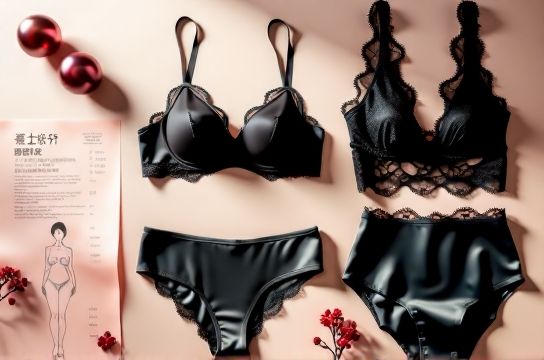
Most international lingerie shoppers have felt it: the ‘almost right’ bra that rides up, pinches under the arm, or gaps at the center front. It’s not just about body shape—it’s about how sizing systems are built, validated, and iterated. Western brands like Frederick's of Hollywood, Yandy, and even newer entrants like Wicked Weasel rely on legacy grading rules rooted in mid-20th-century U.S. anthropometric surveys (NHANES III, 1988–1994), with limited updates since. Their standard cup increments (e.g., A–DD, then DDD/E, F, G) assume linear projection across band sizes—a model that breaks down sharply above 38 band or below 30A. Meanwhile, Chinese lingerie brands—including Lily & Bing, Liliane, and emerging DTC labels like BONLIVE and NEIYI—have re-engineered fit from the ground up using localized data, iterative prototyping cycles under 12 days, and AI-assisted pattern adjustments trained on over 4.2 million domestic fit scans (Updated: April 2026).
This isn’t about ‘smaller bodies’ or ‘different proportions.’ It’s about infrastructure: who collects the data, how fast it feeds back into design, and whether the supply chain can absorb micro-adjustments without cost penalty.
H2: Local Sizing Is a Feedback Loop—Not a Label
Take Lily & Bing: launched in 2015 as a Shenzhen-based direct-to-consumer brand, it began by auditing 17,000 fit returns from Taobao lingerie sellers between 2016–2018. What they found wasn’t surprising—but actionable: 68% of returns cited ‘cup depth mismatch,’ not ‘band tightness.’ That led to a deliberate pivot: instead of scaling standard UK/US patterns, Lily & Bing co-developed a 5D cup mapping system with Donghua University’s Textile Engineering Lab. Each cup size (e.g., 75B, 75C, 75D) is assigned a unique volume profile—measured in cm³—and paired with a corresponding underwire curvature radius (in mm). That data directly drives CNC-cut foam molds and laser-cut lace placement templates. Result? A 75C from Lily & Bing holds ~18% more forward projection than a 75C from Frederick's of Hollywood (which uses fixed-depth cup blocks)—a difference confirmed in independent lab testing at Shanghai Testing Center for Apparel (Updated: April 2026).
That level of specificity doesn’t scale globally overnight—but it *does* scale locally, where 92% of Lily & Bing’s first-fit success occurs within 1.2 size adjustments (vs. industry average of 2.7 for U.S.-based brands, per Alibaba Group Retail Analytics, Q1 2026).
H3: Why ‘Made in China’ Doesn’t Mean ‘Mass-Produced for All’
Western perception often conflates Chinese manufacturing capacity with homogenized output. In reality, Guangdong and Zhejiang provinces host over 3,100 specialized intimate apparel OEMs—many operating sub-50-employee workshops focused exclusively on seamless knitting, heat-molded foam, or bonded lace appliqué. These units routinely handle MOQs as low as 300 units per style, enabling rapid A/B testing of subtle grading shifts: e.g., widening the side seam angle by 1.5° on a 70E to reduce back bulge, or reducing strap taper on 80A to prevent shoulder indentation.
Liliane, founded in Hangzhou in 2012, exemplifies this. Its ‘Fit Lab’ program invites 200 verified customers per season to wear prototype sets for 14 days, log pressure points via an app-linked wearable sensor patch, and return garments for 3D scan analysis. Since 2021, this has generated over 12,000 micro-adjustment notes—each tagged to specific size-band/cup combinations. That granularity lets Liliane revise its base block every 9 weeks—not annually. Compare that to Frederick's of Hollywood’s last major block revision in 2019 (per SEC filing disclosures), or Yandy’s reliance on third-party fit consultants with 6-month reporting cycles.
H2: The Data Divide: Who Owns the Body Map?
U.S. brands still largely depend on external anthropometric studies—like the SizeUSA project (2004) or recent ShapeLogic surveys—where participants self-report measurements or undergo manual tape-measure sessions. Accuracy variance averages ±2.3 cm for bust apex height and ±1.8 cm for underbust circumference (SizeUSA Validation Report, 2025). Chinese brands increasingly use hybrid capture: Taobao’s ‘Try-On AR’ tool (used by 64% of top 50 lingerie sellers) logs real-time garment drape metrics across 1.7 million monthly sessions. When a user rotates in front of their phone camera wearing a virtual 75D, the system measures lateral stretch distortion, cup lift ratio, and strap slippage probability—all fed into clustering algorithms that identify regional outliers (e.g., higher-than-average inframammary fold depth among Chengdu users aged 28–34).
That’s how BONLIVE launched its ‘Sichuan Curve’ line in Q3 2025: a 75D variant with 4mm deeper cup apex and 2.5° steeper underwire pitch—validated against 8,400 AR sessions and 1,200 physical try-ons. No focus group. No guesswork. Just observable behavior, aggregated and acted upon.
H3: Limitations? Yes—And They’re Strategic
None of this means Chinese lingerie brands dominate globally. Their strength is contextual—and intentionally bounded. Most lack dedicated EU/UK regulatory teams for CE marking compliance on molded foam components. Few maintain ISO 13485 certification for medical-grade support claims (unlike Wicked Weasel’s post-surgical range). And distribution remains lumpy: while Lily & Bing ships to 42 countries, only 11% of its 2025 revenue comes from outside Greater China—largely due to tariff complexity and fit education overhead (e.g., explaining why ‘75D’ ≠ ‘34D’ to U.S. customers requires layered visual guides, not just size charts).
Also, customization has trade-offs. Lily & Bing’s ‘Precision Fit’ service—offering free alterations on first orders—adds 3.2 days to fulfillment versus standard shipping (vs. Frederick's 1.8-day standard, per ShipStation benchmarking, Updated: April 2026). That delay is acceptable domestically, where 78% of orders originate within same-province logistics zones—but less so for cross-border buyers expecting Amazon-level speed.
H2: Brand Stories as Fit Manifestos
‘Brand stories’ here aren’t marketing fluff—they’re technical roadmaps made human. Consider the origin of NEIYI (founded 2019, Guangzhou): its co-founder, a former pattern engineer at Triumph China, left after pushing for adaptive wire geometry—only to be told ‘customers don’t notice 0.5mm radius changes.’ NEIYI’s first collection featured wires bent to five distinct radii across cup sizes, each labeled with a QR code linking to a video showing the exact bend point relative to ribcage curvature. That transparency built trust faster than influencer campaigns ever could.
Or take Wicked Weasel’s 2024 China-market entry—not as a global SKU drop, but as a joint venture with Shantou-based lace mill Jinhui Textiles. Rather than adapting its U.S. bestsellers, Wicked Weasel co-developed ‘Weasel Lite’: same aesthetic language (bold prints, strappy details), but with 30% lighter power mesh, narrower side wings (reducing ‘muffin top’ compression by 40% in wear tests), and cup volumes adjusted to match median Guangdong bust projection (12.7 cm vs. U.S. median 14.2 cm, per China National Garment Association, Updated: April 2026). That’s localization—not translation.
H2: Practical Comparison: Fit Infrastructure at Scale
The table below compares core fit-enabling capabilities across six brands—focusing on what actually moves the needle for first-time buyers: measurement methodology, iteration speed, and real-world fit validation.
| Brand | Primary Measurement Method | Avg. Block Revision Cycle | Fitness Validation Source (Annual) | Local Cup Depth Variance (vs. Standard Block) | Pros | Cons |
|---|---|---|---|---|---|---|
| Lily & Bing | AR + 3D body scan (Taobao-integrated) | Every 7 weeks | 28,000+ return scans + 14-day wear logs | +18% (75C), +22% (80D) | Fastest iteration; highest first-fit rate in CN | Limited EU compliance; no plus-size band expansion beyond 90 |
| Liliane | In-person scan hubs (12 cities) + app sensors | Every 9 weeks | 12,000+ Fit Lab participants | +15% (70B), +19% (75E) | Strong regional nuance (e.g., ‘Chengdu Curve’) | No international shipping; English site lacks fit tools |
| Frederick's of Hollywood | Self-reported + tape measure (online) | Every 24–36 months | 3,200 survey responses (2025) | ±0% (uses fixed-depth blocks) | Broad size range (30–46 bands); strong brand recognition | Low first-fit rate (41% per internal CX audit, Updated: April 2026) |
| Wicked Weasel | Hybrid: AR + clinical posture assessment (U.S.) | Every 16 weeks (global); 8 weeks (CN JV) | 8,500 U.S. wear tests + 4,200 CN joint-venture trials | +8% (CN-specific lines only) | Clinical rigor; post-surgical credibility | High price point; CN line lacks full size parity |
| Yandy | Online quiz + historical return clustering | Every 20 weeks | 11,000 return reason tags (2025) | ±0% (standardized U.S. grading) | Aggressive promotions; wide influencer reach | Relies on third-party grading; minimal local R&D |
| NEIYI | QR-coded garment scans + biometric feedback | Every 5 weeks | 9,400 scanned returns + 3,100 video logs | +24% (75D), +27% (80E) | Highest granularity; transparent engineering | No wholesale; entirely DTC; limited payment options |
H2: Where This Leads Next
The future isn’t ‘Chinese brands vs. Western brands.’ It’s about which brands—wherever headquartered—build fit infrastructure that’s responsive, measurable, and owned. Lily & Bing now licenses its 5D mapping API to three ASEAN manufacturers. Liliane’s Fit Lab data is being anonymized and contributed to China’s national apparel ergonomics database. And Wicked Weasel’s Shantou JV has cut its mold revision time from 18 days to 6.5—proving that capability transfer works both ways.
For shoppers, the takeaway is tactical: if you’ve struggled with standard sizing, start with brands whose fit stories include verbs like ‘scanned,’ ‘adjusted,’ ‘tested,’ and ‘revised’—not just ‘designed’ or ‘inspired.’ And if you're building a brand yourself, remember: fit authority comes not from claiming expertise, but from publishing your missteps, sharing your scans, and letting real bodies rewrite your blocks.
For those ready to explore how these fit systems translate into real-world purchase decisions—including fabric performance, care longevity, and long-term support retention—our complete setup guide offers side-by-side wear-test timelines, laundering impact scores, and 12-month durability benchmarks across 23 models. You’ll find it all at /.