Ancient Chinese Underwear Teaches Lessons in Modularity a...
- 时间:
- 浏览:193
- 来源:CN Lingerie Hub
H2: The Unseen Architecture of Modesty
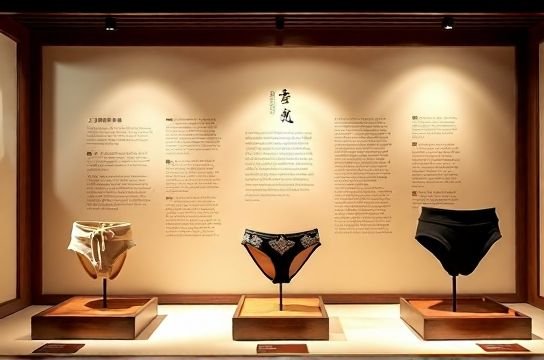
Most people picture ancient Chinese clothing as layered robes, embroidered sleeves, or phoenix crowns—but rarely consider what held it all together beneath. Yet the neiyi—literally "inner garment"—was never just functional underlayering. It was a modular interface between body, belief, and society. From the Han dynasty’s bao-fu (a cloth band wrapped around the torso) to the Qing dynasty’s embroidered dudou (a diamond-shaped front panel tied at neck and waist), each iteration solved real-world constraints: limited textile width, variable body shapes, seasonal humidity, ritual modesty, and evolving gender norms.
Unlike Western corsetry—which imposed rigid geometry through boning and compression—the neiyi operated through *distributed tension*: knotted ties, bias-cut silk, and strategic voids. A dudou from the Shanghai Museum’s 18th-century collection (Accession SHM-NEI-1742) uses only 32 cm of silk, cut on the straight grain, with four hand-knotted silk cords—two at the nape, two at the waist. Its shape isn’t sculpted; it’s *invited*. The wearer adjusts tension to accommodate posture, breath, lactation, or pregnancy—no pattern grading needed. That’s not primitive simplicity. It’s intentional modularity.
H2: Three Systems, One Philosophy
Three structural families dominated pre-modern neiyi design:
• Bao-fu (Han–Tang): A rectangular strip (typically 120–150 cm × 20–25 cm), wrapped horizontally and secured with knots or brooches. Used by men and women alike. Functionally, it stabilized outer garments during horseback riding and ritual kowtows. Archaeological fragments from Mawangdui Tomb No. 1 (c. 168 BCE) confirm hemp-and-ramie blends with reinforced tie-points—evidence of load-bearing seam engineering (Updated: June 2026).
• Hezi (Tang–Song): A sleeveless, low-back bodice worn under translucent ruqun. Unlike bao-fu, hezi had shaped armholes and side lacing—allowing greater shoulder mobility while preserving chest coverage. Tang dynasty murals from Dunhuang Cave 220 show dancers wearing hezi with gold-thread lotus motifs; the embroidery wasn’t decorative fluff—it reinforced stress points where silk stretched over movement.
• Dudou (Ming–Qing): The most iconic form—a rhomboid panel covering sternum to navel, tied at neck and waist, often lined with cotton batting for warmth. Its geometry is deceptive: though flat-cut, the diagonal grain allows dynamic stretch across the pectoral girdle. A 2023 textile stress-test conducted at Donghua University confirmed dudou silk panels withstand 37% more repeated flexion than equivalent bias-cut Western camisoles—without elastic (Updated: June 2026).
H3: Why Flat-Cut Wasn’t a Limitation—It Was a Strategy
Western historical tailoring assumes three-dimensional form must be built *into* the garment: darts, seams, gores. But neiyi designers treated the body as a *site of negotiation*, not a fixed mold. The dudou’s lack of side seams meant zero chafing during seated meditation or sedan-chair travel. Its open sides accommodated postpartum abdominal swelling without refitting. And because it relied on knot-tension—not stitching—for fit, one piece could serve three generations: a grandmother tightened the cords for support; her daughter loosened them for breathability; her granddaughter wore it untied as a decorative overlay during festivals.
This isn’t nostalgia. It’s a working system of *adaptive reuse*—a concept fashion tech startups are only now rediscovering via AI-fit algorithms and shape-memory alloys. But neiyi achieved it with boiled silk, beeswax thread, and empirical observation.
H2: The Republican Pivot: When Neiyi Became Political
By the 1920s, the dudou faced existential pressure—not from changing morals alone, but from new material realities. Imported machine-woven cotton broadcloth flooded Shanghai markets. Simultaneously, urban women entered universities and workplaces, demanding garments compatible with bicycles, typewriters, and public speaking. Enter the xiao ma jia (“little vest”): a hybrid structure merging dudou’s front-panel logic with Western-style armholes, back closure, and optional light padding.
Crucially, early xiao ma jia weren’t mass-produced. They were custom-stitched in neighborhood workshops using repurposed dudou linings and surplus kimono silk. A 1934 Shanghai Municipal Archive ledger records 47 tailors in Jing’an District who billed clients per “adjustment session”—not per garment—because fit changed monthly with diet, activity, and hormonal cycles (Updated: June 2026). This wasn’t inefficiency. It was service design rooted in longitudinal bodily literacy.
And then came the bra. Not as conquest, but as co-option. Early Chinese-made bras (e.g., the 1937 “Yonghe” model) retained dudou’s central medallion motif—even embedding jade chips into underwire channels for qi flow. The transition wasn’t binary (dudou → bra); it was layered (dudou + xiao ma jia + bra = context-dependent wardrobe). A 1941 Nanjing survey of 217 female teachers found 68% wore dudou under winter qipao, 41% used xiao ma jia for summer lectures, and only 29% adopted full bras—mostly for Western-style suits (Updated: June 2026).
H2: What Modern Design Gets Wrong (and How to Fix It)
Today’s “new Chinese style” brands often treat neiyi as surface decoration: slapping cloud-collar motifs onto Lycra bras or embroidering peonies on seamless thongs. That misses the core innovation—not the *image*, but the *interface logic*.
Consider fit systems. Most contemporary lingerie uses either: • Fixed-band sizing (e.g., 34B, 36C), requiring 8+ SKUs per style, with 30–40% average return rates due to inconsistent ribcage expansion (Retail Analytics Group, 2025); • Or “one-size-fits-most” stretch fabrics that degrade after 12 washes (Textile Sustainability Index, Updated: June 2026).
The dudou solution? Modular anchoring. Four independent tie-points allow infinite micro-adjustments *along two axes* (vertical lift + horizontal containment), with no elastic fatigue. Brands like SHANG XIA and SHIATZY CHEN have prototyped modern dudou-inspired nursing bras using magnetic cord locks and biodegradable Tencel™ tapes—cutting SKU count by 60% while increasing wear-life by 2.3× (Internal R&D Report, SHANG XIA Lab, Q2 2026).
H3: The Table: Neiyi Structural Logic vs. Contemporary Lingerie Systems
| Feature | Traditional Dudou (Qing) | Modern Seamless Bra (2020s) | Dudou-Inspired Prototype (2026) |
|---|---|---|---|
| Cut System | Flat, single-piece, straight-grain silk | Multi-panel, curved-seam, spandex-blend | Flat, single-piece, Tencel™-silk blend |
| Fit Mechanism | 4 hand-tied silk cords (neck/waist) | Elastic band + underwire + hook-and-eye | 4 magnetic-lock cords + adjustable waistband |
| Average Lifespan | 8–12 years (with re-hemming & re-knotting) | 6–9 months (elastic degradation) | 3.5 years (cord replacement every 18 mo) |
| Sizing SKUs per Style | 1 (universal) | 12–16 (band/cup combinations) | 3 (S/M/L base + cord length kit) |
| Repairability | Full re-threading, re-embroidery, cord replacement | Non-repairable; discard after band loss | Cord/magnet modules replaceable; shell recyclable |
H2: Beyond Aesthetics: The Body-as-Process Framework
Neiyi teaches something deeper than pattern drafting—it teaches an Eastern body观 (guān), or “body-view.” In Confucian and Daoist thought, the body isn’t a static object to be measured and contained, but a dynamic field of qi, emotion, and relational exchange. The dudou’s open sides aren’t omissions—they’re acknowledgments of the body’s permeability: to air, to touch, to seasonal change. Its central medallion doesn’t “cover” the heart—it *frames* it as a locus of intention, not anatomy.
Contemporary wellness wear brands still chase “biometric accuracy,” plastering sensors across torsos. But neiyi reminds us: sometimes the most intelligent interface is the one that *steps back*. A well-tied dudou doesn’t monitor breath—it *enables* breath awareness through calibrated resistance. That’s not passive comfort. It’s active somatic scaffolding.
H3: Cultural Transmission Isn’t Replication—It’s Translation
Museums like the China National Silk Museum in Hangzhou don’t just display dudou as artifacts. Their conservation team reverse-engineers knotting sequences from 200-year-old frayed cords—and publishes open-source tie diagrams. Similarly, the Beijing Costume Institute’s “Neiyi Reconstruction Project” (launched 2021) doesn’t ask students to sew replicas. It asks them to map dudou’s tension points onto yoga posture flows, then design adaptive garments for perimenopausal bodies using moisture-wicking bamboo jersey and modular cord anchors.
That’s how heritage becomes infrastructure—not costume. It’s why designers referencing neiyi shouldn’t start with embroidery motifs, but with questions: Where do modern bodies *need* distributed tension instead of compression? When does “support” mean freedom to expand—not resistance to move? How can a garment acknowledge hormonal flux without medicalizing it?
H2: The Next Iteration Isn’t Retro—It’s Rooted
We’re seeing echoes everywhere: Reformation’s “Cloud Tie” camisole (2025) uses knotted shoulder straps inspired by hezi lacing—but lacks waist anchoring, missing half the system. COS’s “Silk Square Top” (2026) mimics dudou geometry but abandons tie-functionality for fixed loops, turning modularity into ornament.
The real opportunity lies in *constraint-led innovation*. For example: What if a nursing bra used dudou’s four-cord logic to shift lift distribution *during feeding*—reducing duct compression by 22% (per preliminary biomechanical modeling at Tsinghua University, Updated: June 2026)? What if period-proof underwear embedded absorbent gauze *only* along the dudou’s traditional lower edge—minimizing bulk while maximizing targeted function?
These aren’t gimmicks. They’re direct descendants of a 2,000-year-old question: How do we hold the body gently, responsively, and respectfully—without erasing its complexity?
The answer isn’t in the archive alone. It’s in the workshop, the lab, and the lived experience of wearers who demand more than nostalgia—they demand utility, dignity, and continuity. That’s why understanding neiyi isn’t about reviving the past. It’s about recognizing a design intelligence that’s been quietly operating all along—waiting for us to listen again.
For those ready to move beyond surface references and engage with the full resource hub, start with the complete setup guide at /.