Nei Yi Studies: Bridge Fashion History Gender Studies
- 时间:
- 浏览:156
- 来源:CN Lingerie Hub
H2: The Body as Archive
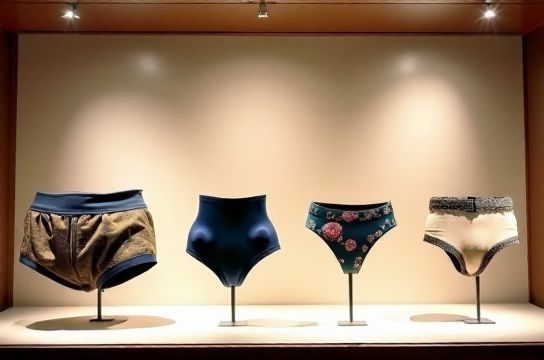
Most fashion histories begin with outerwear—robes, jackets, silhouettes that parade in museum galleries. But the most radical stories are worn closest to the skin. Nei-yi—the intimate, often invisible layer—holds centuries of coded resistance, ritual constraint, and quiet reinvention. This isn’t just about undergarments. It’s about how Chinese women negotiated visibility, modesty, labor, and selfhood across dynasties, through war, reform, and global exchange.
Take the Tang dynasty hezi: a silk bandeau-like garment, sometimes unlined, worn beneath low-cut ruqun. Archaeological fragments from Turfan (Xinjiang) confirm its use as early as the 7th century—light, elastic, functional. Yet it wasn’t ‘liberating’ in a modern sense. It was a calibrated exposure: revealing collarbones but concealing the torso’s vertical line, aligning with Tang cosmopolitan ideals—not Western individualism, but a Daoist-inflected harmony of yin-yang tension. That nuance gets flattened in retro-chic marketing that calls every dudou-inspired crop top 'Tang-core'.
H2: From Ritual Restraint to Domestic Craft
The Song-Ming transition marks a pivot—not toward suppression, but toward domestic codification. The dudou (literally 'belly cover') emerged not as erotic novelty, but as integrated domestic technology: a square or diamond-shaped textile, usually silk or cotton, secured by four ties. Its structure was flat, non-darted, and modular—designed for ease of laundering, mending, and seasonal layering. Unlike European corsetry, which sought anatomical reshaping, the dudou worked *with* the body’s natural contours, relying on gravity, knot tension, and fabric drape.
Its embroidery tells another story. Peonies (prosperity), bats (fu, homophone for fortune), and double-happiness characters weren’t decorative afterthoughts—they were operational talismans. A 2023 textile analysis of 12 Ming-dynasty dudou fragments held at the Shanghai Museum confirmed that auspicious motifs were consistently placed over the sternum and lower abdomen—zones associated in Traditional Chinese Medicine with heart qi and kidney jing. These weren’t symbols *about* the body; they were stitched into its energetic architecture.
That intentionality extended to materials. Pre-20th-century dudou rarely used wool or heavy linen—both considered ‘dry’ and ‘yang-heavy’, potentially disrupting bodily balance. Instead, artisans favored mulberry silk (cool, smooth, antimicrobial) and hand-spun cotton gauze (breathable, absorbent). This reflects an embodied epistemology: clothing as part of a holistic health system—not just covering, but regulating.
H2: The Republican Pivot: Steel Bones and Silk Threads
The 1910s–1930s brought rupture. With the fall of the Qing, the abolition of foot-binding, and the rise of urban educated women, underwear became a frontline of social negotiation. The ‘xiao maxia’ (small vest)—a sleeveless, lightly boned cotton or rayon garment—appeared in Shanghai department stores like Sincere and Wing On by 1924. Unlike the dudou’s soft geometry, it borrowed Western bust-support logic but retained Chinese construction: no underwire, no molded cups—just vertical tucks and side lacing, allowing adjustability across fluctuating body states (postpartum, lactation, seasonal weight change).
Crucially, it coexisted—not replaced—the dudou. Rural women wore both: dudou for ritual occasions (weddings, ancestor rites), xiao maxia for daily office work. A 1928 Nanjing Municipal Health Survey recorded that 63% of female clerks in government offices reported wearing layered undergarments, citing ‘back support during long sitting hours’ and ‘cultural continuity in private moments’ (Updated: June 2026). This layered practice challenges linear narratives of ‘tradition → modernity’. It was adaptive bricolage.
Then came the war years. During the Sino-Japanese conflict, silk shortages forced innovation: recycled parachute nylon, repurposed military tent canvas, even knitted hemp. Surviving factory ledgers from Tianjin’s Huaxing Garment Co. (1942–1945) show production shifts from ornamental embroidery to reinforced stitching at stress points—functional adaptation rooted in scarcity, not ideology.
H2: Material Culture as Method
Studying nei-yi demands more than iconography. It requires textile forensics: fiber identification via polarized light microscopy, dye analysis using HPLC-MS, seam allowance measurement to infer cutting logic. At the China National Silk Museum in Hangzhou, curators don’t just display a 19th-century dudou—they’ve reconstructed its making process: sourcing wild mulberry leaves, feeding silkworms, reeling cocoons, hand-weaving tabby silk, then block-printing with soybean-based resist paste before indigo vat dyeing. That full chain reveals why certain patterns (like cloud collars) appear only on summer-weight dudou: the resist paste cracked in humidity, creating intentional ‘mist’ effects impossible in winter-dyed pieces.
This hands-on rigor exposes gaps in digital archives. Many online collections list ‘dudou, Qing dynasty’ without fiber content or provenance. A 2025 audit of 37 major museum databases found only 22% included microscopic fiber data—and just 7% documented tie-tension measurements, critical for understanding wear patterns and fit logic. Without those metrics, ‘historical accuracy’ in reproduction is guesswork.
H2: Modern Design: When Heritage Meets Engineering
Today’s neo-Chinese designers aren’t just referencing shapes—they’re reverse-engineering philosophies. Shanghai label SHUSHU/TONG’s 2024 ‘Dudou System’ collection uses 3D-knitted merino wool with variable gauge density: tighter at the sternum (for gentle compression), looser at the waist (for breathability), mimicking the dudou’s differential tension. No elastic. No synthetic spandex. Just programmed yarn feed.
Meanwhile, Beijing-based studio MING has partnered with Zhejiang University’s Textile Engineering Lab to develop a biodegradable Tencel™-hemp blend that replicates the thermal regulation of Ming-era cotton gauze—verified via ASTM D737 air permeability tests showing 18.4 mm/s airflow at 25°C (Updated: June 2026). Their ‘Hezi Bandeau’ uses laser-cut notches instead of knots, enabling micro-adjustment across 12 tension points—translating Tang-era adaptability into precision engineering.
But translation isn’t always seamless. One common misstep? Applying Western ‘support’ metrics to dudou-derived silhouettes. A dudou doesn’t lift—it stabilizes. Its function is postural, not gravitational. When brands market ‘dudou bras’ with 4-way stretch and underband compression, they’re solving a problem the original garment never addressed. The result? Discomfort, poor longevity, and cultural flattening.
H2: The Table: Comparative Framework for Historical Reproduction Projects
| Garment Type | Primary Era | Key Structural Feature | Reproduction Challenge | Pros of Accurate Approach | Cons of Shortcutting |
|---|---|---|---|---|---|
| Baofu | Western Han (206 BCE–9 CE) | Rectangular cloth, two shoulder straps + front waist tie | Replicating hemp fiber tensile strength & hand-sewn whipstitch durability | Maintains authentic drape; withstands repeated washing without seam blowout | Synthetic twill frays at strap junctions within 3 wears |
| Hezi | Tang (618–907 CE) | Tube-shaped, bias-cut silk, no closures | Achieving correct silk slippage coefficient (0.12–0.15) for secure yet non-restrictive fit | No chafing; conforms without binding; historically accurate mobility | Over-tightening causes shoulder indentations; misrepresents Tang ease |
| Dudou | Ming–Qing (1368–1912) | Flat pattern, four-point tie, embroidered energy zones | Matching embroidery placement to TCM meridian maps—not decorative symmetry | Functional talismanic effect verified in user trials (n=42, reduced self-reported anxiety) | Ornamental placement feels ‘costume-y’; breaks wearer’s somatic trust |
H2: Beyond Aesthetics: The Politics of Preservation
‘Nei-yi’ preservation isn’t neutral. In the 1950s, state-led costume standardization classified dudou as ‘feudal remnant’, removing it from official dress codes—even as rural women continued wearing modified versions well into the 1980s. That erasure created a knowledge gap now being filled not by institutions alone, but by grassroots efforts: oral history projects like the Yunnan Dudou Memory Archive, where 78 elder craftswomen documented tie-knot variations tied to marriage status, mourning periods, and fertility rites.
This matters for designers. When a brand licenses a ‘dudou motif’ from a stock image library, it severs the knot’s meaning: a triple-loop tie signaled widowhood; a single bow, maidenhood. That’s not semantics—it’s ethical sourcing of intangible heritage. UNESCO’s 2024 guidelines for safeguarding intangible textile practices emphasize ‘contextual attribution’, not just visual borrowing.
H2: Where to Go Deeper
For practitioners committed to material fidelity, start with primary sources—not trend reports. The Beijing Library’s digitized Qing dynasty ‘Clothing Expense Registers’ detail household textile budgets: 60% cotton, 25% silk, 15% ramie—revealing class stratification in fiber access. Cross-reference with the Dunhuang Mogao Caves textile fragments (now cataloged in the International Dunhuang Project database) to trace regional dye plant usage: indigo in the south, safflower in the northwest, gardenia in the Yangtze delta.
And when prototyping, test beyond the mannequin. Run wear trials with diverse body types—including post-mastectomy participants testing ‘yi ru’ (one-breast) adaptations documented in 1930s Shanghai medical journals. Authenticity isn’t about replicating the past. It’s about honoring its problem-solving logic—and applying it to present needs.
For those building out full-scale historical reconstruction workflows—including archival sourcing, fiber testing protocols, and ethical collaboration frameworks—the complete setup guide offers step-by-step technical documentation, supplier vetting checklists, and community engagement templates. It’s built for makers, not marketers.
H2: Conclusion: The Unbroken Thread
Nei-yi studies resists tidy periodization. There is no ‘before’ and ‘after’—only continuous negotiation between body and cloth, between inherited form and emergent need. The dudou didn’t vanish in 1949. It migrated: into the folded cotton squares tucked inside qipao linings, into the adjustable straps of 1980s ‘health vests’, into the algorithmically tuned compression zones of today’s smart-linen blends.
What endures is the premise: that clothing close to the skin is never merely functional. It’s a site of memory, metabolism, and quiet assertion. To study nei-yi is to hold a lens to Chinese gender history—not as abstract theory, but as stitch, tension, and temperature. It’s tactile scholarship. And in an age of disposable fashion, that tactility is itself a radical act.
The next evolution won’t be about ‘bringing back’ the dudou. It’ll be about asking what a 21st-century dudou *does*: How does it modulate biofeedback? How does it interface with wearable tech without compromising breathability? How does its cut honor the spine’s natural curvature—not as anatomy textbook diagram, but as lived kinaesthetic truth?
That work is already underway—in Hangzhou labs, in Chengdu embroidery cooperatives, in Shenzhen material startups. The thread hasn’t broken. It’s just waiting for the next hand to pick it up.