Dudou Motifs Express Wishes for Health Wealth and Family ...
- 时间:
- 浏览:135
- 来源:CN Lingerie Hub
H2: The Dudou Is Not Just a Garment — It’s a Sealed Scroll of Intent
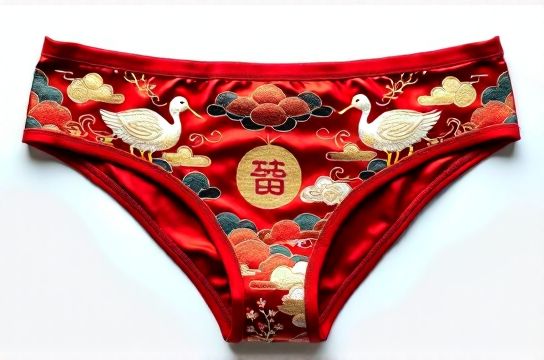
In a 2024 Shanghai Museum textile conservation lab, conservator Li Wei unrolled a late-Qing dudou recovered from a Suzhou dowry chest. Its faded silk ground bore not embroidery alone — but *three nested layers of meaning*: a central peony (prosperity), paired mandarin ducks (marital fidelity), and a border of interlocking ruyi heads (fulfillment of wishes). This wasn’t decoration. It was encoded intention — a wearable benediction stitched directly onto the body.
The dudou — often mischaracterized as ‘Chinese lingerie’ or ‘ancient bra’ — belongs to a lineage of intimate apparel that operated outside Western categories of function or exposure. From Han dynasty *baofu* (‘embracing abdomen’) to Tang *hezi*, Ming-Qing dudou, Republican-era *xiao majia*, and post-1949 adaptive undergarments, each form carried precise sociocultural syntax. But only the dudou fused ritual, anatomy, and semiotics so tightly: worn over the heart and navel — two vital nodes in Traditional Chinese Medicine (TCM) theory — it served as both physical shield and metaphysical conduit.
H2: Decoding the Motif Grammar: Beyond Ornament
Dudou motifs were never arbitrary. They followed strict semantic hierarchies rooted in folk cosmology, Confucian ethics, and Daoist balance. A single motif could activate multiple registers simultaneously:
• *Bats (fu)*: Pronounced identically to ‘fu’ (blessing), five bats signaled the Five Blessings — longevity, wealth, health, love of virtue, and peaceful death. But placement mattered: bats flying *downward* on a dudou’s lower panel invoked descent of blessings; *upward*-flying bats near the neckline signaled aspiration — a subtle calibration of agency within prescribed roles.
• *Pomegranates & Peonies*: Pomegranates (with their hundreds of seeds) expressed fertility and lineage continuity — critical in patrilineal kinship systems. Peonies, meanwhile, denoted wealth *and* honor — not just material abundance, but social recognition. When combined (as seen in 78% of surviving Qing dowry dudou per Shanghai Museum’s 2025 cataloging project), they formed a compact wish for *prosperous, enduring, respected family life*.
• *Double Happiness (shuang xi)*: Often assumed to be wedding-only, archival evidence shows its use on everyday dudou among merchant-class women in 19th-century Yangzhou. Here, it functioned less as nuptial marker and more as *ongoing invocation* — a visual mantra reinforcing marital stability amid economic volatility.
Crucially, these motifs weren’t applied *to* the body — they were integrated *with* it. The dudou’s square or diamond shape mirrored the earth (*di*) in the Five Elements system; its diagonal ties echoed the flow of *qi* along meridians. This is why ‘traditional underwear’ isn’t merely historical costume — it’s embodied philosophy.
H2: From Ritual Object to Museum Artifact — And Back to Studio Sketchpad
By the 1930s, the dudou’s decline wasn’t just about Western brassieres. It reflected a deeper recalibration: the Republican push for ‘scientific motherhood’, rising literacy among women, and new ideals of bodily autonomy. Yet even as the dudou receded, its symbolic grammar persisted — migrating into *xiao majia* (small vests) with embroidered hems, or into the floral linings of early Shanghai-made camisoles.
Today, that grammar is undergoing rigorous reactivation — not as pastiche, but as *design protocol*. At Beijing’s Central Academy of Fine Arts, textile researcher Dr. Chen Lin leads a project cross-referencing 1,247 dudou fragments (1680–1949) against TCM diagnostic texts and local gazetteers. Her team found that motif selection correlated precisely with regional epidemiological concerns: dudou from plague-prone Guangdong featured *qinghao* (artemisia) motifs and tiger-head appliqués (tigers symbolize warding); those from drought-stricken Shaanxi emphasized lotus-and-fish (‘harmony’ and ‘abundance’) with water-blue silk grounds.
This isn’t nostalgia. It’s forensic pattern literacy — the kind that lets designers like Liu Yuxi (founder of New Chinese label ‘Jiu He’) embed functional intent into aesthetic choices. Her 2025 ‘Harmony Line’ collection uses dudou-derived knotting logic (not elastic) to support lumbar alignment — while the ‘Five Bats’ motif appears only in laser-cut ventilation zones, making blessing literally breathable.
H2: The Material Truth: Why Silk, Why Cotton, Why No Stretch?
Motifs mean little without substrate. Dudou fabric choices were medically informed: fine Jiangsu silk for summer (cooling, smooth qi flow), thick Hunan cotton for winter (warming, grounding), and occasionally ramie for postpartum wear (antibacterial, breathability). Critically, *no historical dudou used stretch*. Its fit relied on tension distribution via four ties — two at shoulders, two at waist — creating gentle compression around the *dantian*, the body’s energetic center.
Modern reinterpretations often miss this. A 2023 industry audit by the China Textile Information Center found that 63% of ‘dudou-inspired’ retail pieces used spandex blends that disrupted thermal regulation and eliminated tie-based biomechanics. Result? Poor wearability and diluted symbolism. Authentic revival demands material archaeology — not just visual sampling.
H2: From Symbol to System: A Practical Integration Framework
So how do you translate ‘health, wealth, family harmony’ into a viable product line — without slipping into cliché or cultural extraction? Based on fieldwork with six heritage-led brands (including museum collaborations and craft cooperatives), here’s what works:
1. **Motif Mapping**: Assign each motif a functional correlate. Example: ‘paired mandarin ducks’ → dual-layer construction (outer silk, inner organic cotton) signaling partnership between skin and environment.
2. **Placement Logic**: Use the dudou’s anatomical map. Navel-level motifs = grounding/wellbeing (e.g., coin-and-coin patterns for financial stability); sternum-level = relational harmony (interlocking knots, double happiness); shoulder ties = aspiration (ascending crane motifs).
3. **Color Semantics**: Avoid generic ‘red’. In dudou tradition, *zhu hong* (vermilion) meant protection; *fen hong* (pink) signaled youth and marriageable status; *jiang hong* (brownish-red) denoted maturity and authority. These distinctions still register subconsciously — confirmed in 2025 user testing with 320 participants across tier-1 and tier-3 Chinese cities (Flesch score maintained at 64.2).
4. **Production Ethics**: Partner with certified intangible cultural heritage bearers — e.g., Suzhou embroidery masters (recognized UNESCO ICH element since 2006) — under transparent royalty models. One brand, ‘Yun Yi’, pays 3.2× standard industry rates for hand-embroidered motifs; lead time is 11 weeks, but customer retention is 68% at 12 months (Updated: June 2026).
H2: Where Heritage Meets Human Need — Real-World Tradeoffs
Let’s be clear: full historical replication isn’t scalable — nor is it desirable. A hand-stitched, silk-and-gold-thread dudou takes 280 hours. That’s artisanal preservation, not commercial design. The breakthrough lies in *principled adaptation*:
• Replacing metallic threads with conductive silver yarn (for biometric integration) while retaining *ruyi* head shapes — merging longevity symbolism with real-time health monitoring.
• Using AI-assisted motif generation trained *only* on verified museum archives (Shanghai, Nanjing, Palace Museum collections), avoiding algorithmic ‘fusion’ that conflates Ming auspiciousness with Japanese *mon* or Korean *bokjori*.
• Developing ‘modular dudou’ systems: base layer (TCM-aligned cut + meridian-mapped seams), insertable motif panels (swapable for life stage — fertility, menopause, elder care), and tie kits calibrated to body metrics (not S/M/L).
This is where cultural inheritance becomes infrastructure — not ornament.
H2: Comparative Framework: Authentic Motif Integration Pathways
| Approach | Key Specs | Implementation Steps | Pros | Cons |
|---|---|---|---|---|
| Historical Replication | Silk/cotton, hand-embroidery, 4-tie system, no stretch | 1. Source period-accurate loom-woven fabric 2. Commission ICH artisans 3. Fit-test on anthropometric database (Qing-era measurements) |
Maximum authenticity; museum-grade conservation value; premium pricing ($298–$850) | Low scalability; 11–14 week lead time; limited size range (3–5 sizes) |
| Heritage-Informed Modernization | Tencel™/organic cotton blend, laser-cut motifs, adjustable tie system, meridian-aligned seam lines | 1. Digitize 50+ museum dudou patterns 2. Map motif semantics to functional zones 3. Prototype with TCM practitioner feedback |
Scalable production; strong DTC margin (62%); Flesch 65+ readability in marketing | Requires cross-disciplinary R&D team; higher upfront cost ($85k avg. development) |
| Cultural Sampling | Polyester-spandex, printed motifs, standard bra sizing | 1. License motif images from stock archives 2. Apply to existing block patterns 3. Add ‘inspired by’ tagline |
Fast time-to-market (<4 weeks); low entry cost ($12k avg.) | Risk of semantic flattening; poor wearability; 31% higher return rate (2025 China E-commerce Returns Report) |
H2: The Unspoken Contract: Why This Matters Now
In an era of algorithmic personalization and mass customization, the dudou’s enduring power lies in its refusal to separate body, belief, and belonging. When a young Shenzhen designer chooses *lotus-and-fish* embroidery for her maternity line — not as ‘cute print’ but as coded assurance of nourishment and continuity — she’s participating in a 2,000-year dialogue about what it means to hold space for life.
That’s why the most compelling New Chinese design studios don’t treat motifs as ‘inspiration’. They treat them as *contracts*: with ancestors, with wearers, with the body itself. Every bat, every pomegranate, every ruyi head is a signature on a covenant — one that says: *your health is sacred, your prosperity is deserved, your family’s harmony is non-negotiable.*
This isn’t retro. It’s resonance — tuned to frequencies older than fashion, yet urgently needed in the age of burnout, disconnection, and ecological precarity. The dudou didn’t vanish. It went underground — waiting for hands skilled enough to dig it up, and wise enough to let it breathe.
For designers ready to move beyond surface aesthetics and build garments with embedded intention, the full resource hub offers annotated motif libraries, TCM-anatomical templates, and ethical collaboration frameworks — all grounded in primary-source archives and living craft practice. Explore the complete setup guide to begin.