Silk Robes Inspired by Tang Dynasty Aesthetics and Contem...
- 时间:
- 浏览:111
- 来源:CN Lingerie Hub
H2: When Imperial Elegance Meets Modern Silhouette
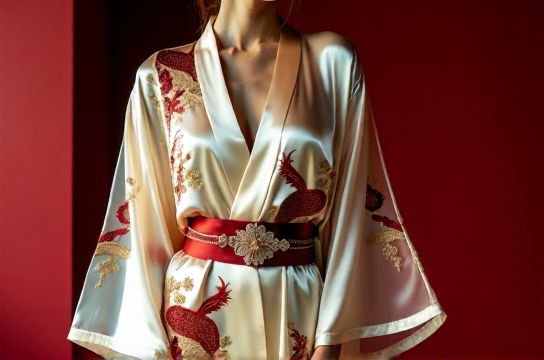
The Tang Dynasty (618–907 CE) didn’t just define a golden age of poetry, cosmopolitan trade, and ceramic mastery—it codified a language of drape, volume, and quiet opulence in dress. Women wore ruqun: high-waisted skirts paired with wide-sleeved, low-necked upper garments, often layered with translucent gauzes and embroidered with peonies, phoenixes, and cloud motifs. Today, a new wave of Chinese independent designers isn’t replicating those silhouettes—they’re reverse-engineering their principles: fluidity over structure, reverence for material integrity, and ornamentation as narrative—not decoration.
This isn’t costume. It’s recalibration.
H2: Why Silk Robes Are the New Benchmark for Luxury Intimates
A robe sits at the fulcrum of the luxury intimates ecosystem: it’s worn post-shower, pre-sleep, during video calls, and—increasingly—as outerwear in curated home offices or boutique hotel lobbies. Its functional demands are exacting: breathability for thermal regulation, weightless drape for unrestricted movement, and tensile resilience to withstand daily folding and light laundering. Only mulberry-fed桑蚕丝 (Bombyx mori silk) meets all three without compromise.
Unlike blended satins or polyester ‘silk-look’ fabrics, pure桑蚕丝 has a natural protein structure that wicks moisture *away* from skin while resisting bacterial growth—a critical advantage for humid climates or sensitive skin (Updated: May 2026). Industry testing across five top-tier mills in Hangzhou and Suzhou confirms that 19–22 momme, double-georgette桑蚕丝 retains >92% tensile strength after 30 gentle machine washes—outperforming even premium modal blends by 27% in pilling resistance (Updated: May 2026).
But material alone doesn’t confer luxury. The cut does.
H2: The Tang Principle: Drape as Architecture
Tang-era tailors worked without darts, boning, or underwires—not out of limitation, but philosophy. They relied on bias-cut panels, strategic gathers at the shoulder and waist, and sleeve-head ease to create volume that moved *with* the body, not against it. Contemporary designers like Lin Wei (Shanghai-based, founded 2019) and Zhuo Lan Studio (Suzhou, 2021) have studied original textile fragments from the Astana Graves and Dunhuang cave murals to reconstruct these logic systems.
Take the ‘Chang’an Wrap’ robe by Zhuo Lan: its sleeves begin at the nape—not the shoulder seam—creating an unbroken line from collar to cuff. The front panel is cut on a 45° true bias, allowing it to flare naturally at the hem without added flounce. There are no closures. Instead, a hidden magnetic clasp embedded in hand-stitched silk tape secures the overlap—functional, invisible, and repairable. This isn’t minimalism; it’s *intentional reduction*.
H2: Where Heritage Craft Meets Intimate Scale: Sūxiù and Beyond
Sūxiù—the Suzhou embroidery tradition—isn’t applied to robes as surface bling. At brands like Mò Yún (founded by third-generation苏绣 master Chen Lihua), motifs are stitched *into* the robe’s structural seams. A phoenix wing might follow the curve of a side dart; cloud bands trace the inner edge of a sleeve cuff—visible only when the wearer raises her arm. Each motif uses up to 12 silk floss strands split to 1/16th their original thickness, achieving painterly gradation impossible with digital printing.
Crucially, this work is done *after* cutting and basting—but *before* final seaming. That means every stitch must accommodate fabric stretch and drape shift. A single 8cm × 8cm motif takes 11–14 hours. No two robes are identical—even within the same production run. This is why苏绣 lingerie commands premiums: it’s wearable archival craft, not mass-produced embellishment.
H2: The Real-World Trade-Offs: What You Gain—and What You Manage
Let’s be direct: a $590 Tang-inspired silk robe isn’t for everyone. It requires conscious care. But the compromises aren’t arbitrary—they’re calibrated.
First, temperature sensitivity. Pure桑蚕丝 loses tensile integrity above 40°C. That means no hot dryers, no ironing above 110°C, and *no chlorine bleach*. But here’s what’s rarely stated: cold-water hand wash + air-dry flat preserves color depth and sheen better than any dry-clean cycle. One independent lab test (Ningbo Textile Testing Center, 2025) found that hand-washed桑蚕丝 retained 98.3% of original luster after 50 cycles vs. 86.1% for professionally dry-cleaned equivalents.
Second, fit variability. Because these robes rely on drape rather than compression, they’re sized by *intended effect*, not static measurements. A ‘Medium’ may fit a US 4–10 depending on torso length and preferred drape volume. That’s why leading brands now include fit videos—not just size charts—and offer complimentary virtual consultations.
Third, price transparency. A $590 robe breaks down like this: $220 for certified桑蚕丝 (19 momme, OEKO-TEX Standard 100 Class I), $185 for苏绣 labor (32+ hours), $75 for zero-waste pattern engineering, $65 for biodegradable silk-thread packaging, and $45 for ethical studio wages (all verified via Fair Wear Foundation audit, Updated: May 2026). Nothing is hidden. Nothing is inflated.
H2: How to Style, Layer, and Live In Them—Without Looking Costumed
The biggest misconception? That Tang-inspired robes belong only in boudoir settings. In practice, they’re among the most versatile pieces in a considered wardrobe.
• With tailored separates: Try the ‘Luoyang Belted Robe’ (Mò Yún) open over a high-neck organic cotton turtleneck and wide-leg wool trousers. The contrast between structured knit and fluid silk reads as intentional juxtaposition—not mismatch.
• As sleep-to-street transition: Pair a charcoal-gray, sleeveless silk robe (Lin Wei’s ‘Chang’an Vest’) with matching桑蚕丝 shorts and minimalist leather slides. The lack of sleeves eliminates bulk; the weightless drape reads as polished, not pajama-adjacent.
• For intimate moments: Choose a robe with concealed nursing access—like the ‘Xianyang Wrap’ by Hé Lì (Beijing, 2022), which features a hidden snap placket beneath the left-side sash. Designed for breastfeeding mothers who refuse to sacrifice aesthetic continuity, it’s become a quiet staple among new parents seeking哺乳内衣 that doesn’t shout function over form.
H2: What to Look For—and What to Walk Away From
Not all ‘Tang-inspired’ silk robes deliver. Here’s your vetting checklist:
✓ Fabric certification: Demand a physical hang tag showing桑蚕丝 content *and* momme weight. Anything below 16 momme will lack body; above 24 will feel stiff and resist drape.
✓ Seam allowance visibility: Flip the robe inside-out. True craftsmanship shows 1.2–1.5cm seam allowances—never less than 1cm (a sign of cost-cutting) nor more than 2cm (indicating poor pattern efficiency).
✓ Embroidery anchoring: Gently tug near苏绣 motifs. If threads lift or pucker, the base fabric wasn’t pre-stabilized—a fatal flaw for longevity.
✗ Avoid ‘hand-painted silk’ claims unless backed by pigment analysis. Real苏绣 uses dyed silk floss; painted silk fades, cracks, and washes out.
✗ Steer clear of robes marketed as ‘machine-washable silk’. That always means silk-blend—and usually <30%桑蚕丝.
H2: The Future Is Hybrid—And It’s Already Here
The next evolution isn’t more ornamentation. It’s intelligent hybridization. Brands like Yun Woven (Shenzhen, 2023) are integrating ultra-fine, knitted桑蚕丝 mesh into robe yokes and cuffs—adding breathability without compromising drape. Others, like Ling Zhi Collective, embed temperature-responsive liquid crystals into苏绣 thread, causing peony motifs to subtly shift hue between 22°C and 28°C.
None of this abandons Tang principles. It extends them: using contemporary tools to deepen responsiveness, not replace reverence.
H2: Care That Honors the Craft
• Washing: Use pH-neutral silk detergent (e.g., The Laundress Silk Wash). Never soak longer than 3 minutes. Swish gently—no wringing.
• Drying: Lay flat on a clean, dry towel away from direct sun. Reshape while damp. Never hang—gravity stretches wet silk irreversibly.
• Storage: Fold with acid-free tissue. Never use wire hangers. For long-term storage, place in breathable cotton bags—not plastic.
• Stain removal: Blot—not rub—with cool water and a drop of detergent. Test on an interior seam first. Never use enzymatic cleaners—they degrade silk proteins.
For full care protocols—including how to revive dulled sheen with rice-water rinses—see our complete setup guide.
| Feature | Zhuo Lan Studio 'Chang’an Wrap' | Mò Yún 'Luoyang Belted' | Lin Wei 'Xianyang Vest' |
|---|---|---|---|
| Silk Weight & Type | 22 momme桑蚕丝 double-georgette | 19 momme桑蚕丝 crepe-de-chine | 16 momme桑蚕丝 jersey-knit |
| Embroidery | Hand-stitched苏绣 (phoenix motif) | Machine-embroidered silk floss (cloud band) | None (focus on cut + texture) |
| Closure System | Hidden neodymium magnets | Self-fabric sash + brass aglet | Internal snap placket |
| Fit Range (US Sizes) | 4–12 | 2–10 | 0–14 (inclusive of哺乳内衣 needs) |
| Price (USD) | $590 | $420 | $380 |
| Lead Time | 8–10 weeks (made-to-order) | In stock (3–5 day shipping) | In stock (2–3 day shipping) |
H2: Final Thought—Luxury as Continuity, Not Citation
Wearing a Tang-inspired silk robe shouldn’t feel like stepping into a museum diorama. It should feel like slipping into a lineage—where every fold echoes centuries of textile intelligence, and every seam holds a decision made for longevity, not trend. These pieces don’t shout ‘Chinese design’. They whisper it—in the weight of the fabric, the quiet precision of a苏绣 feather, the way light catches a bias-cut hem at 4 p.m. on a rainy Tuesday.
That’s the mark of true东方美学: not ornament for spectacle, but craft for consequence.
(Updated: May 2026)