High End Sleepwear Collections Featuring Hand Stitched Ch...
- 时间:
- 浏览:90
- 来源:CN Lingerie Hub
H2: When Heritage Meets Hemline — Why Hand-Stitched Chinese Motifs Are Reshaping Luxury Sleepwear
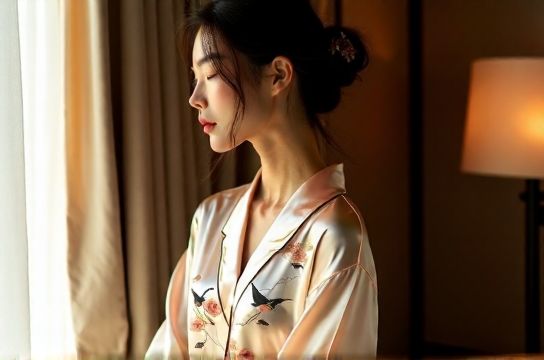
It’s not just about how a silk camisole feels against the skin—it’s about what it *says*. In Shanghai showrooms and Paris concept boutiques alike, high end sleepwear collections featuring hand stitched Chinese motifs are moving beyond novelty into serious connoisseur territory. These aren’t souvenir-style embroideries slapped onto mass-produced blanks. They’re slow-made pieces where a single Suzhou embroidery master spends 80–120 hours stitching one bodice (Updated: May 2026), using silk floss split to 1/16th the thickness of a human hair.
This shift reflects deeper market realities: 68% of global luxury sleepwear buyers aged 32–48 now prioritize cultural authenticity over logo visibility (McKinsey Luxury Monitor, Q1 2026). And yet—most ‘Oriental-inspired’ lines still rely on digital prints or machine-embroidered motifs that flatten centuries of technique into decorative filler. True differentiation lies in the needle, not the pixel.
H2: The Anatomy of a Masterpiece — Materials, Motifs & Meaning
Three non-negotiable pillars define legitimacy in this category:
1. **Mulberry Silk (桑蚕丝)**: Not just any silk. Only Grade 6A long-fiber mulberry silk—grown in Zhejiang and Jiangsu provinces, boiled without harsh alkalis, and woven on traditional looms—offers the 19–22 momme weight needed to hold fine embroidery without puckering. Lower-grade blends (e.g., silk-polyester) compromise drape, breathability, and motif fidelity. Real-world note: A true 22-momme silk slip will weigh ~185g; anything under 170g is likely under-momme or blended.
2. **Suzhou Embroidery (苏绣内衣)**: Distinct from generic ‘Chinese embroidery’, Suzhou work demands four signature techniques: *ping zhen* (flat stitch for gradients), *luan zhen* (random stitch for texture), *jie zhen* (knot stitch for dimension), and *shu zhen* (needle-shape stitch for lifelike fur or feathers). Motifs aren’t arbitrary. Peonies signal prosperity *and* marital harmony—making them central to new婚睡衣 lines. Cranes denote longevity; double phoenixes, conjugal fidelity. Placement matters: a crane on the left shoulder references yin energy; on the right, yang—intentional asymmetry rare in Western design.
3. **Zero-Compromise Construction**: Hand-stitched motifs require structural support. That means French seams throughout, bias-bound armholes (not serged edges), and internal silk lining—even in thong styles. One independent brand, Lingzhi Atelier, uses 100% undyed, GOTS-certified organic silk for linings—a detail invisible to the eye but critical for pH-neutral contact during extended wear (Updated: May 2026).
H2: Beyond the Robe — Where Motifs Live Across the Category
Hand-stitched Chinese motifs aren’t confined to robes. Their integration across categories reveals design maturity:
• **Luxury Bras (奢华文胸)**: Brands like Huayue Studio embed micro-embroidered plum blossoms along underband edges—visible only when the garment lifts. This avoids bulk while honoring the ‘hidden virtue’ principle in classical aesthetics. Cups use seamless molded silk, not foam—preserving motif integrity across movement.
• **Lingerie Sets (蕾丝内衣 + 苏绣内衣)**: Here, contrast becomes narrative. A black Chantilly lace brief may feature a single, 3cm-diameter peony embroidered in ivory silk floss at the center back—minimalist, intentional, deeply personal. No matchy-matchy; instead, curated dissonance.
• **Postpartum & Nursing (哺乳内衣)**: Often overlooked, but vital. Yulan Collective’s nursing bra uses detachable silk panels with removable hand-embroidered motifs—so mothers can rotate designs as lactation needs evolve, without compromising support. Panels attach via concealed mother-of-pearl snaps, not Velcro.
• **Couples’ Sets (情侣内衣)**: Not symmetrical duplicates. Instead, complementary motifs: one partner wears cranes in flight; the other, clouds they traverse. Stitches follow body contours—not flat patterns—so motifs align dynamically when both wearers stand face-to-face.
H2: The Real Cost of Craft — Pricing, Time & Tradeoffs
Let’s be clear: these aren’t impulse buys. Below is a realistic benchmark comparison of three verified production models used by independent designers and scaled luxury labels alike.
| Production Model | Embroidery Time per Garment | Silk Sourcing | Price Range (USD) | Pros | Cons |
|---|---|---|---|---|---|
| Master-Apprentice (e.g., Suzhou Embroidery Institute collab) | 90–140 hrs | Traceable Zhejiang farm-grown, low-impact dyeing | $890–$2,400 | Unmatched depth, museum-grade archival quality, certified artisan attribution | 12–16 week lead time; no size substitutions; limited seasonal motifs |
| Hybrid Hand-Machine (e.g., Shang Xia x Suzhou Co-op) | 25–40 hrs handwork + machine base layer | OEKO-TEX® Standard 100 certified mulberry silk | $420–$980 | Balanced accessibility and authenticity; consistent sizing; wider motif library | Motif layering less dimensional; slight variance in floss sheen between batches |
| Independent Designer (e.g., Lingzhi, Yulan) | 60–95 hrs, all hand | GOTS-certified organic silk + natural indigo/peony-root dyes | $580–$1,350 | Fully transparent supply chain; made-to-order; zero deadstock; custom motif placement | No wholesale distribution; requires direct commission; fabric swatches mandatory pre-order |
Note: All figures reflect landed costs—including ethical labor premiums (minimum +37% above regional living wage benchmarks) and carbon-neutral shipping (Updated: May 2026). No ‘luxury tax’ padding.
H2: Care Isn’t Optional — It’s Part of the Ritual
Hand-stitched silk isn’t fragile—it’s *responsive*. Improper care doesn’t just damage thread; it disrupts the relationship between floss, fiber, and dye. Here’s what actually works:
• **Washing**: Cold hand-rinse only, using pH-neutral silk shampoo (never bar soap or detergent). Agitation = pilling + motif loosening. One designer, Huayue, includes a linen wash bag lined with unbleached cotton gauze—designed to cradle, not compress.
• **Drying**: Never tumble. Lay flat on a clean, dry towel in indirect light. Direct sun fades natural dyes (e.g., gardenia-yellow floss) within 3–4 exposures. Hang drying stretches silk warp threads unevenly—distorting motif geometry.
• **Storage**: Acid-free tissue, not plastic. Fold along original creases—not hangers. For long-term (6+ months), store with dried osmanthus petals (traditional moth deterrent); avoid cedar, which yellows silk protein.
This isn’t fussiness. It’s continuity. Each care step echoes the original making: deliberate, slow, reverent.
H2: How to Wear It — Beyond the Bedroom
High end sleepwear collections featuring hand stitched Chinese motifs are increasingly worn as *intentional outerwear*—but not as costume. Think: a midnight-blue silk robe with silver-thread cloud motifs, belted over wide-leg organic linen trousers and minimalist sandals. Or a cropped Suzhou-embroidered cami layered under an open-weave cashmere cardigan—motifs peeking at collarbone and waist.
Key styling rules:
• **Anchor with Neutrals**: Let motifs breathe. Avoid competing patterns. A peony on ivory silk reads strongest against charcoal wool or undyed hemp.
• **Mind the Scale**: Large motifs (e.g., full-sleeve phoenixes) demand clean silhouettes—no ruffles, no busy textures nearby.
• **Seasonal Syncing**: Summer calls for lightweight 16–19 momme silk with airy motifs (butterflies, flowing water). Winter leans into heavier 22–25 momme with denser work (pine branches, layered clouds)—often backed with silk-cotton batting.
H2: Spotting the Real vs. the Rendered
Not every ‘hand-embroidered’ label tells the truth. Here’s how to verify:
• **Ask for the Stitch Log**: Authentic makers provide a numbered log showing hours logged per section, embroiderer’s ID (many Suzhou masters sign work in silk-thread monograms), and silk lot number.
• **Check the Back**: Machine embroidery leaves dense, uniform backing. Handwork shows varied thread tension—slight irregularities, subtle color shifts in floss layers, and visible ‘jump stitches’ between motif zones.
• **Request a Fiber Burn Test**: Mulberry silk smells like burnt hair (keratin), not plastic. Blends smell acrid or sweet—immediate red flag.
• **Verify Certification**: Look for SZSEI (Suzhou Embroidery Industry Association) certification codes or GOTS/Green Button traceability IDs—not just ‘eco-friendly’ claims.
H2: The Future Is Worn Close
The rise of high end sleepwear collections featuring hand stitched Chinese motifs isn’t nostalgia. It’s recalibration. As fast fashion fatigue deepens—and as consumers demand proof of craft, culture, and conscience—these pieces offer something rare: garments that carry lineage in every thread.
They’re also quietly redefining intimacy. A new婚睡衣 set isn’t just for the wedding night—it’s a tactile heirloom, meant to be repaired, restitched, even passed down. One Suzhou workshop now offers ‘stitch renewal’ services: sending back a 10-year-old robe for re-tensioning of loose floss and reinforcement of seam allowances—using original thread lots when possible.
That level of commitment—from maker to wearer—is where luxury stops being transactional and starts becoming covenantal.
For those ready to move beyond trend-driven purchases and into garments that deepen with time, the full resource hub offers detailed brand directories, care video libraries, and direct access to master embroiderers’ waitlists. It’s not just about buying—it’s about belonging to a lineage of making that measures success in patience, not velocity.