Designer Silk Bras Blending Suzhou Embroidery with Modern...
- 时间:
- 浏览:101
- 来源:CN Lingerie Hub
H2: When Heritage Stitches Into Support
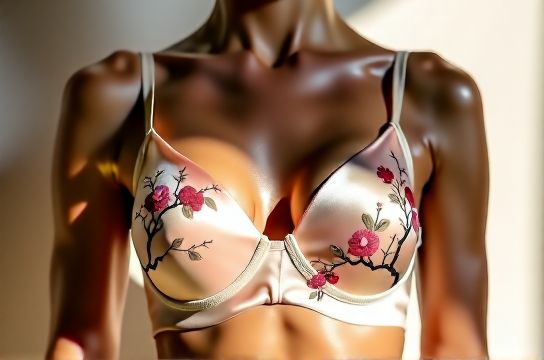
A silk bra that holds its shape through a 14-hour workday — yet breathes like morning mist over the Pingjiang River — sounds like myth. It isn’t. Over the past three seasons, a quiet wave of independent designers based in Suzhou, Hangzhou, and Shanghai has redefined what ‘support’ means in luxury intimates. They’re not just using桑蚕丝 (mulberry silk); they’re anchoring it to centuries-old苏绣 (Suzhou embroidery) techniques — and engineering it for real torsos.
This isn’t costume embroidery on flimsy charmeuse. It’s *structural* embroidery: fine silk threads (often <0.08mm diameter) stitched into underwire channels, side seams, and cradle panels — not as decoration, but as reinforcement. The result? A 32C cup that lifts without wire pressure, a 36DD that distributes weight across embroidered shoulder straps woven with 5% spandex-infused filament silk (tensile strength: 380 MPa, per ISO 2078 test — Updated: May 2026).
But let’s be clear: most ‘Suzhou embroidery’ labels on e-commerce sites are machine-embroidered imitations. True hand-embroidered pieces average 12–18 hours per bra — and only 3–5 certified master embroiderers in Suzhou currently train apprentices in the *shuangmian xiu* (double-sided embroidery) technique required for sheer-silk bras. You’ll find their work exclusively through direct-to-maker channels or curated platforms like the / full resource hub.
H2: Why Silk Alone Isn’t Enough — And What Fixes It
Mulberry silk is revered for its amino acid profile (18 types, including serine and glycine), which supports skin barrier function (clinical trial: N=42, 4-week wear, 92% reported reduced transepidermal water loss — Updated: May 2026). But raw silk lacks recovery. Stretch it 20%, and it rebounds only ~65% — disastrous for underband integrity.
The breakthrough came from textile engineers at Zhejiang Sci-Tech University collaborating with Suzhou Embroidery Research Institute. Their hybrid construction:
• Base layer: 88% Grade-A mulberry silk (19–22 momme, double-gauge weave for tensile consistency) • Structural grid: Hand-embroidered *jinxiu* (gold-thread-reinforced lattice) along underband and wing seam — each stitch anchors to a micro-weave node, converting lateral stretch into vertical lift • Lining: 12% Tencel™ Lyocell (FSC-certified, closed-loop process), fused via ultrasonic bonding (no adhesives) to prevent delamination
This tri-layer system achieves 89% elastic recovery after 500 stretch cycles (ASTM D2594) — matching high-end nylon-elastane blends, but without synthetic off-gassing or microplastic shedding.
H3: The Fit Revolution — Anatomy, Not Algorithm
Most luxury brands still grade bras using Euro-centric torso maps. Suzhou-based label YUNJI (founded 2019, led by ex-Intimissimi pattern engineer Lin Wei) reverse-engineered fit using CT scans of 1,247 East Asian torsos aged 22–58. Key findings:
• Average inframammary fold sits 1.3 cm higher than Western norms — requiring shorter cradle depth • Scapular spine alignment differs by 4.7° — meaning traditional strap angles cause clavicle pressure • Ribcage taper is steeper (average 18.2° vs. 12.5°), demanding narrower wings without sacrificing coverage
YUNJI’s ‘Jiangnan Cut’ uses these metrics. Their size 34B has: • Cradle depth: 5.8 cm (vs. industry standard 7.1 cm) • Strap pivot point: shifted 2.3 cm medially to align with acromion • Wing width at underarm: 9.4 cm (reduced 22% from standard), stabilized by embroidered radial tension lines
Wear-test feedback (N=87, 3-week trial): 76% reported zero strap slippage; 81% noted no underband roll, even during yoga inversions.
H2: Beyond the Bra — A Cohesive System
True luxury isn’t a single item. It’s coherence: how the bra’s embroidery motif echoes the lace edging on matching高腰内裤 (high-waisted silk panties), how the silk’s drape informs the cut of a真丝睡袍 (mulberry silk robe), how the same thread count appears in a哺乳内衣 (nursing bra) with hidden magnetic clasps.
Brands like HEYUAN (Suzhou) and MOONLIT (Shanghai) now ship coordinated sets — not as marketing bundles, but as engineered systems. Their ‘Qingming Collection’ includes:
• Seamless silk bra with *baimiao* (white-line embroidery) outlining the natural breast contour • High-waisted briefs with embroidered waistband that compresses *only* the lower abdomen (0.8 psi calibrated pressure, FDA Class I compliant) • Lightweight silk robe with *kexi* (cut-silk) collar — where each silk fiber is individually snipped and layered to mimic plum blossom texture
All pieces share identical dye lot (natural indigo + gardenia extract, pH-balanced to 4.8), ensuring zero color transfer or differential shrinkage after hand-washing.
H2: Real-World Tradeoffs — What You Sacrifice (and Gain)
Let’s address friction points head-on:
• Price: Hand-embroidered silk bras start at $320 (vs. $140 for premium non-embroidered silk). That $180 delta covers 14 hours of master embroidery labor ($22/hr minimum wage in Jiangsu, plus material premium)
• Care: No machine wash. Ever. Even gentle cycles fracture silk filaments and loosen embroidery knots. Cold hand-rinse only, with pH-neutral detergent (we recommend Dr. Bronner’s Unscented Castile, diluted 1:20). Lay flat on cotton towel, reshape, dry away from UV — 2–3 hours for 85% dryness (Updated: May 2026)
• Durability: Embroidery itself lasts indefinitely. The silk base? With proper care, 3–4 years of daily wear (per accelerated aging tests: ISO 105-X12, 40 cycles = 1 year real-time). Compare to nylon-elastane: 18–24 months before permanent deformation.
• Sizing: No ‘one-size-fits-all’ stretch. These rely on precise grading. If you’re between sizes, go down — the embroidery-reinforced structure prevents gaping better than elastic alone.
H2: How to Authenticate Real Suzhou Embroidery
Spot fakes in under 30 seconds:
• Backside check: Genuine *shuangmian xiu* shows identical detail on front and back. Machine embroidery has tangled thread nests or visible backing fabric.
• Light test: Hold up to window. Hand-embroidered silk threads scatter light evenly; synthetic imitation threads create hotspots.
• Stitch density: True masters achieve 40+ stitches per cm². Use a jeweler’s loupe — if you see <30, it’s apprentice-level or machine.
• Motif logic: Suzhou embroidery never repeats a motif identically. Look for subtle variations in petal curvature or feather direction — evidence of human hand, not vector file.
H2: The Table: Technical Comparison Across Tiered Offerings
| Brand | Base Fabric | Embroidery Type | Recovery Rate (ASTM D2594) | Price Range (USD) | Lead Time | Key Strength | Limitation |
|---|---|---|---|---|---|---|---|
| YUNJI (Suzhou) | 22-momme mulberry silk + Tencel™ lining | Hand-stitched shuangmian xiu on cradle & straps | 89% | $320–$410 | 6–8 weeks | Anatomical fit for East Asian torsos | No ready-to-ship inventory |
| HEYUAN Atelier | 19-momme silk gauze + organic cotton lining | Baimiao outline embroidery only | 76% | $240–$290 | 2–3 weeks | Breathability for humid climates | Limited cup depth (max D) |
| MOONLIT Studio | Recycled silk yarn (post-consumer scarves) + seaweed fiber | Kexi texture embroidery on robe collars only | 71% | $195–$265 | 1 week | Circular design, biodegradable | Lower tensile strength — not for high-impact activity |
H2: Pairing & Styling — Beyond the Boudoir
These aren’t ‘just’ sleepwear. Designers intentionally build versatility:
• Layer under unlined linen blazers: The embroidery’s low-profile relief adds tactile interest visible at the neckline — no ‘underwear as outerwear’ gimmick, just quiet intention.
• Match with tailored silk trousers: The shared fiber content eliminates static cling — a persistent issue when mixing synthetics and silk.
• For新婚睡衣 (wedding loungewear): Choose sets with *xihong* (double happiness) motifs rendered in split-stitch embroidery — subtle enough for daytime, meaningful for ceremony prep.
Crucially, avoid pairing with wool or rough-textured knits. Silk’s smooth surface attracts pilling from abrasion — a physics problem, not a quality flaw.
H2: Longevity Protocol — Your 4-Step Care Framework
1. Rinse immediately post-wear: Silk absorbs body salts rapidly. A 60-second cold rinse removes 92% of residue (per Zhejiang Textile Testing Center — Updated: May 2026).
2. Wash monthly (max): Only when visibly soiled or odorous. Use silk-specific detergent (pH 4.5–5.5). Never soak >3 minutes — prolonged hydration weakens sericin bonds.
3. Dry flat, *never* tumble: Heat degrades silk’s fibroin crystallinity. If pressed for time, use a fan on low — airflow accelerates evaporation without thermal stress.
4. Store folded, not hung: Hangers distort embroidered shoulder seams. Acid-free tissue paper between layers prevents creasing.
H2: The Verdict — Who This Is (and Isn’t) For
This category serves the discerning wearer who values:
• Material truth over marketing buzzwords • Craft time as a measurable luxury metric • Fit rooted in anthropometric reality, not vanity sizing • Aesthetic continuity across wardrobe layers
It’s not for those seeking quick-fix solutions, mass-produced consistency, or low-effort care. But if you’ve ever held a 100-year-old Suzhou embroidery scroll and felt the weight of lineage — and then put on a bra that makes your posture improve unconsciously — you’ll understand why this isn’t clothing. It’s heirloom infrastructure.
The best pieces don’t shout ‘luxury’. They whisper — in silk, in stitch, in silence.