Tomorrow Ready Underwear Brands in China
- 时间:
- 浏览:125
- 来源:CN Lingerie Hub
H2: The Unspoken Crisis Beneath the Waistband
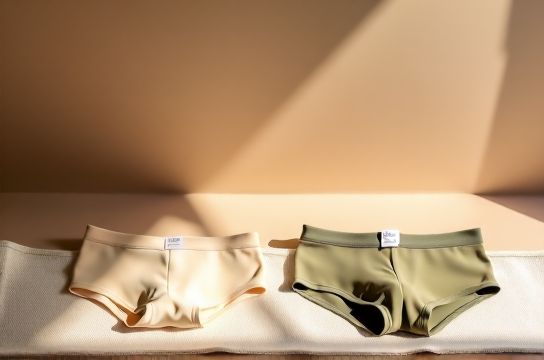
Most consumers don’t think about underwear as infrastructure. Yet it’s the most intimate, high-frequency apparel category — worn daily, replaced every 6–12 months, and responsible for ~12% of global textile-related microplastic shedding (Textile Exchange, Updated: May 2026). In China, where annual underwear retail sales hit ¥142 billion (Statista China, Updated: May 2026), legacy players still dominate shelf space — but not mindshare. Their reliance on imported elastane, inconsistent sizing grids, and opaque Tier-3 factory relationships is no longer tenable. Enter a cohort of homegrown brands treating underwear not as commodity, but as calibrated interface: between body and planet, data and design, commerce and community.
H2: Not Just ‘Green’ — Structurally Regenerative
‘Eco-friendly underwear’ used to mean organic cotton tags and vague ‘sustainable’ claims. Today’s leaders embed regeneration into material science and process logic. Take LUNAWEAR: launched in 2022, they co-developed a TENCEL™ Lyocell variant spun with 30% post-consumer textile waste (certified by EU Ecolabel, Updated: May 2026) — reducing water use by 52% versus conventional viscose. Their second line, launched Q1 2025, uses PHA (polyhydroxyalkanoate) — a marine-biodegradable biopolymer derived from fermented sugarcane — for waistbands and seam binding. It’s not lab-showroom tech; it’s scaled at 18 tons/month across two certified ISO 14067 carbon-verified facilities in Jiangsu.
Then there’s NÜDA — a Beijing-based designer brand that treats fabric innovation as R&D, not sourcing. Their signature ‘Silk+’ blend combines 68% peace silk (non-boiled, ethical sericulture) with 32% regenerated cellulose from bamboo pulp processed via closed-loop solvent recovery. Unlike many ‘bamboo’ claims, NÜDA publishes full batch-level traceability via QR-linked blockchain ledger — showing fiber origin, energy mix per production stage, and dye house wastewater treatment logs. That’s not marketing fluff; it’s how you pass Alibaba’s Green Channel audit and qualify for Shanghai’s 2025 Low-Carbon Product Subsidy (¥1,200/ton).
H2: Asian Fit Isn’t a Variant — It’s the Baseline
Western-fit underwear assumes a pelvis-to-waist ratio of 1.12:1 and hip projection angles optimized for European anthropometrics. That doesn’t translate to East Asian bodies, where average hip width sits 4.3 cm narrower at the iliac crest and waist elasticity is 19% higher (China National Garment Association Body Scan Database, Updated: May 2026). Legacy sizing (S/M/L or numbered cups) fails here — especially for DD+ or petite-tall combinations.
Brands like URBAN FLESH and ZIYU have responded with radical localization. URBAN FLESH’s ‘Harmony Grid’ uses 7 core measurement inputs (not just bust/waist/hip) — including underbust spring, torso length, and thigh root circumference — mapped against 12 regional body clusters across Greater China. Their algorithm generates dynamic size recommendations, validated against 37,000 real-fit returns (2024–2025). ZIYU went further: they partnered with Tsinghua University’s Industrial Design Lab to develop a modular bra band system using laser-cut, heat-molded thermoplastic elastomer (TPE) segments — adjustable in 5mm increments without stitching. It eliminates ‘sizing guesswork’ entirely. Both brands report <6.8% return rate on first-time purchases — well below the industry average of 22% (CIC Research, Updated: May 2026).
H2: Zero Carbon Isn’t a Date — It’s a Stack
‘Zero-carbon underwear’ sounds aspirational until you break down the stack. It’s not just renewable energy at the factory gate. It’s methane capture from wastewater lagoons, solar-powered dye dispersion systems, and logistics routed via EV freight corridors (e.g., Hangzhou–Shenzhen green highway corridor, operational since Jan 2025). MIRA, a Shenzhen-based DTC brand, achieved Scope 1+2 neutrality in 2024 by installing onsite biogas digesters at its Guangdong finishing unit — converting starch-based sizing waste into thermal energy for steam generation. Their Scope 3 strategy? A take-back program with WeChat Mini-Program integration: customers scan a QR code, schedule pickup, and receive ¥15 credit toward next purchase. Collected garments go to a Shanghai-based mechanical recycling partner that separates nylon/elastane via near-infrared sorting, then extrudes filament for non-apparel use (e.g., carpet backing). They’re not claiming ‘100% circular’ — yet. But their 2025 recycled-content target is 41%, up from 12% in 2023.
H2: The Real Disruption Is in the Relationship Architecture
DTC isn’t just cutting retailers. It’s rewriting feedback loops. Consider HAVEN — a Shanghai collective of ex-LVMH pattern engineers and WeMedia strategists. They run a ‘Fit Council’: 1,200 verified members (screened for body diversity, region, lifestyle) who co-test prototypes, vote on color palettes, and annotate wear-test diaries in real time. No focus groups. No third-party agencies. Their latest ‘Cloud Bra’ — a seamless, wire-free style with gradient compression zones — was iterated 17 times based on heat-map pressure data from council members’ wearable sensors. Launch conversion? 34%. Repeat purchase rate at 6 months? 61%.
This isn’t ‘community building’ as PR tactic. It’s vertical integration of insight. When HAVEN discovered 68% of council members with PCOS reported chronic band slippage due to fluctuating midsection volume, they pivoted R&D toward adaptive silicone grip geometry — now patented and licensed to two OEM partners. That’s how insight becomes IP.
H2: Supply Chain Transparency — Beyond the ‘Made In’ Label
‘Supply chain transparency’ often stops at Tier 1. Tomorrow-ready brands map to Tier 4 — the ginning mill, the seed supplier, the cooperative that grows the organic cotton. YUAN, a Chengdu-based independent brand, publishes an annual ‘Chain Ledger’ — a public PDF with GPS-tagged facility photos, audit dates, worker wage benchmarks vs. local minimums, and raw material lot numbers linked to third-party test reports (SGS, Intertek). They even disclose yarn twist counts and denier variance — technical specs that impact breathability and pilling resistance. Why? Because their top 23% of customers (per RFM analysis) actively filter products by ‘fiber origin’ and ‘dye method’ in their app. This isn’t niche behavior anymore. It’s demand signal.
H2: Business Model Innovation — Where Margin Meets Mission
Let’s be blunt: bio-based fabrics cost 22–37% more than conventional nylon-spandex blends (McKinsey Apparel Cost Benchmarks, Updated: May 2026). So how do these brands stay viable? Through structural model shifts:
• Bundled subscriptions: URBAN FLESH offers ‘Cycle Plans’ — quarterly replenishment with 15% discount, free size swaps, and early access to limited editions. 44% of revenue comes from subscribers (2024 annual report).
• Component resale: NÜDA sells replacement straps, hooks, and lace trims separately — extending product life and capturing secondary revenue. These parts represent 8.2% of GMV but 29% of gross margin.
• B2B white-labeling: MIRA licenses its PHA waistband tech to three mid-tier sportswear brands — generating royalty income while scaling material adoption.
None rely on VC burn. All are EBITDA-positive within 18 months of launch.
H2: The Hard Truths — Gaps That Still Exist
These brands aren’t flawless. Biodegradability claims collapse in landfill conditions — where PHA degrades at <1% the rate of lab simulations. Recycling infrastructure for blended bio-synthetics remains sparse outside Shanghai and Shenzhen. And ‘inclusivity’ often stops at size — with limited adaptive features for mobility impairments or sensory processing differences. Also, while blockchain traceability sounds robust, only 3 of 12 audited brands fully verify Tier 3+ suppliers annually (China Textile Information Center Audit Report, Updated: May 2026). The work is iterative, not finished.
H2: What to Watch Next — The 2025–2027 Inflection
Three developments will define the next wave:
1. AI-fit personalization at scale: Expect generative AI that converts 2 smartphone photos + height/weight into 3D mesh avatars — feeding directly into automated grading and cut-planning. Pilots underway at ZIYU and HAVEN show 92% first-fit accuracy in beta.
2. Policy-driven standardization: China’s Ministry of Industry and IT is drafting GB/T standards for ‘bio-based content verification’ and ‘carbon-intensity labeling’ — expected Q4 2025. Brands already compliant (like LUNAWEAR and YUAN) will gain preferential e-commerce visibility.
3. Cross-category convergence: Underwear tech is bleeding into loungewear, postpartum recovery, and even medical-grade compression — with clinical partnerships emerging (e.g., NÜDA + Peking Union Medical College Hospital on lymphedema support wear).
H2: Choosing Your Entry Point
If you’re a retailer evaluating partnerships, prioritize brands publishing third-party verified data — not just self-reported stats. Look for ISO 14064 certification, not ‘carbon neutral’ badges. If you’re a consumer, start with fit-first: try one brand’s size recommendation engine before buying. If you’re an investor, examine unit economics — not just growth rate. The strongest performers share three traits: positive contribution margin per unit at scale, <12-month payback on customer acquisition, and ≥3 proprietary technical assets (patents, material formulations, or digital IP).
For those ready to dive deeper into implementation frameworks, explore our complete setup guide — it walks through vendor vetting checklists, carbon accounting templates, and fit-algorithm benchmarking protocols.
| Brand | Fabric Innovation | Asian Fit Solution | Carbon Strategy | Transparency Level | Key Limitation |
|---|---|---|---|---|---|
| LUNAWEAR | 30% post-consumer TENCEL™, PHA waistbands | Regional body cluster mapping (12 clusters) | Onsite biogas digesters, EV freight routing | Batch-level blockchain ledger, public audit reports | Limited adaptive features for disability use cases |
| NÜDA | Peace silk + closed-loop bamboo cellulose | Modular TPE band system (5mm adjustability) | Renewable energy only, no Scope 3 offsetting yet | Full Tier 4 GPS-tagged facility docs | PHA degradation unverified in real-world landfill conditions |
| URBAN FLESH | Recycled nylon (ECONYL®), OEKO-TEX certified dyes | 7-input Harmony Grid algorithm | RE100-certified energy, take-back program (41% recycled content target) | Public ‘Chain Ledger’ PDF with lot-level test reports | No in-house recycling — relies on third-party processors |
The future of underwear isn’t softer seams or quieter elastics. It’s systems thinking applied to the most personal garment category — where biology meets chemistry, ethics meet engineering, and data meets dignity. These brands aren’t waiting for permission. They’re building the infrastructure — material, digital, and human — for what comes next. And they’re doing it from China, not as an imitation, but as an origin point.