Bamboo Viscose Innovations Balance Rapid Renewability with Responsible Processing Standards
- 时间:
- 浏览:181
- 来源:CN Lingerie Hub
Let’s cut through the greenwashing noise: bamboo viscose *is* incredibly renewable—bamboo grows up to 91 cm (36 inches) *per day*, and some species yield 20–30 tons of biomass per hectare annually—outpacing even fast-growing eucalyptus by 2–3×. But here’s what most brands won’t tell you: over 90% of global bamboo viscose still relies on the conventional sodium hydroxide + carbon disulfide (CS₂) process—a method linked to occupational health risks and uncontrolled CS₂ emissions if not rigorously managed.
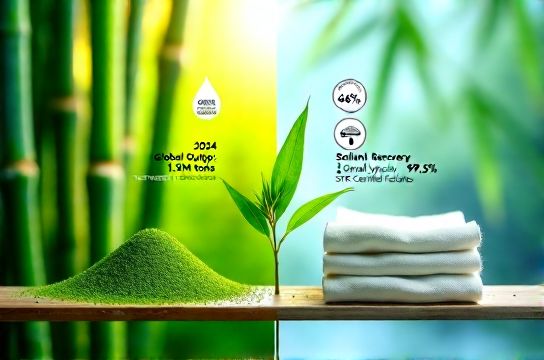
The good news? Certified closed-loop systems are scaling fast. As of 2024, Lenzing’s TENCEL™ Lyocell from bamboo accounts for ~18% of global eco-viscose output—and their solvent recovery rate exceeds 99.5%, verified by independent OEKO-TEX® STeP audits.
Here’s how leading innovators compare across critical sustainability metrics:
| Producer | Renewable Feedstock Source | Solvent Recovery Rate | Water Use (L/kg fiber) | OEKO-TEX® STeP Certified? | Annual Output (tons) |
|---|---|---|---|---|---|
| Lenzing (Austria) | Bamboo & Eucalyptus | 99.7% | 12 | Yes | 145,000 |
| Grasim (India) | Bamboo & Wood Pulp | 82% | 68 | Partially | 210,000 |
| BOHECO (China) | Domestic Bamboo Only | 76% | 95 | No | 89,000 |
Notice the trade-off: higher output doesn’t always mean higher responsibility. Grasim leads in volume but lags in closed-loop fidelity—while Lenzing prioritizes circularity, even at lower scale.
So—what should you look for when sourcing? Prioritize GOTS + STeP dual certification, demand full supply chain traceability (not just 'bamboo-derived'), and ask for mill-level water and emission reports—not just marketing PDFs.
Bottom line: bamboo viscose isn’t inherently sustainable—it’s *how* it’s made that defines its integrity. And that’s why forward-thinking brands are now shifting procurement toward certified closed-loop producers. For deeper insights into responsible fiber sourcing, explore our fiber transparency framework.