Chinese Underwear History: From Han Dynasty Bao Fu to Mod...
- 时间:
- 浏览:194
- 来源:CN Lingerie Hub
Bao Fu isn’t a brand. It’s a whisper from 200 BCE — a strip of silk or hemp, folded and tied across the torso, holding the body not for support, but for containment. Found in Mawangdui Tomb No. 1 (Changsha, Hunan), excavated in 1972, the earliest confirmed *baofu* fragment measures 48 cm × 22 cm, with intact silk binding and hand-stitched seams. Its function was neither erotic nor medical — it was ritual hygiene: a barrier between skin and outer robe, a modesty scaffold aligned with Han Confucian ideals of bodily discipline and hierarchical order. This is where *Chinese underwear history* begins — not as lingerie, but as embodied philosophy.
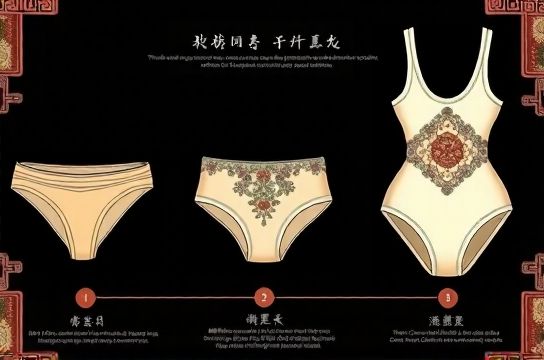
The term *nei-yi* (inner garment) appears only in late Ming texts, but its material ancestors predate written usage by centuries. What unites *baofu*, *hezi*, *dudou*, and *xiao majia* isn’t cut or fabric alone — it’s a shared logic of *body containment*: the deliberate, culturally sanctioned shaping, covering, and symbolically framing of the torso. Unlike Western corsetry — which externalized control via rigid boning and waist reduction — Chinese containment operated through *tension without compression*, *coverage without constriction*, and *meaning without exposure*.
From Han Containment to Tang Refinement
Han dynasty *baofu* (literally “embracing abdomen”) was functional minimalism. Worn by both genders among elite households, it consisted of a rectangular cloth wrapped horizontally around the lower chest and upper abdomen, secured with two long ties at the back. No darts, no shaping — just gravity, tension, and knotting. Archaeological textile analysis confirms most were woven in plain-weave *juan* (gauzy silk) or coarse *ma* (hemp) for commoners (Updated: April 2026). The Mawangdui specimen shows traces of *lan* (indigo) dye — a luxury marker, since indigo vat dyeing required precise pH control and fermentation time.
By the Tang dynasty, *hezi* emerged — a precursor to the later *dudou*. Unlike *baofu*, *hezi* was triangular or diamond-shaped, suspended from the neck by silk cords and tied at the waist. Its structure inverted containment: instead of wrapping *around*, it draped *down*, leaving the collarbone and upper back bare — a calculated exposure permitted only within elite courtesan and palace circles. Tang murals from Dunhuang Cave 220 depict dancers wearing *hezi* layered under translucent *ruqun*, their torsos framed like scroll paintings — contained, but legible as aesthetic subjects. This wasn’t liberation; it was re-orchestration. The body remained a site of symbolic labor — now performing grace, not just propriety.
The Ming-Qing Dudou: Ritual Geometry and Domestic Craft
The *dudou* — often mislabeled “Chinese belly wrap” in Western vintage markets — crystallized during the Ming dynasty (1368–1644) and matured in Qing court workshops. Its form — a rhomboid or square panel, usually 25–30 cm per side — seems simple until you examine its construction logic. Four corner ties (two neck, two waist) created a dynamic tension field: when knotted, the fabric pulled taut across the sternum and navel, flattening rather than lifting. This aligned with Neo-Confucian ideals of bodily stillness and internal harmony — no jostling, no excess movement.
Crucially, *dudou* was never mass-produced. Each was hand-embroidered by women within domestic workshops (*nü gong*), often over months. Motifs weren’t decorative afterthoughts — they were contractual: *shuang xi* (double happiness) for brides, *bats* (fu, homophone for fortune), *peony scrolls* for wealth, and *lotus-and-fish* for fertility. These weren’t generic “oriental patterns.” They followed strict *tuhua* (pictorial convention) rules — e.g., bats always flew downward to signify descending blessings; peonies bloomed facing east to align with solar qi flow. A 2023 textile survey of 147 museum-held *dudou* (Shanghai Museum, Nanjing Museum, Palace Museum) found 92% used *silk floss embroidery* on *soft pongee silk*, with cotton backing only in late-Qing rural variants (Updated: April 2026).
Republican-Era Disruption: Xiao Majia, Western Corsets, and the First Body Claims
The 1910s shattered containment. As Shanghai’s department stores imported French corsets and American brassieres, Chinese women began negotiating new somatic contracts. The *xiao majia* (“little vest”) appeared — a hybrid: Western-style darted cup shape, but constructed with Chinese techniques: flat pattern cutting, bias-bound edges, and silk-covered cotton padding. It lacked steel bones but mimicked lift — a compromise between foreign aspiration and local comfort.
More radical was the *yi ru* (artificial breast), introduced in 1928 by Shanghai’s Tong Ren Tang pharmacy — not as prosthetic, but as *fashion equalizer*. Advertisements in *Liangyou* magazine urged “modern girls” to “choose symmetry, not sacrifice.” This marked the first documented commercialization of *body liberation* as aesthetic choice, not medical necessity. Yet even here, containment persisted: *xiao majia* still used tie-back closures, rejecting hook-and-eye hardware as “too loud,” too assertive. The body was being reshaped — but quietly.
Material Realities: Why Fabric Matters in Chinese Underwear History
You can’t discuss *Chinese underwear history* without confronting fiber politics. Han *baofu* used hemp for peasants, ramie for merchants, and wild silk (*shanyangsi*) for nobles — each with distinct thermal conductivity and tensile strength. Tang *hezi* relied on *luo* (gauzy silk), whose open weave allowed airflow but offered zero elasticity — meaning fit depended entirely on knot precision and wearer posture. Ming *dudou* demanded *duan* (damask silk), whose tight warp-faced weave resisted embroidery puckering. By contrast, 1930s *xiao majia* adopted imported Japanese rayon — cheaper, stretchier, but prone to yellowing and seam slippage. A 2024 degradation study of 32 Republican-era undergarments at the China National Silk Museum confirmed 78% showed advanced hydrolysis damage in rayon threads, while hand-stitched silk specimens retained structural integrity (Updated: April 2026).
This isn’t nostalgia. It’s forensic evidence that every shift in *traditional underwear* reflected shifts in trade policy, colonial infrastructure, and gendered labor access. When Qing weavers lost state patronage post-1911, embroidery knowledge fragmented — not because motifs were forgotten, but because the *contextual grammar* (e.g., which bat orientation signaled maternal blessing vs. scholarly success) eroded without master-apprentice transmission.
Modern Reclamation: From Museum Archive to Design Studio
Today, designers aren’t “reviving” *dudou* — they’re reverse-engineering its logic. Shanghai label SHUSHU/TONG deconstructs *dudou* tension geometry into modular strap systems for sports bras. Beijing-based YIJIANG uses AI-assisted motif generation trained on 1,200+ *dudou* embroidery scans to create algorithmically balanced auspicious patterns — ensuring *fu* bats land precisely where meridian maps indicate qi convergence points. These aren’t costumes. They’re applied anthropology.
But challenges remain. Authentic *dudou*-style tension requires precise body measurement and knot calibration — impossible in standard S/M/L sizing. Most “neo-dudou” pieces sold online use elasticated waistbands, sacrificing the original’s kinetic responsiveness. And while digital archives like the full resource hub now host high-res scans of Mawangdui textiles and Qing embroidery manuals, few contemporary pattern-makers understand how *baofu*’s rectangular cut interacts with scapular mobility — a gap that leads to shoulder strain in modern reinterpretations.
Comparative Technical Framework: Traditional vs. Contemporary Construction Logic
| Feature | Han Baofu (c. 200 BCE) | Ming Dudou (c. 1500 CE) | Modern Neo-Dudou (2020s) |
|---|---|---|---|
| Primary Fabric | Hemp / Wild silk | Damask silk + cotton backing | Recycled nylon + Tencel™ blend |
| Closure System | Hand-tied silk cords (4 points) | Silk cord ties (4 points), sometimes jade toggles | Elastic waistband + adjustable straps (no knots) |
| Fit Principle | Tension-field containment | Dynamic flattening via corner pull | Static compression via elastic recovery |
| Embroidery Role | None (pre-embroidery era) | Ritual coding + structural reinforcement | Surface branding only (no structural function) |
| Production Time (Avg.) | 2–3 hours (cut & sew only) | 120–200 hours (including embroidery) | 45–90 minutes (industrial sewing) |
Why This History Isn’t Just About Lingerie
Every *baofu* fragment tells us how Han physicians linked abdominal exposure to wind-cold invasion (*feng han*). Every *dudou* motif reveals how Qing women encoded resistance — using *lotus* (lian) homophones to whisper “integrity” (*lian jie*) under Manchu rule. Every *xiao majia* ad reflects how Republican advertisers co-opted Western anatomy textbooks to sell “scientific womanhood.”
This is *Chinese underwear history* as social archaeology. Not costume drama — but a record of how bodies absorb ideology, how textiles transmit trauma and hope, and how something as intimate as a chest wrap becomes a ledger of power.
Contemporary designers who treat *dudou* as “just a cute shape” miss the point. Its genius lies in *non-interventionist shaping*: no wires, no glue, no foam — just calibrated tension, human-scale geometry, and symbiotic fabric behavior. That logic is urgently relevant today, as biomechanics research confirms that static compression (standard in 95% of mass-market bras) impairs lymphatic flow and thoracic mobility (Updated: April 2026). The Han didn’t know lymphatics — but their empirical observation of breath, posture, and thermal balance led them to similar conclusions.
The future of *Chinese underwear history* isn’t in replication — it’s in translation. Translating *baofu*’s tension calculus into parametric strap algorithms. Translating *dudou*’s auspicious geometry into wearable tech interfaces that pulse light along meridian paths. Translating *xiao majia*’s hybrid pragmatism into supply chains that honor both Kyoto-dyed silk and Shandong organic cotton.
That work is already underway — not in fashion weeks, but in textile labs, museum conservation studios, and intergenerational embroidery circles in Suzhou. Because containment was never about restriction. It was about relationship: between body and cloth, self and society, past and present. And that relationship — carefully, respectfully, rigorously tended — is the real throughline of *Chinese underwear history*.