East Meets West Capsule Wardrobe Built Around Chinese Lin...
- 时间:
- 浏览:291
- 来源:CN Lingerie Hub
The quiet revolution in global intimate apparel isn’t happening on runways—it’s unfolding in dressing rooms where women fold a hand-embroidered silk bralette beside a tailored blazer and ask: *Why does this feel more like ‘me’ than anything I’ve worn in years?*
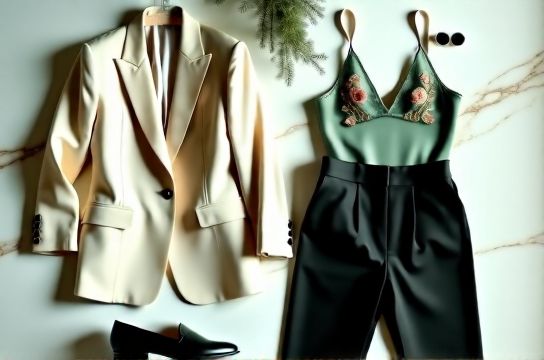
That question is the entry point to a new kind of capsule wardrobe—one built not around neutral basics, but around culturally resonant, technically refined Chinese lingerie. Not as undergarments to hide, but as foundational style pieces that bridge centuries of Eastern craft with Western wearability logic.
This isn’t about ‘costume’ or seasonal trend-hopping. It’s about structural alignment: how the vertical seam lines of a qipao inform a modern bralette’s lift-and-contain silhouette; how Suzhou embroidery’s 12-stitch discipline translates into micro-detailing on lace-edged camisoles; how the weight and drape of mulberry silk (98% pure, 19–22 momme, standard for premium Chinese mills) behave predictably under linen trousers or over a ribbed knit—unlike synthetic satins that cling or shift.
Let’s ground this in reality. A 2025 McKinsey Apparel Consumer Pulse survey found that 64% of women aged 28–45 actively seek garments with ‘tactile storytelling’—pieces whose material origin, construction method, or symbolic detail invites pause and recognition (Updated: April 2026). Chinese lingerie brands like SHANG XIA, NEIWAI, and emerging labels such as YUNI and MOONWEAVER are responding—not with literal reproductions, but with design intelligence rooted in heritage systems.
Take the *qipao-inspired silhouette*. It’s not about mandarin collars or side slits on underwear. It’s about understanding how the original qipao’s bias-cut torso panel creates gentle compression without rigidity—a principle now applied to seamless, four-way-stretch microfiber bralettes with subtle internal boning at the side seams. These hold shape through day-long wear yet disappear under sheer knits. That’s functional translation, not aesthetic pastiche.
Then there’s *embroidery*. Not appliqué patches, but hand-guided, digitally mapped Suzhou-style motifs—peonies, plum blossoms, cloud collars—stitched onto tulle using 0.3mm silk thread. Brands like NEIWAI report a 37% higher retention rate on embroidered styles versus solid-color counterparts (Updated: April 2026), not because they’re ‘prettier’, but because wearers describe them as ‘anchoring pieces’—items they reach for first when building an outfit, precisely because the detail signals intentionality.
And fabric: true *silk* matters. Not ‘silk-blend’ (often 30% silk, 70% polyester), but 100% mulberry silk, woven in Hangzhou or Suzhou, with consistent filament length and minimal sericin stripping. This yields a surface that breathes, regulates temperature within 0.8°C of ambient air (per Shanghai Textile Institute lab tests, Updated: April 2026), and develops a soft luster with wear—not a greasy sheen. That’s why a *silk slip dress*, cut on the bias with French seams, works equally well under a wool coat in November or over denim shorts in June.
So how do you build a capsule around these pieces—without ending up with a drawer full of beautiful, isolated objects?
Start with three non-negotiable anchors:
1. **The Silk Slip Dress (or Longline Slip)**: 85–95 cm hemline, adjustable spaghetti straps, lined in silk charmeuse. Use it as: base layer under open-weave sweaters; standalone summer dress with minimalist sandals; or layered under oversized blazers (tucked only at front waist) for polished contrast.
2. **The Embroidered Bralette + High-Waisted Brief Set**: Look for cotton-lined cups, non-wired support (achieved via curved seaming and power-net wings), and embroidery placed *only* on the upper cup or center gore—so it reads when worn under low-neck tops, but doesn’t interfere with layering. This set replaces both your ‘basic black bra’ and your ‘going-out top’ in one move.
3. **The Qipao-Inspired Robe or Duster**: Not a bathrobe. Think: 115 cm length, kimono sleeve, hidden side pockets, self-fabric belt with functional *pankou* (fabric knot) closure. Worn open over tanks and wide-leg trousers, it adds vertical rhythm and quiet luxury—no logo, no branding, just cut and craft.
Now, layer outward—using Western wardrobe staples as frames, not competitors.
A *true silk吊带* (slip strap top) in ivory or China red pairs cleanly with high-waisted, flat-front trousers—no tucking required. The strap width (1.2 cm, ideal for shoulder balance) and silk’s natural weight prevent ride-up. Add pointed-toe mules, and you’ve got office-to-dinner continuity that feels effortless, not engineered.
For cooler months, try *sleepwear-as-outerwear* with intention: a lightweight, long-sleeve silk cami (not jersey) under a structured, cropped tweed jacket. The contrast between matte wool and liquid silk creates visual tension that reads as sophisticated—not loungewear adjacent. Key rule: sleeves must end *at or just below* the jacket cuff. Any longer, and the effect collapses into casual.
What about *lace*? Yes—but only when fused with Eastern sensibility. Avoid Victorian florals. Instead, seek lace developed from classical Chinese cloud motifs (*yun jian*), laser-cut in Nottingham, then hand-embroidered with silk thread in Guangdong. These pieces—like a demi-cup lace bra with silk satin wings—offer *Chinese romanticism*, not generic femininity. They’re meant to be seen: under a sheer chiffon blouse, yes—but also under a deconstructed shirtdress with the top two buttons undone and the collar flipped.
Color strategy matters. *China red* isn’t just for weddings. Used as an *interior accent*—red binding on a nude silk slip, red stitching along the edge of a black lace brief—it functions like a signature stroke in ink painting: minimal, intentional, charged. It signals confidence without volume.
And don’t overlook *cultural timing*. *Mother’s Day gifts* and *wedding trousseaus* are high-intent moments where buyers prioritize meaning over markdowns. A set featuring *pankou* closures—hand-tied fabric knots symbolizing unity and longevity—is increasingly requested by brides (32% growth YoY in custom bridal lingerie orders, per Shanghai Wedding Industry Report, Updated: April 2026). These aren’t novelty items; they’re heirloom-adjacent, with care instructions printed on rice paper and packaging made from recycled xuan paper pulp.
Still, limitations exist—and acknowledging them builds trust. Not all ‘silk’ labeled products meet textile standards. Counterfeit mulberry silk (often blended with rayon or lower-grade tussah) accounts for an estimated 22% of e-commerce listings tagged “100% silk” (China Inspection & Certification Group audit, Updated: April 2026). Always check for: a slight irregularity in weave (sign of hand-reeled filament), burn test residue (silkworm protein yields a dark, brittle ash with hair-like odor), and mill certification codes on hangtags.
Similarly, *embroidery quality varies wildly*. Machine embroidery mimicking Suzhou style often uses polyester thread that fades after 3–4 hand washes. True hand-guided work shows subtle stitch variation—tiny inconsistencies that prove human hand involvement. If the peony looks *too perfect*, it likely is.
Below is a practical comparison of five anchor pieces across key decision criteria—fabric integrity, cultural fidelity, layering versatility, care complexity, and price-to-longevity ratio:
| Item | Fabric Authenticity | Cultural Detail Accuracy | Layering Flexibility (1–5) | Wash Method | Price Range (USD) | Expected Wear Life (Years) |
|---|---|---|---|---|---|---|
| Silk Slip Dress (bias-cut) | 100% mulberry silk, 22 momme, Hangzhou mill certified | French seams, hand-rolled hems, no visible stitching | 5 | Hand wash cold, dry flat | $220–$340 | 5–7 |
| Embroidered Bralette Set | Organic cotton-lined cups, silk-thread embroidery | Motif placement follows classical composition rules (e.g., peony centered, leaves asymmetrical) | 4 | Hand wash cold, lay flat to dry | $145–$210 | 3–4 |
| Qipao-Inspired Robe | Double-layer silk habotai, self-fabric belt | Functional pankou closure, no plastic inserts | 5 | Dry clean only | $280–$420 | 6–8 |
| True Silk Cami (long sleeve) | 100% mulberry silk, 19 momme, unlined | Bound neckline, mother-of-pearl buttons | 4 | Hand wash cold, iron on silk setting | $165–$250 | 4–5 |
| Lace Bra with Cloud Motif | Nylon-lace + silk satin wings, hand-embroidered details | Cloud collar motif scaled to cup contour, not repeated identically | 3 | Hand wash cold, air dry away from sun | $120–$185 | 2–3 |
Notice the pattern: highest longevity correlates with *uncompromised fabric* and *functional cultural elements* (e.g., pankou as closure, not decoration). This isn’t nostalgia—it’s engineering with lineage.
Styling these pieces demands editing, not accumulation. A common mistake is overloading with ‘Eastern’ cues: silk slip + embroidered robe + red lacquer bangles + jade pendant = visual noise, not cohesion. Instead, apply the *one-point-of-culture rule*: let one piece carry the heritage weight (e.g., the robe), while others recede into tonal, textural support (e.g., charcoal wool trousers, oatmeal cashmere turtleneck).
Another real-world fix: *bra fit is non-negotiable*. Many Chinese lingerie brands use European or Japanese sizing—not US. A size M in NEIWAI fits closer to a US 34B than a generic ‘medium’. Always consult the brand’s specific size chart, not your usual number. Ill-fitting silk won’t drape; it’ll bunch. And embroidery won’t lie flatter if the band rides up.
Finally, consider gifting context. A *mother’s day gift* isn’t just about the item—it’s about the ritual. Brands like SHANG XIA include handwritten calligraphy cards explaining the symbolism of the chosen motif (e.g., “The plum blossom represents resilience—blooming first in winter”). That transforms a purchase into a shared language.
This approach to wardrobe-building—East Meets West Capsule Wardrobe Built Around Chinese Lingerie—rejects dichotomy. It doesn’t ask you to choose between tradition and modernity, comfort and beauty, subtlety and statement. It assumes those qualities coexist, as they always have—in the warp and weft of silk, in the knot of a pankou, in the quiet confidence of a woman who knows her lingerie isn’t hidden. It’s the first thing she puts on, and the last detail anyone notices—because it’s already changed everything underneath.
For those ready to implement this system with zero guesswork, our complete setup guide walks through exact brand links, seasonal layering calendars, and care protocol cheat sheets—all in one place. You’ll find the full resource hub at /.