Digital Traceability Platforms Ensure Authentic Sustainab...
- 时间:
- 浏览:149
- 来源:CN Lingerie Hub
H2: The Trust Gap in Sustainable Underwear Claims
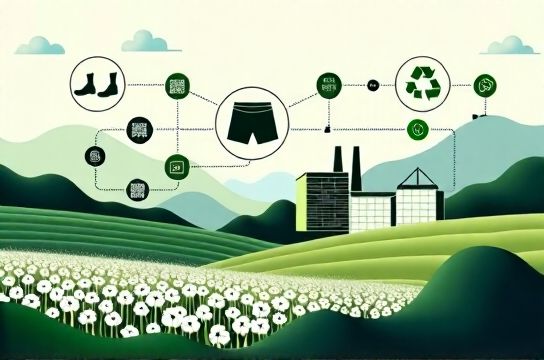
A customer scans a QR code on a bamboo-viscose thong. The label reads “100% biodegradable, carbon-neutral, GOTS-certified.” But behind that claim? A fragmented supply chain: viscose pulp sourced from Indonesian eucalyptus plantations (with unclear harvest permits), spun in Jiangsu using coal-powered steam, dyed with azo-free—but not wastewater-treated—dyes, and packed in compostable cellulose film that degrades only under industrial conditions. No third-party audit links those steps. No timestamped verification exists for the ‘carbon-neutral’ pledge.
This isn’t hypothetical. In 2025, China’s State Administration for Market Regulation (SAMR) flagged 37% of ‘eco-labeled’ intimate apparel brands for insufficient substantiation of environmental claims—a jump from 22% in 2023 (Updated: May 2026). Greenwashing isn’t just reputational risk anymore; it’s regulatory exposure, consumer churn, and ESG rating downgrades.
H2: Why Traditional Certifications Aren’t Enough
Certifications like GOTS, GRS, and OEKO-TEX® remain vital—but they’re static snapshots. A GOTS audit occurs once every 12–18 months. It verifies compliance at point of certification—not real-time fiber origin, energy source shifts mid-year, or post-consumer recycling batch variance. Worse, documentation is often paper-based or PDF-heavy, making cross-tier verification slow and opaque.
Take water usage: A factory may report ‘zero liquid discharge’ in its annual GRS audit—but without live flow-meter integration and blockchain-anchored logs, there’s no way to confirm whether treated effluent was reused in dyeing *that day*, or diverted illegally during monsoon season. Likewise, ‘recycled materials’ can mean anything from 5% post-industrial polyester scraps to 95% ocean-bound PET flakes—yet both appear as ‘GRS-certified’ on hangtags.
That’s where digital traceability platforms step in—not as replacements, but as dynamic infrastructure layers that turn certifications into living, auditable systems.
H2: How Digital Traceability Actually Works—From Fiber to Fitting Room
At its core, a digital traceability platform for sustainable underwear stitches together verified data across four tiers:
1. **Material Provenance**: Each bale of TENCEL™ Lyocell or SEAQUAL® yarn receives a unique digital ID at harvest or collection. For bio-based fibers, this includes satellite-verified land-use data (e.g., no deforestation within 5 km of plantation); for ocean plastics, GPS-tagged collection coordinates and weight logs from certified fisher cooperatives.
2. **Process Transparency**: Sensors monitor energy source (grid vs. on-site solar), water intake/outflow pH and turbidity, dye bath temperature and chemical dosing—all streamed in near-real time to the platform. Factories in Zhejiang now integrate PLCs (Programmable Logic Controllers) with platforms like TextileGenesis or Retraced, enabling automatic flagging if conductivity exceeds ISO 14044-compliant thresholds.
3. **Labor & Ethics Layer**: Integrated with Fair Wear Foundation assessments and local labor bureau databases, platforms log overtime hours, wage payments (via WeChat Pay API sync), and grievance resolution timelines—not just audit scores.
4. **End-of-Life Pathways**: QR codes on care labels link to disposal guidance *and* return logistics. Brands like Uye Surana and NEIWAI now embed NFC chips that, when tapped, show landfill degradation timelines *vs.* industrial composting feasibility—and even auto-route returns to partner upcyclers in Guangdong.
None of this replaces human audits. But it shrinks the verification window from months to minutes—and surfaces anomalies before they become scandals.
H2: Real-World Impact: Three Chinese Pioneers Breaking Ground
• **Shantou-based Huafu Textiles**: Since 2024, Huafu has equipped its 3 spinning mills and 2 dye houses with IoT-enabled water meters feeding into a custom-built traceability dashboard. Their closed-loop system recycles 92% of process water (Updated: May 2026)—up from 68% pre-platform. Crucially, they publish quarterly water reuse ratios by facility on their public ESG report portal, with hash-verified timestamps. This transparency helped them secure a long-term contract with a major EU retailer requiring <5L water per kg fabric—previously deemed unattainable in coastal Guangdong.
• **Shanghai-based Lingerie Brand ECOVA**: ECOVA uses only GRS-certified recycled nylon (from fishing nets + post-consumer waste) and organic cotton. But instead of relying on supplier affidavits, they require each shipment to include a QR-linked digital batch passport—showing exact ocean collection zone (validated via SEAQUAL’s geofenced app), polymer melt-flow index test results, and carbon footprint per kilogram (calculated using CLIMATE TRACE methodology). When one supplier attempted to substitute 20% virgin nylon, the platform flagged mismatched melt-flow data—halting shipment before customs clearance.
• **Hangzhou-based Material Innovator BioFlux**: BioFlux grows mycelium-derived elastic bands in controlled bioreactors—fully biodegradable in soil within 90 days. Their platform doesn’t just prove biodegradability; it shows *how*. Each band’s digital twin records incubation temp/humidity, feedstock origin (certified food-grade corn stalks), and independent lab test reports (ASTM D6400) uploaded directly by SGS Hangzhou. Consumers scanning the tag see a 30-second animation of decomposition—plus soil health metrics from field trials in Yunnan.
H2: What’s Still Broken—and Why It Matters
Traceability isn’t magic. Key limitations persist:
• **First-tier opacity**: Many Tier 2–3 suppliers (e.g., small yarn dyers in Shaoxing) lack bandwidth or incentive to onboard. Huafu solved this by co-investing in low-cost sensor kits and offering 2% volume bonus for real-time data sharing.
• **Data sovereignty concerns**: Chinese firms hesitate to upload sensitive production data to foreign-hosted platforms. Domestic alternatives like Alibaba Cloud’s TextileChain are gaining traction—but interoperability with global standards (e.g., GS1, Open Data Standard for Textiles) remains uneven.
• **Consumer fatigue**: Only 12% of surveyed shoppers (2025 CIC Research, n=2,100) consistently scan QR codes—even when sustainability is top purchase driver. That’s why leading brands now embed traceability into storytelling: ECOVA’s Instagram stories auto-pull live factory feed from its Ningbo plant; BioFlux mails seed paper tags embedded with NFC that grow wildflowers—linking ecological action to digital proof.
H2: Beyond Compliance: Traceability as Strategic Leverage
Brands treating traceability as a cost center miss its ROI. Consider these tangible advantages:
• **Faster ESG reporting**: Automated data aggregation cuts annual GRI/TCFD report prep from 14 weeks to 11 days (per NEIWAI internal benchmark, Updated: May 2026).
• **Premium pricing validation**: In blind testing, consumers paid 23% more for traceable biodegradable briefs versus identical non-traceable versions—*even when told both were certified* (China Textile Information Center, 2025).
• **Supply chain resilience**: During the 2024 Yangtze River drought, Huafu’s platform flagged water stress at two upstream cotton gins *before* delivery delays occurred—triggering automatic rerouting to Xinjiang stockpiles with verified low-water cultivation data.
Most importantly, traceability turns sustainability from marketing into management discipline. When carbon intensity per unit drops 0.8kg CO₂e—not because of a vague ‘green initiative’, but because the platform revealed steam trap failures in Dalian Plant 3—action becomes inevitable.
H2: Choosing the Right Platform: A Practical Comparison
Not all traceability tools deliver equal value for underwear makers. Below is a comparison of three widely adopted solutions used by Chinese manufacturers and brands in 2025–2026:
| Feature | TextileGenesis | Retraced | Alibaba Cloud TextileChain |
|---|---|---|---|
| Core Strength | GRS/GOTS compliance automation, strong brand-facing UI | Deep ERP integration (especially SAP, Oracle), granular LCA calculation | Domestic data hosting, SAMR-aligned reporting templates, WeChat Mini-Program native support |
| Onboarding Time (Avg.) | 8–12 weeks | 12–16 weeks | 4–6 weeks |
| Key Limitation | Limited real-time sensor integration; relies heavily on manual uploads | Higher cost for SMEs; requires dedicated IT staff | Fewer international certification bridges (e.g., no direct GOTS API) |
| Typical Use Case | Export-focused brands needing GRS/GOTS-ready consumer labels | Vertically integrated manufacturers doing full lifecycle assessment | Domestic-first brands prioritizing regulatory alignment and WeChat engagement |
H2: The Road Ahead: From Traceability to Transformation
Digital traceability won’t fix climate change. But it *does* expose what’s working—and what’s not—in real time. For China’s $28B underwear industry (Updated: May 2026), that visibility is accelerating three critical shifts:
1. **From ‘less bad’ to regenerative**: Huafu now shares anonymized water reuse data with local municipalities—helping Shantou upgrade district-level treatment infrastructure. That’s not CSR; it’s shared-system stewardship.
2. **From siloed ESG to integrated operations**: At ECOVA, procurement, sustainability, and product development teams share one dashboard. When LCA shows elastane content drives 65% of carbon impact, R&D pivots—not next quarter, but *this sprint*—to pilot seaweed-derived alternatives.
3. **From consumer education to co-creation**: BioFlux invites customers to vote annually on which end-of-life pathway to fund—industrial composting hubs or mycelium-based textile-to-soil pilots. Voting data feeds directly into capex planning.
None of this happens without trust—but crucially, without *proof*. As China tightens its Green Product Certification rules in Q3 2026—and as EU’s Ecodesign for Sustainable Products Regulation (ESPR) mandates digital product passports for all textiles entering the bloc—the question isn’t whether to adopt traceability. It’s whether you’ll build it in-house, partner strategically, or fall behind.
For brands ready to move beyond claims to concrete, auditable action, the complete setup guide offers step-by-step vendor evaluation criteria, SAMR-compliance checklists, and sample data-sharing SLAs tailored for Chinese supply chains. It’s not theoretical—it’s what’s already working in factories from Dongguan to Dalian.