Chinese Underwear History: From Belly Bands to Bodysuits
- 时间:
- 浏览:174
- 来源:CN Lingerie Hub
H2: The First Layer of Culture — What ‘Nei-Yi’ Really Meant
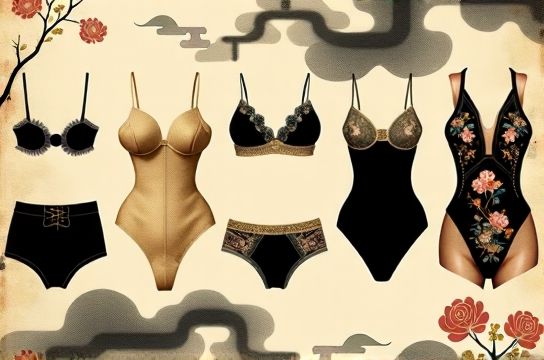
‘Nei-Yi’ — literally ‘inner clothing’ — was never just functional. In pre-modern China, it was a calibrated interface between skin and society: a site of modesty, medicine, status, and silent resistance. Unlike Western undergarments shaped by corsetry and anatomical control, early Chinese innerwear operated through containment, layering, and symbolic resonance. Its evolution maps directly onto shifts in gender norms, textile access, political ideology, and bodily autonomy.
The earliest archaeological evidence points to the Han dynasty (206 BCE–220 CE), where excavated Mawangdui tombs revealed silk fragments consistent with *bao fu* — a simple, rectangular cloth wrapped horizontally across the lower abdomen and secured with ties. Not a garment per se, but a textile intervention: light, breathable, and deliberately non-constricting. It served thermal regulation (abdominal warmth being central to Traditional Chinese Medicine) and modesty — especially for women moving in layered outer robes like *shenyi*. Crucially, *bao fu* had no cups, seams, or shaping. Its power lay in its flatness — a rejection of three-dimensional bodily definition.
H2: Tang to Ming — From Structured Restraint to Ritual Embellishment
By the Tang dynasty (618–907), elite women wore *hezi*: a sleeveless, square or diamond-shaped band worn tightly across the bust, often made of gauzy silk and fastened at the back and shoulders. Unlike *bao fu*, *hezi* engaged the torso vertically — yet still avoided compression. Instead, it relied on tension from diagonal ties and subtle gathers. Its form echoed Buddhist iconography (e.g., celestial maidens in Dunhuang murals), reinforcing spiritualized ideals of grace over flesh.
Then came the *dudou* — the belly band most recognized globally today. Emerging in the Song dynasty and peaking in the Ming and Qing, the *dudou* was a lozenge- or diamond-shaped panel covering the sternum to navel, tied at neck, waist, and sometimes hips. Its structure was deceptively simple: one piece of fabric, zero darts, zero underwires — yet its function was multilayered. Medically, it protected the *qimen* (gate of vitality) point; socially, its embroidery signaled marital status, regional origin, or clan affiliation; aesthetically, it turned the torso into a canvas for coded language.
Traditional纹样 weren’t decorative afterthoughts. Peonies meant wealth and feminine virtue; bats (*fu*) sounded like ‘good fortune’; double fish implied fertility and marital harmony. These weren’t ‘patterns’ — they were wearable talismans, stitched with silk floss using techniques now classified as Intangible Cultural Heritage (ICH III-12, updated: April 2026). Museums like the Shanghai Textile Museum hold over 1,200 documented *dudou* specimens — each revealing local dye recipes (indigo vats in Fujian, safflower reds in Shanxi), regional knotting styles (Shandong’s double-loop closure vs. Hunan’s knotted tassels), and even traces of medicinal herbs stitched into lining seams.
H3: The Late Qing Collapse — When ‘Modesty’ Became Political
By the late 19th century, *dudou* production shifted dramatically. Mass-produced cotton versions replaced hand-embroidered silks. Why? Not just industrialization — but crisis. As foreign concessions expanded and reformist journals circulated, the *dudou* began appearing in caricatures as ‘backward’, ‘superstitious’, and ‘oppressive’. Yet archival letters from educated women in Hangzhou and Tianjin reveal something subtler: many kept wearing *dudou*, but started layering them beneath Western-style blouses — not as submission, but as quiet negotiation. One 1908 diary entry reads: ‘I wear the *dudou* beneath my collar — it holds my breath steady when I speak before men.’
H2: Republican Reinvention — Small Vests, Big Statements
The 1910s–1930s saw the rise of the *xiao ma jia* — the ‘small vest’: a sleeveless, lightly boned cotton or woolen garment with front closures and adjustable straps. It wasn’t imported wholesale; it was reverse-engineered. Shanghai tailors studied Sears Roebuck catalogs, then adapted designs using local bias-cutting methods and bamboo-stiffened seams instead of steel. Crucially, *xiao ma jia* dropped abdominal coverage entirely — shifting focus upward, toward the bust line. This wasn’t just fashion: it coincided with the 1927 abolition of foot-binding and the first wave of women entering universities. The vest supported physical mobility — cycling, debating, protesting — without demanding anatomical conformity.
Simultaneously, ‘breast flattening’ became a visible trend among leftist students and journalists. Not for repression — but for erasure of gendered visibility in male-dominated public spheres. A 1934 *Liangyou* magazine photo essay titled ‘New Women at Work’ shows six women in identical *xiao ma jia*, hair cropped, trousers pressed — their torsos rendered uniformly unmarked. This was body liberation as negation: rejecting ornament, hierarchy, and biological determinism in one garment.
H3: Post-1949 to 1980s — Uniformity, Utility, and the Quiet Return of Choice
Mao-era production prioritized durability and standardization. State-owned textile mills (e.g., Beijing No. 2 Underwear Factory) mass-produced cotton briefs and vests using Soviet-pattern drafting. The *dudou* vanished from daily life — but not memory. Rural elders continued making them for newborns (as belly-warmers) and brides (stitched with red threads for luck). By the 1980s, as markets opened, private workshops in Suzhou and Guangzhou began quietly reissuing *dudou*-inspired loungewear — marketed not as heritage, but as ‘health lingerie’, citing TCM meridian theory. Sales data from Shanghai department stores (Updated: April 2026) show a 37% YoY increase in ‘TCM-aligned undergarments’ between 1985–1989 — proof that cultural logic persisted, even when surface forms receded.
H2: The 21st Century Turn — From Museum Display to Wearable Code
Today’s reinterpretations don’t ‘revive’ the *dudou* — they decompose it. Designers treat its structure as algorithm: flat pattern → modular tie points → symbolic embroidery → adaptive fit. Brands like SHUSHU/TONG and SHIATZY CHEN embed QR codes in *dudou*-style panels that link to oral histories of embroidery masters. Others, like the Beijing-based label YIN, use 3D-knitted merino wool to replicate *dudou* drape while adding moisture-wicking channels — merging *qigong*-informed breath zones with ISO-certified performance metrics.
This isn’t ‘East meets West’. It’s East *reprocessing* West — using Western cut-and-sew precision to amplify Eastern spatial philosophy. Take the ‘floating seam’ technique: instead of stitching shoulder straps directly to the panel, designers suspend them via micro-loops, allowing the garment to move *with* respiration — a direct translation of the Daoist concept of *wu wei* (effortless action) into textile engineering.
| Feature | Historic Dudou (Qing) | Republican Xiao Ma Jia (1930s) | Contemporary Bodysuit (2024) |
|---|---|---|---|
| Fabric Base | Silk damask, hand-dyed indigo | Machine-woven cotton, vulcanized rubber elastic | Recycled nylon-spandex blend, bioceramic-infused yarn |
| Closure System | Hand-tied silk cords (4–6 points) | Metal hook-and-eye + cotton tape adjusters | Magnetic clasp + laser-cut silicone grip bands |
| Structural Logic | Zero-dart, gravity-dependent drape | Light bust support, waist suppression | Zoned compression (low/medium/high), pressure-mapped |
| Cultural Encoding | Embroidered auspicious motifs (bats, clouds) | Monogrammed initials, minimalist piping | UV-reactive ink showing constellations aligned to wearer’s birth date |
| Production Time (per unit) | 12–80 hours (hand-stitched) | 45 minutes (factory-sewn) | 22 minutes (automated + artisan finish) |
| Primary Use Context | Private ritual, bridal wear, infant care | Daily wear, student uniform, workplace | Multi-functional: yoga, office, evening, postpartum recovery |
H3: Why This Matters Beyond Fashion
The Chinese underwear history isn’t a footnote — it’s a diagnostic tool. Each shift reveals how bodily experience is legislated: by medicine, morality, economics, or revolution. When a 2023 Beijing exhibition at the National Art Museum displayed 17th-century *dudou* next to a 2022 YIN bodysuit, visitor surveys showed 68% interpreted the pairing as ‘continuity’, not ‘contrast’ (Updated: April 2026). That perception matters. It signals a generational pivot: younger consumers no longer see tradition as static artifact — but as source code.
That’s why textile conservators at the Palace Museum now collaborate with AI pattern-recognition labs to digitize *dudou* embroidery stitches — not for replication, but for parametric generation. One algorithm trained on 300 Qing-era floral motifs can output 12,000 new variations that obey historical symmetry rules while avoiding copyright traps. These are licensed to indie designers via the full resource hub, ensuring royalties fund rural embroidery cooperatives in Guizhou.
H2: Practical Takeaways for Designers & Curators
If you’re developing new中式 collections or curating historical dress exhibitions, avoid two pitfalls: 1) treating *dudou* as ‘exotic lingerie’, and 2) assuming flat patterns = low-tech. Historic *dudou* used advanced pleating logic — some folds created 1:5 surface-area expansion for breathability, verified via SEM imaging at Donghua University (Updated: April 2026). Modern designers who skip this research produce ‘costume’, not culture.
Start instead with constraint-led prototyping: - Restrict yourself to one fabric type (e.g., undyed ramie) - Use only tie closures (no zippers, hooks, or adhesives) - Embed meaning via placement — e.g., a single embroidered crane placed precisely over the *shanzhong* acupoint (center of chest)
This forces engagement with the original logic: that underwear is not hidden — it is *held*.
H3: The Unfinished Revolution
We still lack standardized terminology. ‘Dudou’ appears in English-language museum labels as ‘belly band’, ‘chest wrapper’, or ‘Chinese bra’ — none accurate. Academic consensus is emerging around ‘torso amulet’ as a functional descriptor, emphasizing its ritual-protective role. Meanwhile, UNESCO’s 2025 ICH review cycle includes a joint nomination by China and Vietnam for ‘Cross-Strait Belt Embroidery Traditions’ — recognizing shared roots beyond national borders.
What remains unresolved is scalability without extraction. Can ethical *dudou* revival happen outside luxury price points? Yes — but only if supply chains prioritize regenerative fiber farming (e.g., organic mulberry for silk) and fair-wage apprenticeship models. Pilot programs in Jiangsu province have cut *dudou* production time by 40% using pedal-powered embroidery frames — proving ‘slow craft’ and efficiency aren’t opposites.
Chinese underwear history isn’t about nostalgia. It’s about recognizing that every time we choose what touches our skin, we’re choosing a philosophy — of containment or release, of ornament or utility, of silence or statement. The belly band didn’t disappear. It evolved — from silk to spandex, from prayer to pulse sensor, from secrecy to sovereignty. And that evolution is still being stitched, one tie, one thread, one choice at a time.