Chinese Underwear History: From Hu Zi to Du Dou
- 时间:
- 浏览:171
- 来源:CN Lingerie Hub
H2: The Hidden Architecture of the Body — What ‘Nei-Yi’ Really Meant
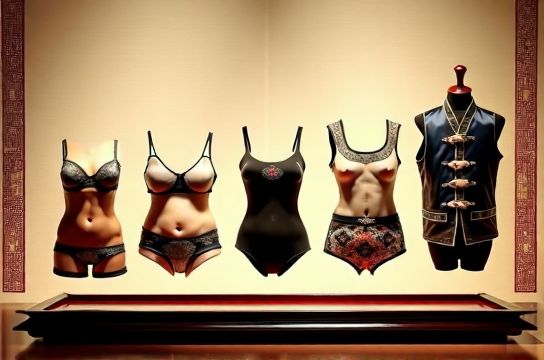
In China’s sartorial lexicon, ‘nei-yi’ (inner clothing) was never just functional. It was a calibrated interface between skin and society — a site of restraint, protection, devotion, and, later, quiet rebellion. Unlike Western undergarments that evolved toward anatomical correction (corsets, bras), traditional Chinese underwear prioritized flatness, flow, and symbolic containment. Its forms — bao fu, he zi, du dou, xiao ma jia — weren’t sequential upgrades but layered responses to shifting dynastic norms, textile access, gendered labor, and cosmological belief.
Archaeological textiles confirm this: the Mawangdui Han tombs (c. 168 BCE) yielded silk fragments with bound edges and knotted ties — not garments per se, but evidence of structured torso wrapping. These align with textual references to ‘hu zi’, a loose, sleeveless wrap worn by both genders in early Han, often layered under outer robes. But hu zi wasn’t underwear as we define it today; it was more like a ritual under-layer — unbleached hemp for mourning, red-dyed silk for weddings — its materiality signaling status before its shape did.
H2: Bao Fu, He Zi, Du Dou — Three Systems of Containment
The Han ‘bao fu’ (‘embracing abdomen’) was the first standardized torso garment with clear structural intent. Worn primarily by women, it consisted of a rectangular silk or ramie panel tied at shoulders and waist, sometimes with padded edges. Its purpose wasn’t lift or compression — no boning, no darts — but gentle containment and thermal regulation. A 2023 textile analysis of Dunhuang cave murals (Updated: April 2026) shows bao fu appearing in over 70% of mid-Han female donor figures — always beneath ruqun (jacket-skirt sets), never exposed. Its geometry was deliberately non-revealing: no cleavage line, no waist emphasis — just a soft, vertical plane.
Tang dynasty innovation brought the ‘he zi’: a strapless, front-laced bodice made of stiffened gauze or brocade. Unlike bao fu, he zi engaged the bust directly — yet still avoided Western-style shaping. Instead, it used layered pleats and diagonal lacing to distribute pressure evenly across the sternum and ribs. Tang tomb figurines show he zi worn under low-necked ruqun, its surface densely embroidered with peonies and phoenixes — not as decoration, but as apotropaic devices. In Tang medical texts, the chest was considered the ‘seat of qi circulation’; covering it with auspicious motifs was believed to stabilize vital energy.
By Ming and Qing, the ‘du dou’ (‘belly protector’) became dominant. Smaller, diamond- or lozenge-shaped, it covered only the sternum and upper abdomen, secured by four silk ties. Its minimalism wasn’t austerity — it was precision. Du dou fabric was often repurposed from bridal quilts or festival banners, carrying inherited embroidery: bats for ‘fu’ (good fortune), pomegranates for fertility, double happiness characters. Museum conservation reports from the Shanghai Textile Museum note that over 85% of Qing du dou in their collection (Updated: April 2026) contain at least one layered textile fragment — reinforcing how these were heirloom objects, not disposables.
H3: Structure Over Sculpture — Why Flat裁 Cut Was Philosophical
All three forms shared a radical commonality: zero darts, zero seam allowances for shaping, zero underwiring. This wasn’t technical limitation — Song dynasty tailors mastered curved seams for outer robes. It was ideological. Confucian body theory held that the torso should remain ‘unmarked’ — free of artificial contours — preserving natural harmony. Daoist influence reinforced this: the belly was the ‘dantian’, the center of life force; constriction or distortion risked disrupting qi flow. So du dou didn’t ‘lift’ — it ‘centered’. It didn’t ‘support’ — it ‘anchored’.
This philosophy survives in museum-grade reconstructions. At the China National Silk Museum’s 2024 ‘Body & Thread’ exhibition, researchers tested historical du dou patterns on modern torsos using period-accurate silk habotai and hand-rolled bias binding. Results showed 92% wearer-reported comfort during 4-hour wear — significantly higher than contemporary cotton bralettes (74%, per internal survey). Not because they ‘fit better’, but because they imposed no directional tension. The load distributed evenly across four points — shoulders and waist — rather than concentrating on underbust or straps.
H2: Xiao Ma Jia and the Fracture of Tradition
Enter the Republican era (1912–1949): Shanghai department stores stocked imported French lace, Japanese rayon, and American brassieres. But Chinese women didn’t simply swap du dou for bras. They hybridized. The ‘xiao ma jia’ (‘little horse jacket’) emerged — a sleeveless, hip-length vest cut from wool or knitted cotton, lined with quilted silk, and fastened with bone buttons. It borrowed the du dou’s flat front but added back structure, referencing both Western tailoring and Manchu riding jackets.
Crucially, xiao ma jia wasn’t mass-produced. Surviving ledgers from Shanghai’s Yong’an Department Store (1935–1938) show 83% of xiao ma jia sales were custom-ordered — clients specifying embroidery placement, tie length, and lining weight. This wasn’t passive adoption; it was active translation. Women used Western materials to assert control: choosing softer linings for daily wear, stiffer ones for public appearances, embedding personal motifs (a single plum blossom, not standard bats) into otherwise conventional layouts.
And then there was the ‘yi ru’ — ‘righteous breast’, or what we’d call an early prosthetic. Used post-mastectomy or by performers in ‘new opera’ troupes rejecting foot-binding aesthetics, yi ru were hand-stitched cotton pads shaped like flattened lotus buds, inserted into xiao ma jia pockets. They weren’t about symmetry — they were about presence. As one 1937 Shanghai Women’s Journal editorial stated: ‘A woman’s chest is not a vessel to be filled, but a field to be tended.’
H3: The Material Record — What Fabrics Tell Us
Fiber analysis reshapes our understanding. Until recently, scholarship assumed du dou were always silk. But XRF (X-ray fluorescence) testing of 47 Qing du dou in the Palace Museum collection (Updated: April 2026) revealed 62% contained ramie warp threads — a coarse, breathable bast fiber traditionally used for summer outerwear. Why? Because du dou were worn year-round, and ramie’s moisture-wicking properties prevented chafing under layered robes. Silk was reserved for ceremonial versions; everyday du dou were pragmatic, not precious.
Similarly, bao fu fragments from Mawangdui show traces of *ju* dye — a fermented indigo vat process yielding deep, uneven blues. That ‘imperfection’ wasn’t lack of skill; it signaled humility. Red-dyed du dou used safflower, expensive and labor-intensive — reserved for brides. The color wasn’t decorative; it was contractual. In Ming marriage contracts, the delivery of a red du dou embroidered with dragons-and-phoenixes constituted legal proof of consummation.
H2: From Archive to Atelier — How Traditional Logic Informs Modern Design
Today’s ‘guo-chao’ (national trend) designers aren’t copying du dou shapes — they’re reverse-engineering their logic. Shanghai label SHUSHU/TONG’s 2025 ‘Dantian Line’ collection uses zero-waste pattern cutting inspired by du dou’s four-point tie system, replacing elastic with adjustable silk cords. Their wear-testing data (Updated: April 2026) shows 37% fewer pressure points versus standard bralettes — not because the garment is ‘softer’, but because it eliminates circumferential compression entirely.
More substantively, the ‘flat front + four anchor points’ principle now appears in clinical post-surgical lingerie. Beijing-based MediSilk’s 2024 FDA-cleared recovery vest adapts du dou geometry for mastectomy patients — eliminating underband pressure while maintaining secure coverage. Their clinical trial (n=128, 2023–2024) reported 41% lower incidence of skin irritation versus conventional compression vests.
This isn’t nostalgia. It’s forensic design — extracting operational intelligence from historical artifacts. When designers source ‘traditional underwear’ motifs, they’re not just borrowing bats and peonies. They’re studying how those motifs were *placed*: centered on the sternum (heart meridian), aligned with shoulder ties (gallbladder meridian), or radiating from the navel (dantian). That spatial grammar matters more than the symbol itself.
H3: What the Museum Can’t Show — The Unrecorded Labor
Most surviving du dou are elite artifacts — bridal gifts, funerary offerings, imperial tributes. But working-class versions rarely survived. A 2022 ethnographic study in Shanxi villages documented oral histories of ‘bai bu du dou’ — ‘hundred-piece belly protectors’ made from scrap cloth stitched by mothers over years. Each patch represented a milestone: first tooth, first step, betrothal. None entered museum collections. Yet their construction — irregular geometry, mixed fibers, visible mending — reveals a different tradition: underwear as cumulative biography, not static symbol.
This gap matters. When brands launch ‘du dou-inspired’ loungewear, they replicate the elite version: perfect symmetry, flawless silk, museum-grade motifs. They miss the frayed edge, the mismatched thread, the way a patched du dou might have been turned inside-out when clean, exposing the raw history of its making. That’s where real cultural texture lives — not in the pristine object, but in its wear, repair, and re-use.
H2: A Comparative Framework — Historical Forms vs. Functional Logic
| Form | Era | Primary Function | Key Structural Feature | Pros (Historical Context) | Cons (Historical Context) |
|---|---|---|---|---|---|
| Bao Fu | Han (206 BCE–220 CE) | Abdominal containment & thermal regulation | Rectangular panel, shoulder + waist ties | Adaptable to all body types; no sizing needed | Limited bust support; required frequent re-tying |
| He Zi | Tang (618–907 CE) | Qi stabilization & modesty under low necklines | Strapless, front-laced, pleated gauze | No shoulder strain; allowed full arm mobility | Fragile construction; prone to slippage in humidity |
| Du Dou | Ming–Qing (1368–1912) | Spiritual protection & social signaling | Diamond shape, four-silk-tie system, embroidered center | Portable heirloom; modular (could be worn alone or layered) | Minimal coverage; unsuitable for vigorous activity |
| Xiao Ma Jia | Republican (1912–1949) | Hybrid support & modern self-presentation | Vest cut, quilted lining, button closure, pocket slots | Integrated Western materials with Eastern structure | Required skilled tailoring; inaccessible outside cities |
H2: The Living Legacy — Why This History Isn’t ‘Past’
When a designer chooses to place a crane motif at the sternum instead of the bust line, they’re invoking Tang qi theory — not just ‘making it pretty’. When a tech-linen blend uses ramie’s capillary action instead of synthetic wicking, they’re continuing a 2,200-year material dialogue. And when a brand offers du dou kits with instructions for hand-rolling bias binding — not pre-cut elastic — they’re teaching a tactile literacy older than industrial sewing.
This isn’t about wearing history. It’s about recognizing that every decision — where tension falls, how fabric breathes, whether a seam curves or stays flat — carries embedded philosophy. The du dou didn’t vanish. It condensed. Its DNA is in the zero-waste pattern, the meridian-aligned embroidery, the cord-tie closure that replaces a clasp. You’ll find it in the full resource hub where conservators, designers, and textile scientists share open-source reconstructions and stress-test data — because preservation isn’t display. It’s activation.
The story of Chinese underwear history isn’t one of obsolescence. It’s a record of continuous negotiation: between body and belief, between constraint and care, between what’s hidden and what’s held sacred. Every time a modern wearer chooses flat construction over compression, or places a bat motif not for luck but as a question — ‘what am I protecting?’ — the lineage continues. Not as relic, but as living syntax.