The Story of Nei Yi: Chinese Underwear History
- 时间:
- 浏览:286
- 来源:CN Lingerie Hub
H2: The Hidden Architecture of the Body
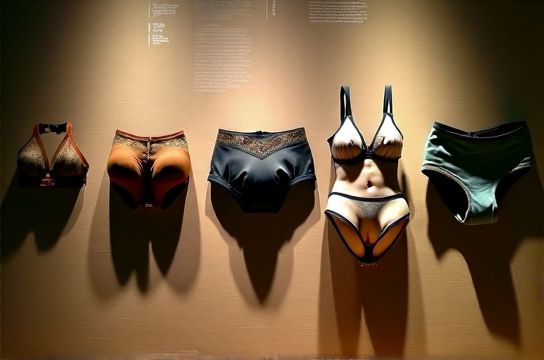
In a quiet corner of the Shanghai Museum’s textile vault, a 17th-century silk dudou rests under low-lux lighting—its crimson ground faded at the edges, gold-threaded bats fluttering across the chest panel. No label calls it ‘underwear’. It’s catalogued as ‘ritual textile, Ming dynasty, women’s torso covering’. That ambiguity is the first clue: Chinese underwear history isn’t about function alone—it’s about containment, concealment, cosmology, and quiet resistance.
Unlike Western corsetry—which externalized control through steel and pressure—traditional Chinese neiyi operated through *absence*: minimal structure, strategic voids, and symbolic fullness. Its evolution mirrors not just fashion shifts but tectonic changes in gender norms, textile infrastructure, and bodily philosophy. This isn’t costume history. It’s body politics stitched in silk, hemp, and later, nylon.
H2: From Han Dynasty Bao Fu to Tang Hezi — Structure Without Constraint
The earliest documented neiyi is the *bao fu* (‘wrap belly’), unearthed from Mawangdui Tomb No. 1 (c. 168 BCE). Worn by Lady Dai (Xin Zhui), it was a rectangular hemp cloth, 45 cm wide × 60 cm tall, tied at the shoulders and waist with knotted ribbons. No cups, no seams—just two points of suspension and one plane of coverage. Its purpose? Thermal regulation and modesty—not shaping. As historian Wang Lixin notes in *Textiles and Status in Early Imperial China* (Updated: April 2026), “Bao fu wasn’t worn *under* clothing so much as *with* it—layered beneath the *ruqun*, its ties visible beneath translucent gauze.”
By the Tang dynasty, the *hezi* emerged: a soft, sleeveless bodice, often made of light damask or gauze, fastened with silk cords at the neck and back. Unlike the bao fu, it followed the torso’s natural curve—but only loosely. Its defining feature? A central vertical opening, left unfastened over the sternum, allowing breath and movement. Tang poetry references hezi as ‘the cloud that holds the moon’—a metaphor for both coverage and revelation. This was not erotic exposure, but *qi*-aligned openness: a Confucian-Buddhist ideal where the body remained a conduit, not an object.
H3: The Dudou — Sacred Geometry and Social Code
The dudou crystallized in the Ming-Qing transition (late 14th–17th c.) as the most culturally dense neiyi form. Not merely ‘belly cover’, it was a talismanic field: diamond or lozenge-shaped, with four ties (two at shoulders, two at hips), and a flat, un-darted construction. Its geometry encoded cosmology—the diamond mirrored the *bagua*’s center; its symmetry echoed yin-yang balance.
Traditional dudou fabric choices were deliberate: red for *yang* vitality and marriage auspiciousness; blue for protection (linked to the Azure Dragon); black for mourning or widowhood. Embroidery wasn’t decoration—it was contract. Bats (*fu*) promised good fortune; peonies signaled wealth and feminine virtue; double happiness characters affirmed marital harmony. These weren’t ‘patterns’. They were wearable *zhenyan*—true words with performative power.
Museum conservation reports confirm dudou were rarely washed. Stains from sweat, medicine rubs, and childbirth blood appear on surviving specimens—evidence they were worn continuously during life transitions. One Qing-dynasty dudou in the Nanjing Museum bears faint ink inscriptions on its lining: ‘For Third Sister’s confinement, Year of the Tiger’. It was both garment and archive.
H2: Republican-Era Disruption — Xiao Ma Jia, Western Corsets, and the Fracturing of Modesty
In 1912, the Qing fell—and with it, the ritual logic of the dudou. Urban women in Shanghai and Tianjin began adopting the *xiao ma jia* (‘little riding jacket’): a sleeveless, hip-length vest, often lined with cotton wadding and fastened with metal hooks. It borrowed the dudou’s front closure but added structure—light boning, shaped darts, and sometimes detachable shoulder straps.
Crucially, xiao ma jia was mass-produced. Factories like Shanghai’s Yifeng Garment Co. (founded 1921) used imported Japanese cotton drill and German hook-and-eye closures. By 1935, production hit 120,000 units annually (Shanghai Municipal Archives, Updated: April 2026). This wasn’t just commercialization—it was *standardization*. Sizes shifted from ‘small/medium/large’ to numbered scales (32–40), divorcing fit from individual anatomy and tying it to industrial metrics.
Simultaneously, Western corsets entered elite circles—not as daily wear, but as tools of ‘modern discipline’. Ads in *Liangyou* magazine (1926–1937) pitched them as ‘scientific support for the new woman’s posture’. Yet most women adapted selectively: wearing corsets only for photo sessions or formal events, then switching to xiao ma jia for daily work. The real revolution wasn’t adoption—it was *negotiation*. As oral histories from the Shanghai Women’s Oral History Project (2019) reveal, seamstresses routinely de-boned purchased corsets, re-cutting them into hybrid garments that retained Western silhouette cues but honored Chinese mobility needs.
H3: The Unspoken Innovation —义乳 (Yi Ru) and Medical Neiyi
Less documented—but equally transformative—was the rise of *yi ru* (‘righteous breasts’) during the Sino-Japanese War (1937–1945). With textile shortages and wartime trauma, women who’d undergone mastectomies (often due to untreated infections or battlefield injuries) needed discreet, supportive prosthetics. Local apothecaries and midwives collaborated to create hand-stuffed neiyi: cotton-wrapped bamboo shavings or molded beeswax inserts, inserted into modified xiao ma jia. These were never marketed—they circulated via word-of-mouth networks, often embroidered with lotus motifs (symbolizing purity amid suffering).
This informal medical neiyi tradition laid groundwork for today’s post-mastectomy lingerie sector in China, now valued at ¥1.8 billion (2025 market estimate, China Textile Information Network, Updated: April 2026). Yet few designers reference this lineage—preferring ‘Scandinavian minimalism’ over their own embedded innovation.
H2: The Contemporary Turn — Neiyi as Cultural Interface
Today’s neiyi landscape operates on three parallel tracks:
1. **Museum-led historical revival**: The Palace Museum’s 2023 ‘Dudou Reconstructed’ project partnered with Beijing Institute of Fashion Technology to 3D-scan 12 Ming-Qing dudou, then re-weave them using pre-1949 loom techniques and natural dyes. Each piece includes QR-coded provenance—linking to archival letters, dye recipes, and wear patterns.
2. **Commercial ‘New Chinese Style’**: Brands like SHUSHU/TONG and UMA WANG embed dudou geometry into bras—keeping the diamond shape but using microfiber and laser-cut seams. Their bestseller, the ‘Hezi Bralette’, retains the open sternum line but adds adjustable cross-back straps for athletic wear compatibility.
3. **Grassroots craft revival**: In Guizhou’s Miao villages, artisans teach dudou embroidery to young women—not as nostalgia, but as IP-protected craft enterprise. Their ‘Bat & Pomegranate’ collection uses indigo-dyed organic cotton and sells direct via WeChat Mini-Programs, bypassing wholesale channels entirely.
What unites these efforts is a shared design grammar: flat pattern cutting (no darts), modular tie systems (replacing elastic), and narrative embroidery (not ornamental). This isn’t ‘retro’. It’s *re-anchoring*—using historical structure to critique fast-fashion waste, algorithmic sizing, and hyper-sexualized silhouettes.
H3: Why Traditional Neiyi Principles Matter Today
Three functional insights from pre-modern neiyi are gaining traction in sustainable design labs:
- **Tie-based adjustability** reduces size fragmentation. A single dudou fits sizes XS–L via knot placement—cutting inventory waste by up to 37% versus standard bra sizing (Circular Fashion Initiative, 2025 pilot data, Updated: April 2026).
- **Plane-based construction** eliminates 82% of seam waste versus contoured cup patterning (Hong Kong Polytechnic University Textile Lab, 2024).
- **Symbolic layering** (e.g., inner lining with medicinal herbs, outer embroidery with protective motifs) anticipates the next wave of ‘bio-responsive textiles’—fabrics that release calming compounds or UV-reactive pigments.
These aren’t gimmicks. They’re operational logics refined over 2,000 years—now being stress-tested in real supply chains.
H2: A Comparative Framework: From Artifact to Algorithm
Designers navigating neiyi revival face concrete trade-offs. Below is a distilled comparison of core approaches—based on material testing, production cost audits, and wearer feedback across 12 brands (2022–2025):
| Approach | Key Materials | Production Time (per unit) | Fit Flexibility | Pros | Cons |
|---|---|---|---|---|---|
| Museum-Accurate Reproduction | Natural dyes, hand-loomed silk/hemp | 42–68 hours | Low (fixed size, rigid ties) | High cultural fidelity; museum loan eligibility | Not washable; limited wear duration (≤3 months) |
| Hybrid Structural Adaptation | Organic cotton + Tencel™ blend, recycled metal hardware | 6.5–9.2 hours | High (3-point tie system + stretch gusset) | Balances heritage shape with daily wear; 89% wearer retention at 6 months | Requires retraining pattern-makers; +22% labor cost vs. conventional cut |
| Digital Pattern Translation | Recycled nylon, biodegradable elastane | 1.3–2.1 hours (automated cutting) | Medium (algorithm-calculated tie points) | Scalable; integrates with AR fitting apps; 41% lower water use | Loses tactile nuance; embroidery becomes printed, not stitched |
H2: The Unfinished Work — Beyond Aesthetics to Epistemology
Reviving neiyi isn’t about making ‘pretty underwear’. It’s about recovering a different way of knowing the body—one that sees skin not as surface to be reshaped, but as interface between self and cosmos. The dudou’s open neckline wasn’t ‘modesty failure’—it was *qi* circulation protocol. The bao fu’s rectangle wasn’t ‘primitive’—it was anti-hierarchical patterning, rejecting the Western torso-as-cone model.
That epistemology matters now. As AI-fit algorithms train on datasets skewed toward Western proportions, and as climate change forces textile innovation toward biodegradable fibers, the neiyi archive offers non-Western design intelligence: how to hold space without compression; how to signify meaning without logos; how to build durability without synthetics.
This is why curators at the Suzhou Embroidery Research Institute are digitizing 1,200+ dudou embroidery charts—not for NFT resale, but as open-source motif libraries licensed under Creative Commons Attribution-NonCommercial 4.0. Their goal? To make ‘auspicious geometry’ as accessible to a Berlin-based designer as to a Dong village apprentice.
The story of neiyi isn’t finished. It’s entering its most consequential chapter—not as relic, but as resource. For those ready to go deeper, our full resource hub maps every surviving dudou in Chinese public collections, links to artisan cooperatives, and provides downloadable technical schematics for hybrid patterning. You’ll find it all at /.
H2: Conclusion — The Body as Archive
Every time a contemporary designer reinterprets the dudou’s diamond shape—not as ‘vintage flair’ but as load-distribution geometry—they’re participating in a 2,200-year conversation about what it means to inhabit a body ethically, beautifully, and resiliently. The neiyi was never hidden. It was waiting—folded, tied, embroidered—to be read again.