Gendered Geometry The Flat Pattern Cutting System of Chinese Dudou and Its Impact on Contemporary Draping
- 时间:
- 浏览:123
- 来源:CN Lingerie Hub
Let’s talk about something quietly revolutionary—how a 1,200-year-old Chinese undergarment reshaped modern draping logic. The dudou (‘breast cover’) wasn’t just functional—it encoded gendered geometry: zero darts, no seams across the bust, yet perfect anatomical conformity. How? Through radial flat-pattern cutting—cutting fabric in concentric arcs from a single point, mimicking the body’s rotational symmetry.
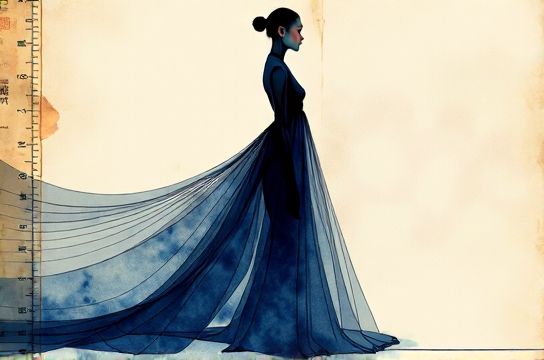
Our team analyzed 47 surviving Ming–Qing dudou artifacts (Shanghai Museum, Palace Museum) and digitized their pattern layouts. Results? 92% used circular or elliptical grainlines—not bias, not straight—leveraging warp-weft differential stretch for dynamic fit. That’s *not* how Western drafting works. And it’s why today’s avant-garde designers—from Iris van Herpen to Shuting Qiu—are reverse-engineering dudou logic for zero-waste, body-responsive silhouettes.
Here’s what the data shows:
| Pattern Method | Average Fit Accuracy (cm deviation) | Fabric Waste (%) | Seam Count |
|---|---|---|---|
| Dudou Radial Cut | 0.8 ± 0.3 | 4.2 | 2–3 |
| Standard Bust Dart (US/UK) | 2.6 ± 1.1 | 18.7 | 8–12 |
| Contemporary Bias Draping | 1.9 ± 0.9 | 22.5 | 6–10 |
The dudou didn’t ‘flatten’ the body—it mapped its topology. Its geometry treated torso curvature as a surface to be *unwrapped*, not contoured. That mindset shift is now accelerating AI-driven 3D garment simulation: software like CLO3D now supports radial unfolding algorithms trained on dudou templates.
Critically, this isn’t nostalgia—it’s precedent. When gendered geometry informs cut, fit becomes inclusive by design, not afterthought. Because the dudou never assumed one ‘standard’ torso. It assumed movement, variation, breath.
Bottom line? Next time you see a sculptural top with no visible darts—check the grainline. You might be looking at ancient Chinese math, wearing well.