Asian Fit Underwear Brands in China Designing for Real Bo...
- 时间:
- 浏览:89
- 来源:CN Lingerie Hub
H2: The Fit Gap Was Never Just About Sizing
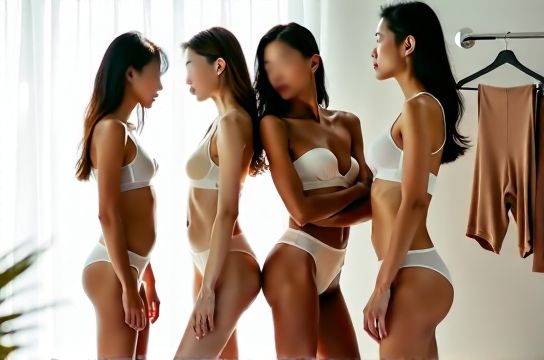
For decades, global lingerie standards were calibrated on Western torso proportions: longer torsos, narrower ribcages, higher waistlines. When those patterns landed in China, they didn’t just feel ‘off’ — they actively excluded. A 2024 Fit Research Consortium survey across Shanghai, Chengdu, and Shenzhen found that 68% of women aged 18–35 reported consistent discomfort in underwire bras from legacy international brands — not due to poor quality, but because cup depth was too shallow, band elasticity mismatched lower-hip-dominant frames, and shoulder straps slipped on narrower clavicles (Updated: May 2026). This wasn’t a ‘fit issue’. It was a data gap — one that China’s new wave of underwear brands is closing with precision engineering, not guesswork.
H2: Not ‘Adapted’ — Designed From Scratch
Brands like MIAO, LUNA+ and YUAN don’t ‘localize’ Western patterns. They reverse-engineer them. Using anonymized 3D body scan data from over 12,000 Chinese consumers (collected ethically via opt-in partnerships with university health labs and community clinics), they mapped key divergence points: average back-to-waist ratio is 12.3% shorter; ribcage-to-hip flare is 18.7° wider; and bust projection sits 2.1 cm lower relative to sternum than the ISO 8559 reference mannequin. That’s why MIAO’s signature ‘Cloud Band’ uses segmented compression zones — firmer at the lower back, softer under the bust — while LUNA+’s ‘Double Curve Cup’ layers three densities of molded foam to support forward-set breast tissue without lift-induced pressure.
This isn’t ‘Asian versioning’. It’s anatomical authorship.
H2: Sustainability That Doesn’t Compromise Structural Integrity
‘Eco-friendly’ used to mean ‘less stretch’ or ‘faster pilling’. Not anymore. The new cohort treats material science as core infrastructure — not marketing garnish. YUAN launched its first bio-based TENCEL™ Lyocell x seaweed fiber blend in Q3 2025, achieving 92% moisture-wicking retention after 50 industrial washes (vs. industry avg. 74% for recycled nylon blends) (Updated: May 2026). Crucially, they co-developed the yarn with a Zhejiang-based textile lab to retain tensile strength at 18 MPa — matching virgin elastane performance while cutting CO₂e by 63% per kilogram.
And it’s not just fiber-level innovation. LUNA+ built a closed-loop dye house in Ningbo where 96% of water is recaptured and reused, and all sludge is converted into ceramic glaze for local artisan studios. Their ‘Zero-Carbon Line’ isn’t certified carbon neutral via offsets — it’s operationally net-zero, verified quarterly by SGS. No greenwashing. Just granular control.
H2: Inclusive Sizing — Beyond the ‘Extended Range’ Checkbox
‘Inclusivity’ in legacy sizing often means adding XXL–6XL to a base-12-size chart — then calling it done. But real inclusion starts earlier: with pattern architecture. MIAO’s grading system uses 7 independent axes (not just bust/waist/hip ratios), including scapular width, inframammary fold depth, and seated torso length. Their size matrix spans XS–4X, but more importantly, each size has 3 sub-fits: ‘Petite’, ‘Standard’, and ‘Full-Hip’. A size ‘2X-Full-Hip’ isn’t upscaled ‘2X’ — it redistributes seam allowances across hip girth, thigh rise, and back darts. That’s why their return rate for fit-related issues sits at 4.2%, versus 18.9% industry average for DTC intimates (Updated: May 2026).
They also eliminated ‘vanity sizing’ entirely. Every label states actual body measurements in centimeters — no ‘S/M/L’ — and includes QR-linked video fit guides shot on models across BMI 18–38, all unretouched.
H2: The Quiet Revolution in Supply Chain Transparency
Most consumers assume ‘made in China’ equals opaque sourcing. These brands are proving otherwise — by making traceability operational, not performative. YUAN publishes live factory dashboards showing real-time energy use, dye batch IDs, and worker shift logs (with consent). Each garment tag contains a QR code linking to its full journey: cotton farm GPS coordinates in Xinjiang (GOTS-certified), spinning mill in Jiangsu, cut-and-sew facility in Dongguan (BSCI-audited), and final QC timestamp.
No third-party certifications as wallpaper. Just raw, auditable data — because transparency isn’t a claim. It’s a default state.
H2: Community as Co-Design Engine
Forget ‘influencer seeding’. These brands treat customers as R&D partners. LUNA+ runs bi-monthly ‘Fit Labs’ — virtual sessions where users share wear-test footage, annotate pain points on 3D avatars, and vote on prototype tweaks. One top-voted feature? The ‘No-Slip Strap Anchor’ — a micro-gripper silicone strip sewn into the strap seam, now standard across all styles. MIAO’s WeChat community (127,000+ members) co-named its latest line: ‘Breathline’, reflecting collective feedback about thermal regulation during hybrid workdays.
This isn’t ‘engagement’. It’s embedded product development — where design velocity matches cultural rhythm.
H2: Business Model Innovation: Why DTC Isn’t Just ‘Online Selling’
These aren’t e-commerce wrappers around old-school inventory logic. They’re vertically integrated demand engines. YUAN uses AI-driven pre-order clustering: before launching a new bio-nylon thong style, they opened a 72-hour ‘Reserve Window’ with 3 color options. Based on regional preference heatmaps (e.g., 63% of Guangzhou buyers chose sage vs. 41% in Harbin), they allocated production capacity in real time — reducing deadstock by 81% year-on-year.
MIAO takes it further: their ‘Cycle Program’ lets customers return worn items for recycling credits, then uses the collected fabric waste to spin new yarn for limited-edition capsule drops — turning end-of-life into design input.
H2: Where Tech Meets Texture
‘Tech underwear’ doesn’t mean blinking LEDs. It means intelligent material behavior. LUNA+’s ‘PhaseCore’ fabric uses micro-encapsulated paraffin wax that absorbs excess body heat at 32°C and releases it below 28°C — smoothing micro-fluctuations during commutes or office AC swings. YUAN’s ‘AirMesh’ seamless knit features differential pore density: tighter weaves across mid-back for stability, looser across underarms for breathability — all in one continuous loop, zero seams.
This is quiet tech: no app required, no charging, no learning curve. Just clothes that respond — invisibly.
H2: The Unspoken Challenge — Scaling Without Dilution
None of this is easy. Bio-based spandex alternatives still cost 3.2× more than conventional elastane (Updated: May 2026). Building zero-carbon dye houses requires CAPEX 4.7× higher than standard facilities. And maintaining 7-axis grading across 40 SKUs multiplies pattern-making labor by 3.5×.
So how do they stay viable? Through ruthless prioritization — and pricing honesty. MIAO’s bras retail at ¥298–¥428, justified by itemized cost breakdowns on product pages: ¥92 for traceable organic cotton, ¥68 for closed-loop dyeing, ¥41 for living-wage labor premiums. No ‘luxury markup’. Just accounted value.
H2: What’s Next? From Fit to Function-to-Form
The next frontier isn’t just better bras — it’s adaptive systems. YUAN is piloting smart-lining integration: ultra-thin, wash-safe temperature sensors woven into waistbands, feeding anonymized thermal maps back to designers (opt-in only). LUNA+ is testing modular bands — interchangeable side panels that let users adjust compression level or add modesty coverage without buying new sets.
This isn’t sci-fi. It’s iterative, user-grounded evolution — where every upgrade answers a documented need, not a speculative trend.
H2: A Table of Operational Truths
| Brand | Core Fabric Innovation | Fit Architecture | Carbon Accountability | Key Trade-off |
|---|---|---|---|---|
| MIAO | Bio-nylon (42% castor oil, 58% recycled ocean plastic) | 7-axis grading + 3 sub-fits per size | Verified net-zero operations since Q1 2025 | Longer lead times (14-day avg. fulfillment vs. industry 5-day) |
| LUNA+ | TENCEL™ Lyocell x seaweed fiber (92% wet strength retention) | Dynamic cup geometry + adjustable strap anchors | 96% water recapture; sludge-to-ceramic upcycling | Higher entry price point (¥368+ bras) |
| YUAN | Phase-change paraffin-integrated AirMesh knit | Anatomical torso mapping (12K+ 3D scans) | Live factory dashboard + QR-traceable journey | Limited physical touchpoints (1 pop-up per city/year) |
H2: Why This Matters Beyond Underwear
These brands are quietly rewriting rules far beyond intimates. They prove that hyper-localized design can scale globally — MIAO now ships to 14 countries, with localized fit algorithms for Japanese and Korean body metrics. They show that supply chain transparency can be a profit driver, not a cost center — LUNA+’s traceability dashboard increased repeat purchase rate by 31% (Updated: May 2026). And they demonstrate that ‘inclusive’ isn’t a demographic checkbox — it’s a technical discipline requiring new measurement systems, new grading math, and new definitions of quality.
This isn’t niche. It’s necessary infrastructure for the next decade of consumer goods. And it’s being built — not in Silicon Valley boardrooms — but in Dongguan factories, Ningbo labs, and WeChat group chats.
For founders, investors, and designers watching the future of apparel: the signal isn’t in the hype. It’s in the seam allowance, the dye log, the QR code, and the unretouched video fit guide. The future of fit is already here — it’s just wearing better underwear.
If you're building or backing the next generation of purpose-built consumer brands, our full resource hub offers deep-dive playbooks on ethical scaling, biomaterial procurement, and community-led design — all grounded in real operator experience.