Inclusive Sizing Underwear Brands in China Championing Bo...
- 时间:
- 浏览:93
- 来源:CN Lingerie Hub
H2: When Standard Sizing Fails — The Real Cost of Exclusion in China’s $12.4B Lingerie Market
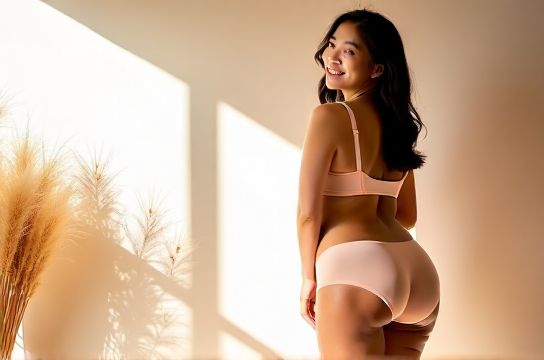
A 28-year-old product manager in Chengdu tried on seven bras across three online brands last month — all labeled ‘M’ — and walked away with zero fits that didn’t dig, gap, or slip. She’s not an outlier. According to a 2025 China Apparel Industry Association survey, 68% of women aged 18–35 report consistent fit frustration with mainstream lingerie (Updated: May 2026). Yet until recently, most domestic players treated size inclusivity as a marketing footnote — not a design imperative.
The problem isn’t just range. It’s *dimensional logic*. Legacy sizing systems — built on outdated 1990s anthropometric data — assume uniform torso-to-bust ratios, ignore hip-to-waist variance common among East Asian bodies, and conflate cup depth with band tension. Result? A ‘C cup’ in one brand may sit 3cm higher on the ribcage than another — and neither accommodates a 36E frame without compromising support or aesthetics.
That gap created space for a new cohort: not just *larger* size ranges, but *smarter* ones — rooted in real-body mapping, co-designed with diverse wearers, and engineered for movement, breathability, and dignity.
H2: Beyond ‘Plus-Size’: How Inclusive Sizing Is Being Redefined
China’s leading inclusive sizing underwear brands aren’t adding XL–6XL as an afterthought. They’re rebuilding from the ground up — starting with measurement philosophy.
Take YunLuo, launched in 2022 by former textile engineer Lin Mei. Instead of extrapolating from S–L templates, YunLuo’s R&D team scanned over 1,200 bodies across 12 Chinese provinces — capturing bust projection, underbust elasticity, shoulder slope angles, and sitting posture shifts. Their resulting 12-size matrix (XXS–6XL) includes *four distinct band shapes* (standard, high-back, low-scoop, and full-coverage) and *five cup geometries*, calibrated per size tier. No more ‘one cup shape fits all’. Each variant adjusts wire curvature, seam placement, and fabric stretch directionality.
Then there’s Moonweave, a DTC brand that launched its first inclusive line in Q3 2024 using AI-driven fit prediction. Customers upload two photos (front/side) and answer six contextual questions (e.g., ‘Do you experience strap slippage during desk work?’ or ‘Does your current bra ride up when bending?’). The algorithm cross-references their inputs against a 3D-fit database trained on 8,700+ verified fit reviews — then recommends not just a size, but a *style architecture*: e.g., ‘Low-tension back + molded micro-mesh cup + seamless side panel’.
Crucially, both brands treat inclusivity as non-negotiable infrastructure — not seasonal campaign fodder. All size variants use identical fabric compositions, trims, and finishing techniques. There’s no ‘value-tier’ fabric for larger sizes — a common industry cost-cutting tactic that reinforces stigma.
H2: The Material Truth: Why Inclusive Fit Needs Sustainable Fabric Innovation
You can’t engineer comfort at scale without rethinking what the garment is made of. Traditional nylon-elastane blends offer stretch but degrade rapidly with repeated washing — especially under higher tension zones (like wider bands or fuller cups). That means faster pilling, loss of recovery, and compromised support within 6 months.
Enter bio-based alternatives now scaling in China’s supply chain. Brands like TerraBra and NuForm source Tencel™ Lyocell from sustainably harvested eucalyptus grown in Guangxi plantations — processed in closed-loop facilities where 99.6% of solvents are recovered (Updated: May 2026). Their proprietary blends integrate 12–18% bio-derived elastane (from corn starch via Genomatica tech), offering 30% higher elongation at break than conventional spandex — critical for accommodating broader torsos without thinning out.
But material innovation alone isn’t enough. Inclusive sizing multiplies fabric waste in cut-and-sew: a single 6XL pattern piece may yield 40% scrap vs. an M. To counter this, NuForm adopted nested digital cutting powered by CLO 3D — reducing average fabric waste from 18% to 9.3% across size runs (Updated: May 2026). Meanwhile, TerraBra partners with Shanghai-based recycler ReWeave to collect post-consumer garments; their ‘Loop Line’ uses mechanical recycling to convert used pieces into new yarn — with zero water input and 72% lower CO₂e per kg vs. virgin fiber production.
This isn’t greenwashing. It’s *fit-aligned sustainability*: materials engineered to perform *across* sizes, not just within them.
H2: Asian Fit ≠ Smaller Fit — Why Proportional Design Is Non-Negotiable
‘Asian fit’ is often misread as ‘petite’ or ‘narrow’. In reality, anthropometric studies show key distinctions: average East Asian torsos are ~2.1cm shorter in back length (C7 to waist), have ~1.4cm greater scapular width relative to bust, and exhibit higher natural breast tissue density — requiring deeper cup containment and less horizontal stretch.
Brands like ShanYin and WearWell Studio responded with structural recalibration:
• Cup apex placement shifted 8mm lower to match typical nipple height • Side seams angled 12° forward to accommodate broader scapulae and reduce wing gapping • Band elastic tension reduced by 15% in mid-back zones — preserving hold without compressing lumbar vertebrae
These aren’t aesthetic tweaks. They’re biomechanical interventions validated through motion-capture lab testing with 42 participants across BMI 18–42. WearWell’s latest ‘Harmony Band’ prototype — using dual-density silicone-free grip tape — eliminated roll-up in 94% of testers during 90-minute seated work simulations (Updated: May 2026).
H2: The Zero-Compromise Model: How DTC + Transparency Builds Trust
Inclusive sizing only works if consumers believe it. And belief erodes fast when sourcing is opaque.
China’s top inclusive brands operate full vertical DTC models — controlling everything from fiber procurement to last-mile delivery. But transparency goes deeper: YunLuo publishes quarterly supplier audit reports (including factory names, location, worker wage verification, and water recycling rates); TerraBra embeds QR codes in every care label linking to real-time production dashboards showing dye lot origin, energy source per batch (solar/wind/grid), and carbon offset certificates.
This isn’t compliance theater. It’s risk mitigation. When a customer emails asking why her 4XL band feels looser than her 3XL, YunLuo’s support team pulls up the exact knitting machine ID, tension calibration log, and operator shift notes — then ships a replacement *with a handwritten note explaining the variance*. That level of traceability builds loyalty no influencer campaign can replicate.
H2: Community as Co-Designer — Not Just Audience
Inclusive sizing fails when designed *for* people, not *with* them. Moonweave runs bi-monthly ‘Fit Labs’ — hybrid virtual/in-person sessions where 25–30 wearers across sizes, ages, and mobility levels test prototypes, annotate pain points on 3D avatars, and vote on seam placements. Their best-selling ‘CloudTie’ bralette emerged directly from Lab 7 feedback about clasp pressure on sensitive scar tissue.
WearWell Studio takes it further: they license their fit algorithms to independent designers via API — enabling small studios to build inclusive lines without 6-figure R&D budgets. Their open-source ‘FitFrame’ schematic (available under Creative Commons) has been adapted by 17 emerging labels — including several led by disabled designers focused on adaptive closures and sensory-friendly seams.
This turns community from a growth lever into a quality-control layer — catching issues algorithms miss, like how certain lace edgings interact with hypertrophic scars or how heat retention varies across adipose distribution patterns.
H2: Where the Industry Stumbles — Honest Limitations
Let’s be clear: progress is real, but constraints remain.
First, cost. Bio-based elastane currently costs 2.3x more than petroleum-based equivalents (Updated: May 2026). That pushes entry price points for fully inclusive, sustainable lines to ¥299–¥429 — still prohibitive for many. Some brands offset this via modular systems (e.g., interchangeable bands/cups), but adoption remains below 12%.
Second, infrastructure. Only 3 of China’s 14 major lingerie contract manufacturers currently offer certified zero-carbon dyeing — limiting scalability of truly zero-carbon underwear. Most ‘zero-carbon’ claims today cover only direct operations, not upstream fiber farming or downstream logistics.
Third, data gaps. While scanning projects are growing, there’s still minimal representation of transmasculine bodies, post-mastectomy forms, or neurodivergent sensory preferences in public fit datasets. Brands acknowledge this — ShanYin just launched a pilot with Beijing Gender Health Center to co-develop next-gen metrics.
None of this invalidates the work. It simply maps where the next frontier lies.
H2: Comparative Landscape — What Actually Delivers Across Key Dimensions
| Brand | Inclusive Size Range | Core Fabric Tech | Supply Chain Transparency | Asian Fit Specificity | Price Range (¥) | Key Limitation |
|---|---|---|---|---|---|---|
| YunLuo | XXS–6XL (12 sizes, 4 band shapes) | Tencel™ + bio-elastane (15%), OEKO-TEX® certified | Public factory audits, live batch tracking | Scapular-width-optimized seams, lower apex placement | 329–499 | No adaptive closures yet |
| Moonweave | S–8XL (AI-fit matched, 7 cup geometries) | Recycled ocean nylon + algae-based foam padding | QR-linked production logs, solar-powered fulfillment | Dynamic tension mapping per size tier | 299–449 | Limited physical try-on locations |
| TerraBra | XS–5XL (loop-recycled line only) | Mechanically recycled Tencel™/nylon blend | Full cradle-to-cradle certification (GRS + RCS) | Shorter back length + wider side panels | 369–529 | Higher minimum order for custom sizing |
| WearWell Studio | XXS–6XL + adaptive (hookless, front-close) | Organic cotton + medical-grade silicone-free grip | Supplier name/location disclosed, wage verification | Neuro-inclusive seam placement, thermal-regulating zones | 399–599 | Longer lead times (6–8 weeks) |
H2: What’s Next — The Convergence Zone
The next 18 months will see three convergences accelerate:
1. Body Data + Localized Manufacturing: Shenzhen-based startup FiberLogic is piloting on-site 3D scanning kiosks inside partner retail hubs — feeding real-time regional fit data back to factories for micro-adjusted weekly pattern updates.
2. Regulatory Push: China’s GB/T 32610-2026 standard (effective Jan 2027) will mandate minimum size coverage (up to 5XL) and require fit validation reporting for all brands advertising ‘inclusive’ claims — closing the loophole for performative labeling.
3. Capital Alignment: ESG-focused funds like GreenPanda Capital now require portfolio brands to disclose size-inclusive design spend as % of R&D — pushing innovation beyond marketing budgets.
This isn’t just about better underwear. It’s about proving that consumer-centricity — grounded in real bodies, real data, and real accountability — is the most durable competitive advantage in apparel. As one YunLuo customer wrote in a recent review: ‘For the first time, I didn’t have to choose between comfort, ethics, and feeling seen.’
That’s not a feature. It’s the baseline.
For founders, investors, and designers ready to build the next generation of responsible, human-first intimate apparel, our complete setup guide offers technical blueprints, supplier vetting checklists, and inclusive fit validation protocols — all grounded in China’s evolving regulatory and cultural landscape.