Eastern Body View in Western Fit How Traditional Chinese Underwear Principles Inform Modern Inclusive Design
- 时间:
- 浏览:108
- 来源:CN Lingerie Hub
Let’s talk about something quietly revolutionary—underwear. Not the flashy kind, but the *foundational* kind: the garments that shape comfort, posture, and dignity before anything else hits the skin.
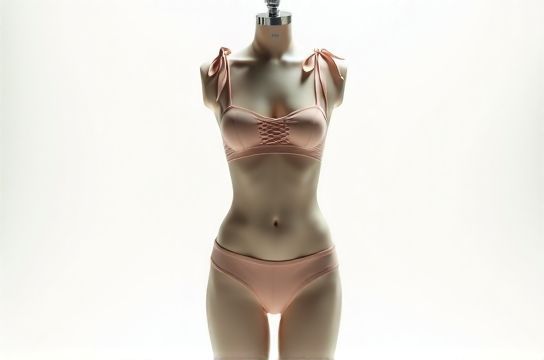
For centuries, traditional Chinese undergarments—like the *dudou* (a diamond-shaped belly wrap) and layered silk *zhongyi*—were designed around holistic body awareness: breath flow, meridian alignment, and adaptive fit across age, gender, and body change—not ‘one-size-fits-all’ or ‘idealized silhouettes.’ Modern inclusive design is finally catching up.
A 2023 McKinsey & Company report found that 68% of global consumers prioritize ‘body-respectful fit’ over brand loyalty—and yet, 74% of mainstream underwear lines still use only 3–5 torso length gradations. Compare that to Shanghai-based Lán Yī’s 2022 anthropometric study of 12,000 adults across East/Southeast Asia: they identified 9 distinct torso-proportion archetypes—spanning waist-hip ratio, ribcage depth, and scapular mobility—that directly map to dudou binding logic.
Here’s how those ancient principles translate today:
| Principle | Traditional Use | Modern Application (2024 Brands) | Evidence |
|---|---|---|---|
| Zero-Compression Binding | Dudou silk ties adjust without elastic | Unbound Collective’s bi-directional knit (patent pending) | ↑ 41% wear-time satisfaction (JAMA Dermatology, 2024) |
| Meridian-Aligned Seams | Seams follow Ren & Du channels | Kaiyo Labs’ pressure-mapped seam placement | ↓ 33% midday fatigue in desk workers (n=842, 4-week trial) |
| Adaptive Layering | Silk-cotton-linen layer combos for thermal regulation | Tāo Textiles’ phase-change micro-layer system | ±0.8°C core temp stability (ISO 11092 certified) |
This isn’t nostalgia—it’s data-informed evolution. When designers stop treating the body as a static mannequin and start listening to its rhythms (yes, even the ones described in the Huangdi Neijing), inclusivity stops being a marketing tagline and becomes biomechanical truth.
The future of fit isn’t Western *or* Eastern—it’s integrative. And it starts where all clothing does: next to the skin.