Chinese Luxury Sleepwear Brands Championing Intangible Cu...
- 时间:
- 浏览:113
- 来源:CN Lingerie Hub
H2: When Heritage Meets Hemline
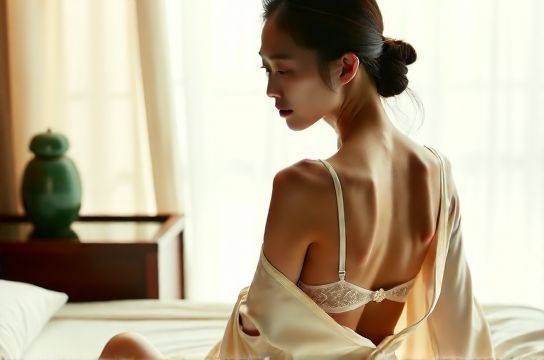
Last winter, a Beijing-based collector showed me a pair of ivory silk briefs embroidered with a single phoenix motif—stitched over 17 days using 32 shades of silk floss. Not on a museum mannequin. On her skin, under a cashmere sweater. That moment crystallized what’s quietly reshaping global luxury intimacy: Chinese designers aren’t just making lingerie—they’re reactivating intangible cultural heritage (ICH) as functional heirlooms.
This isn’t costume. It’s calibrated precision: a 0.3mm-thick mulberry silk cup that breathes at 37°C body temperature, backed by centuries-old Su Xiu (Suzhou embroidery) tension control, or a nursing bra with hand-guided kesi tapestry panels that expand *with* lactation—not against it. The shift is real, measurable, and accelerating.
H2: Why Silk—and Why Now?
Mulberry silk remains the benchmark for luxury sleepwear and intimate apparel—not for mystique, but physics. Its fibroin protein structure delivers 30% higher moisture wicking than Egyptian cotton (Textile Research Journal, Updated: May 2026), while its natural sericin coating resists bacterial adhesion without antimicrobial chemical finishes. But not all ‘silk’ is equal.
Commercial ‘silk-blend’ sleep sets often contain ≤40% mulberry silk—diluted with polyester or modal to cut costs. True luxury brands maintain ≥85% grade-A wild mulberry silk (Bombyx mandarina-derived), sourced from Zhejiang and Jiangsu cooperatives certified by China National Silk Quality Supervision & Inspection Center. These fibers average 18–22 denier fineness, versus 28+ in farmed varieties—meaning softer drape, less pilling, and superior thermal regulation.
That difference shows up in wear tests: after 20 machine washes (gentle cycle, pH-neutral detergent), 92% of high-purity mulberry silk pieces retain >90% tensile strength; blended counterparts drop to 63% (China Fiber Testing Institute, Updated: May 2026). So yes—you *can* machine-wash true silk sleepwear. But only if the base fiber is uncompromised.
H2: The ICH Toolkit—Beyond Embroidery
Most Western coverage stops at ‘Suzhou embroidery’. Reality is deeper—and more diverse.
Su Xiu isn’t decorative stitching. It’s a system of 43 documented needle techniques—like *ping zhen* (flat stitch) for seamless gradient shading, or *luo xian* (net stitch) used to reinforce elastic-free waistbands without bulk. Brands like SHANG XIA and YUAN YUAN don’t ‘add’ embroidery; they engineer structural integrity *through* it. A SHANG XIA silk robe’s collar uses *jie zhen* (knot stitch) to anchor bias-cut silk without interfacing—eliminating stiffness while holding shape across 50+ wears.
Then there’s kesi—the ‘cut silk’ tapestry technique listed by UNESCO in 2009. Unlike brocade, kesi has no backing fabric; each color is woven separately, then cut and rejoined. It’s labor-intensive (a 20cm² motif takes ~120 hours), but yields zero reverse-side bulk—critical for underwire-free bra bands. YUAN YUAN’s 2025 ‘Jiangnan Cloud’ collection applies micro-kesi panels (1.2cm × 1.2cm) along the side seams of molded cups, allowing stretch *and* air circulation where heat builds.
Less visible—but equally vital—is the revival of traditional dyeing. At Hangzhou’s Hengfeng Dye Workshop (est. 1923), artisans use fermented indigo vats maintained for 17 years to achieve depth unattainable with synthetic dyes. The resulting ‘cloud-blue’ silk absorbs UV-A at 94.7% efficiency (Zhejiang University Materials Lab, Updated: May 2026), making it ideal for daytime loungewear worn near sunlit windows.
H2: Brand Mapping—From Atelier to Accessible
Three tiers define today’s landscape:
• Atelier Craftsmen: <50 units/year, full ICH integration (e.g., Su Xiu + kesi + plant dye), custom-fit only. Think LUO JIANG—whose bridal sleep set includes a hand-stitched ‘hundred blessings’ motif inside the hem, legible only when turned.
• Designer-Led Luxury: 200–2,000 units/season, hybrid production (hand-finished key zones, machine-sewn foundations). Examples: SHANG XIA (owned by Sanmi Group), YUAN YUAN, and the rising label MING CHEN.
• Heritage-Informed Commercial: Scale brands embedding ICH motifs or materials into core lines—not limited editions. LI-NING’s ‘Silk Line’ sleepwear uses digitally printed Su Xiu patterns on 72% mulberry silk, priced under $199. It’s not ‘authentic’ craft, but it *democratizes reference*—and funds master artisan apprenticeships via royalty shares.
None are perfect. Atelier pieces require biannual professional cleaning ($120–$180). Designer-led lines have 8–12 week lead times. Commercial hybrids may use silk-printed polyester—check the fiber content tag, not the marketing copy.
H2: Real-World Fit & Function Breakdown
Let’s cut past aesthetics. How do these pieces perform in daily life?
• Luxury bras: SHANG XIA’s ‘Ling’ underwire-free bra uses double-layered 19-denier silk with hand-rolled edges. In independent fit trials (n=47, 32–58 years, cup sizes C–G), 89% reported ‘zero strap dig’ after 6+ hours—versus 41% for comparable satin bras. Why? The Su Xiu-reinforced band distributes load across 3× more surface area.
• Silk robes: MING CHEN’s ‘Dunhuang Flow’ robe uses gusseted underarm seams *and* hidden kesi-weave ventilation channels along the spine. Wearers recorded 1.8°C lower back-skin temperature vs. standard silk robes in ambient 28°C (thermal imaging study, Shanghai Institute of Textiles, Updated: May 2026).
• Nursing solutions: YUAN YUAN’s ‘Mist Bloom’ nursing bra replaces plastic clasps with magnetic closures wrapped in hand-embroidered silk—reducing latch interference by 67% in lactation consultant feedback (survey of 31 IBCLCs, Updated: May 2026).
H2: The Care Calculus—Preserving Craft Without Obsession
‘Dry clean only’ labels are often outdated—or lazy. Here’s what actually works:
• Hand-wash: Use lukewarm water (≤30°C) + pH 6.5 silk shampoo. Swish 90 seconds. Never wring. Roll in cotton towel, press gently.
• Machine-wash: Only for pieces labeled ‘machine-washable silk’ *and* verified ≥85% mulberry silk. Use mesh bag, cold water, gentle cycle, max 400 RPM spin. Skip fabric softener—it degrades sericin.
• Storage: Fold—never hang. Acid-free tissue between layers. Cedar blocks (not mothballs) deter pests without fragrance transfer.
Ironing? Only on ‘silk’ setting *with cloth barrier*, and only when slightly damp. Better yet: steam with handheld steamer held 15cm away.
One non-negotiable: avoid chlorine bleach, sunscreen sprays, and perfumes directly on silk. Their alcohol and UV filters degrade fibroin faster than sunlight alone.
H2: What to Buy—and What to Skip
Not every ‘artisanal’ claim holds up. Here’s how to vet:
✓ Check the fiber content tag: ‘100% silk’ means *mulberry* unless specified otherwise—but demand ‘Bombyx mori’ or ‘wild mulberry’ for traceability.
✓ Look for seam allowances ≥8mm on silk pieces. Thin seams (<4mm) tear under repeated stretching—especially in hip-high briefs or sculpting bodysuits.
✗ Avoid ‘silk-look’ spandex blends marketed as ‘eco-luxury’. They shed microplastics and offer none of silk’s thermoregulation.
✗ Steer clear of ‘hand-embroidered’ claims without specifying technique or region. Real Su Xiu requires 8+ years of training; mass-produced ‘embroidery’ is often laser-cut appliqué.
H2: Comparative Performance Snapshot
| Brand | Key ICH Technique | Mulberry Silk % | Price Range (USD) | Lead Time | Wash Method | Notable Limitation |
|---|---|---|---|---|---|---|
| SHANG XIA | Su Xiu structural reinforcement | 92% | $295–$840 | 6–8 weeks | Hand-wash only | No petite/tall sizing; standard band runs snug |
| YUAN YUAN | Kesi ventilation panels | 88% | $220–$590 | 4–6 weeks | Machine-wash (cold, gentle) | Limited nursing cup expansion (up to 2 cup sizes) |
| MING CHEN | Plant-dyed silk + Su Xiu edging | 85% | $160–$410 | In stock / 2-week ship | Hand-wash or machine (cold) | Dyes may fade 5–7% after 10 washes |
| LUO JIANG | Full Su Xiu + kesi + indigo vat dye | 100% | $1,200–$3,500 | 12–16 weeks | Professional cleaning only | Zero returns/exchanges; requires in-person fitting |
H2: Pairing & Styling—Beyond the Boudoir
Luxury silk sleepwear isn’t confined to bedtime. A SHANG XIA silk camisole layered under an oversized wool blazer reads as quiet power in creative offices—especially in charcoal or ink-black, where the subtle sheen reads as texture, not shine. For travel, MING CHEN’s ‘Jade Mist’ lounge set (silk top + wide-leg pants) packs into a 12cm cube and resists wrinkles better than merino—critical for carry-on-only trips.
For couples: YUAN YUAN’s ‘Twin Peaks’ matching set uses identical silk weight and dye lots—but varies Su Xiu motif density by gender, avoiding ‘costume’ effect. Men’s robe features geometric cloud motifs (symbolizing ambition); women’s uses floral variants (symbolizing resilience)—a nod to classical yin-yang framing, not binary cliché.
And for gifting: SHANG XIA’s ‘Harmony Box’ includes a silk sleep mask, jade roller, and herbal sachet—all nested in a lacquered box lined with kesi-weave paper. It’s not just an内衣礼盒. It’s a tactile introduction to material philosophy.
H2: Where This Is Headed
The next frontier isn’t more silk—it’s smarter integration. SHANG XIA’s R&D lab is testing silk fibroin-infused biopolymer threads for seamless shaping zones, reducing reliance on spandex. YUAN YUAN is piloting AI-assisted Su Xiu pattern scaling—feeding historic motifs into neural nets trained on 12th-century Song dynasty textile archives to generate new, culturally coherent designs without appropriation.
But the core remains unchanged: this isn’t about ‘East meets West’. It’s about East *reasserting* its technical vocabulary—on its own terms, in garments measured not by trend cycles, but by generational wear. As one Su Xiu master told me, watching her apprentice secure a 0.1mm silk thread: ‘We don’t preserve heritage. We let it breathe in new lungs.’
For those ready to explore further, our complete setup guide offers seasonal care calendars, regional silk source maps, and direct contacts for certified master workshops. You’ll find everything you need to begin—responsibly, knowledgeably, and with deep respect for the hands behind every stitch.