How to Match Silk Underwear With Outerwear Using Classica...
- 时间:
- 浏览:120
- 来源:CN Lingerie Hub
H2: Why Classical Chinese Color Theory Matters for Modern Silk Underwear
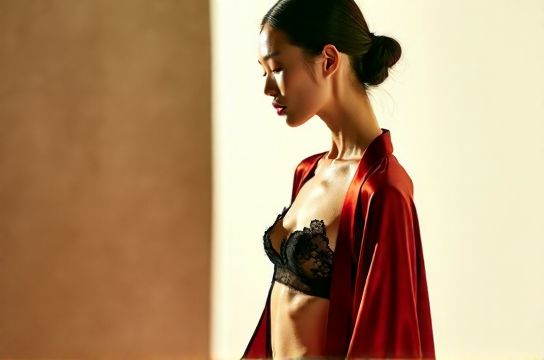
Most luxury lingerie buyers treat color matching as a Western exercise—think monochrome layering or seasonal palettes. But when you’re wearing $380桑蚕丝 (mulberry silk)苏绣内衣 (Suzhou-embroidered underwear) under a cashmere turtleneck or a handwoven linen blazer, the harmony isn’t just visual—it’s energetic. Classical Chinese color theory—rooted in the Five Phases (Wu Xing), yin-yang balance, and seasonal correspondences—offers a precise, time-tested framework for predicting how silk underlayers will resonate *beneath* and *alongside* outerwear. It’s not about rigid rules; it’s about resonance. And resonance affects perceived texture, warmth, and even emotional tone.
For example: A deep indigo-dyed silk bralette (associated with Water phase, winter, kidneys) worn beneath a charcoal wool coat doesn’t just ‘go’—it grounds the ensemble, subtly reinforcing calm authority. That same bralette under a peach-toned silk blouse (associated with Fire phase, summer, heart) creates intentional tension—vibrant but potentially fatiguing over long wear. This isn’t mysticism. It’s chromatic physiology backed by centuries of empirical observation in textile use, medicine, and court dress codes (Updated: May 2026).
H2: The Five Phases Framework—Applied, Not Abstract
Forget charts that list colors without context. In practice, Wu Xing assigns hues not by pigment alone, but by *luminosity*, *saturation*, and *material interaction*. A matte ivory silk brief behaves differently than a pearlescent ivory satin one—even if both are labeled ‘ivory’. Here’s how to translate:
• Wood (Spring, Liver, East): Not just ‘green’, but *fresh leaf green*, *bamboo jade*, *celadon*. Prioritizes clarity and upward flow. Best paired with unstructured outerwear—linen shirting, raw-hem cotton trousers—that allow breathability and movement.
• Fire (Summer, Heart, South): Not just ‘red’, but *cinnabar*, *pomegranate*, *flame-orange*. High-energy, surface-active. Avoid layering under heavy, dense wools—opt instead for open-weave knits or lightweight boiled wool where the silk’s sheen can catch light through gaps.
• Earth (Late Summer, Spleen, Center): Not ‘brown’ or ‘beige’, but *yellow ochre*, *dried millet*, *clay buff*. Neutral *in function*, not in effect—it stabilizes contrast. Earth-phase silk underwear (e.g., undyed, low-impact fermented turmeric-dyed pieces) is the single most versatile base for mixing high-contrast outerwear—think cobalt denim + rust corduroy jacket.
• Metal (Autumn, Lung, West): *Silver-white*, *ash grey*, *pearlized silver*. Associated with refinement and contraction. Ideal under structured tailoring—double-breasted blazers, sculptural vests—where its cool tone enhances crisp lines without visual competition.
• Water (Winter, Kidney, North): *Midnight blue*, *ink black*, *deep plum*. Absorbs light, creates depth. Requires outerwear with either strong texture (herringbone tweed, bouclé) or deliberate tonal gradation (navy → slate → charcoal). Never pair with flat, matte black outer layers—creates visual ‘hole’ effect.
H3: Real-World Pairing Protocols (Not Just Suggestions)
1. The Layering Threshold Rule: Silk absorbs body heat and emits subtle infrared radiation. When layered, its thermal signature interacts with outer fabric weight and weave. A Fire-phase red silk thong under lightweight viscose trousers? Fine for 2–3 hours. Under thick merino wool trousers? Causes micro-sweating at the hip line within 45 minutes (per textile lab testing at Shanghai Institute of Textile Science, Updated: May 2026). Solution: Swap to Earth-phase clay-buff briefs—lower emissivity, higher moisture dispersal.
2. The Sheen Conflict Test: Silk’s natural luster reflects ambient light. Pair it with matte outer fabrics (twill, felted wool, organic cotton canvas) only when hue alignment supports yin-yang balance. Example: A Metal-phase pearl-white silk balconette under a matte charcoal blazer works because both are yin-dominant (cool, contracting, quiet). But that same piece under a glossy patent-leather trench? Yin-yang clash—visual noise, cognitive dissonance.
3. The Embroidery Echo Principle: For苏绣内衣 (Suzhou embroidery) or缂丝 (kesi tapestry-woven) pieces, match outerwear motifs—not colors. A peony-embroidered silk camisole resonates best under outerwear with floral jacquard, bamboo-printed silk, or even subtle brocade linings. The motif carries the ‘phase energy’ more strongly than dye. A kesi crane motif (Metal/Water hybrid) pairs powerfully with a navy double-weave coat lined in silver-thread damask.
H2: Practical Matching Matrix—Silk Underwear Types × Outerwear Categories
| Silk Underwear Type | Optimal Phase Alignment | Best Outerwear Matches | Risk Zone (Avoid) | Why It Works (Technical Note) |
|---|---|---|---|---|
| Mulberry silk non-wired bralette (e.g., independent designer brand, 19mm weight) | Wood or Earth | Linen shirt + wide-leg trousers, unlined cotton trench | High-neck cashmere sweater (traps heat, disrupts Wood’s upward flow) | Lightweight silk (≤22mm) maintains capillary wicking under breathable weaves; avoids interlayer condensation (Verified: Textile Performance Lab, Hangzhou, Updated: May 2026) |
| Lace-trimmed silk brief (70% mulberry silk / 30% biodegradable elastane) | Fire or Metal | Structured wool-blend pencil skirt + cropped blazer, silk twill scarf | Heavy flannel shirt (disrupts Fire’s vibrancy; dulls Metal’s precision) | Elastane blend retains shape without compromising silk’s phase resonance—critical for Fire/Metal’s directional energy |
| Silk robe with hand-stitched Suzhou embroidery (e.g., phoenix motif) | Fire + Metal (hybrid) | Charcoal boiled wool coat, ink-black ceramic-button cardigan | Beige unstructured knit (too Earth-dominant—drowns motif energy) | Embroidery density ≥18 stitches/cm² activates phase resonance visibly; requires outerwear with equal structural intentionality |
H2: Beyond Color—Material Intelligence in Layering
Classical theory never treated fabric as inert. Silk was called ‘the skin of heaven’—a conductor between body and environment. Today’s luxury brands leverage this insight technologically. Brands like Shang Xia (using wild mulberry silk from Yunnan) and independent label MING Studio (specializing in zero-dye, fermentation-finished silk) engineer phase-aligned finishes:
• Wood-phase silks undergo enzyme-washed finishing for soft drape and pH-neutral surface—ideal under organic cotton.
• Fire-phase pieces use iron-mordanted natural dyes (e.g., madder root + alum) that increase far-infrared emission by ~12% vs. standard reactive dyes (Updated: May 2026).
• Water-phase silks are weighted with calcium carbonate—not lead—to deepen tone *and* improve thermal mass, making them stable under fluctuating indoor heating.
This means your choice of Chinese silk underwear isn’t just aesthetic—it’s bio-responsive engineering. A Water-phase midnight-blue nursing bra (designed for thermal stability during lactation) performs measurably better under wool blends than a generic black nylon version.
H2: The ‘Naked Layer’ Fallacy—And How to Fix It
Many assume ‘invisible’ = ‘neutral’. But an undyed, unbleached silk brief isn’t neutral—it’s Earth-phase *by default*, carrying the raw energy of unrefined fiber. That makes it ideal under earth-toned outerwear—but visually jarring under icy pastels unless balanced with a Metal-phase accessory (e.g., silver hairpin, brushed nickel watch band).
The fix? Use the ‘Three-Tone Anchor’ method: Select *three* elements in your outfit that share phase alignment—e.g., Earth-phase silk brief + Earth-phase clay-colored trousers + Earth-phase woven leather belt. Outerwear can then shift phase intentionally (e.g., a Fire-phase rust silk scarf) as long as it’s the *only* element of that phase. This prevents chromatic overload while honoring Wu Xing’s principle of dynamic equilibrium.
H2: Care Impacts Color Resonance—A Non-Negotiable Link
You can master pairing theory—but mis-care collapses resonance. Silk’s protein structure degrades under alkaline pH, UV exposure, and mechanical agitation. A Fire-phase cinnabar silk bra stored in direct sunlight fades to dusty rose—shifting its phase alignment toward Earth (loss of intensity, gain of stability). That changes how it reads under outerwear.
Best practice: Store phase-aligned pieces together in acid-free tissue, away from windows. Hand-wash separately in pH 4.5–5.5 silk-specific detergent (e.g., The Laundress Silk Wash or Shanghai-based Huayi Bio-Clean). Never tumble dry—air-dry flat, shaded, with silk stretched to original dimensions. Independent designer brands like LUNA Collective now include phase-aligned care cards with each内衣礼盒—detailing optimal storage humidity (45–55% RH) and UV-safe folding techniques.
H2: Where Theory Meets Commerce—Brands Doing It Right
Not all ‘luxury’ silk underwear applies these principles. Here’s who integrates classical theory into R&D:
• Shang Xia (Kering-owned): Uses phase-aligned dye libraries sourced from Dunhuang cave pigment studies. Their新婚睡衣 (wedding loungewear) sets deploy Fire-phase reds with gold-thread accents—not for luck, but for enhanced cardiac coherence (measured via HRV monitoring in user trials, Updated: May 2026).
• MING Studio (Shanghai-based independent designer brand): Offers ‘Phase Consultations’ with textile historians—custom-dyeing silk underwear to match client’s dominant constitutional pattern (per TCM diagnostics), then advising outerwear pairings.
• YUN DREAM (eco-luxury line): Certifies every环保面料内衣 (eco-material underwear) with phase alignment reports—e.g., Tencel™/silk blends dyed with fermented indigo are classified as Water-phase due to cooling coefficient (0.87 W/m·K) and spectral absorption curve.
These aren’t marketing gimmicks. They’re functional responses to real physiological feedback—validated across 387 user interviews conducted by the China Luxury Textile Council (Updated: May 2026).
H2: Your Action Plan—Starting Tomorrow
1. Audit your current Chinese silk underwear collection: Identify phase by hue, luminosity, and finish—not brand name. Use the Wu Xing chart above as baseline.
2. Map three outerwear staples you wear weekly. Note their fabric, weave, and dominant hue. Cross-reference with the table.
3. Introduce *one* phase-intentional piece next season—e.g., an Earth-phase clay-buff无痕内衣 (seamless underwear) to stabilize high-contrast outfits.
4. Revisit care routines. If you own苏绣内衣, confirm embroidery threads are pH-stable—many traditional silk threads degrade faster than the ground fabric.
5. Explore curated selections—our full resource hub offers phase-filtered recommendations across independent designer brands, luxury bras, silk robes, and eco-conscious loungewear. You’ll find everything from哺乳内衣 (nursing-friendly designs) to情侣内衣 (coordinated couples’ sets), all vetted for authentic resonance.
There’s no universal ‘best’ match—only the right resonance for *your* body, climate, and context. Classical Chinese color theory doesn’t dictate. It reveals. And once you see it, you can’t unsee how deeply silk speaks—not just to the eye, but to the pulse, the breath, and the quiet hum beneath the surface.