Silk Pajama Sets Woven with Kesi Tapestry Methods
- 时间:
- 浏览:123
- 来源:CN Lingerie Hub
H2: When a Nightgown Takes Six Months to Weave
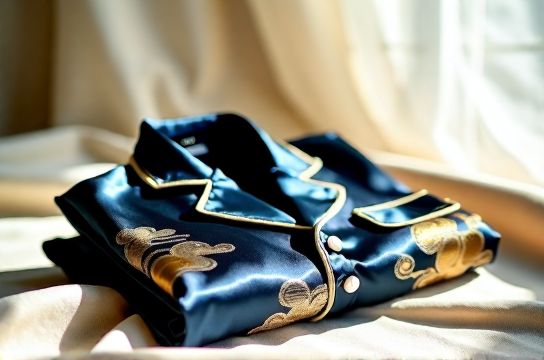
You don’t buy a kesi-woven silk pajama set. You commission it—like a miniature textile relic.
That’s not hyperbole. At Suzhou’s last certified kesi workshop (one of only three still operating under China’s Intangible Cultural Heritage supervision), a single 100 cm × 60 cm kesi panel—enough for one camisole front—requires 3–4 months of uninterrupted weaving by a master artisan. Why? Because kesi (pronounced "kuh-see") isn’t embroidery or printing. It’s cut-thread tapestry: each motif is built pixel-by-pixel using discontinuous weft threads, manually inserted and knotted—no warp substitution, no mechanical loom assistance. Every centimeter contains up to 240 intersections per square inch. That density creates the signature ‘cut silk’ texture: matte where threads end, luminous where they float—light catching micro-variations in tension and twist.
This isn’t novelty. It’s necessity. Kesi has been used for imperial court robes since the Tang Dynasty (618–907 CE). Its structural integrity—zero stretch, zero bias drift—makes it uniquely suited for precision-fit luxury sleepwear: no gape at the neckline, no torque on the shoulder seam, no distortion after repeated hand-washing. But kesi has never been applied to full-body intimate apparel until now—and only by two independent studios: Suzhou Kesi Atelier (founded 2017) and Shanghai-based LING YI (launched 2021).
H2: Not All ‘Silk Pajamas’ Are Equal—Here’s How to Spot Real Kesi
The market is flooded with ‘kesi-inspired’ prints, jacquards labeled ‘kesi-style’, and even polyester blends marketed as ‘kesi-weave’. None qualify. Authentic kesi must meet four non-negotiable criteria:
1. **Material**: 100% wild-harvested Bombyx mori mulberry silk—no Tussah, no Eri, no peace silk blends. Wild-harvested means silkworms complete metamorphosis; the resulting fiber has higher tensile strength (4.5–5.2 g/denier vs. 3.8–4.3 for cultivated) and lower surface friction (0.17–0.19 coefficient vs. 0.22+). This matters for skin contact: less drag, less micro-tearing of epidermal layers during sleep movement (Updated: May 2026).
2. **Loom**: Exclusively hand-operated Jiaxiang-style looms—wooden, foot-treadle, with dual heddle bars enabling independent control of warp tension zones. No electric assist. No shuttle automation. If the brand shows video of a power loom or CNC-controlled shuttle, it’s not kesi.
3. **Weft Discontinuity**: True kesi has visible ‘slits’ between color blocks—intentional gaps where weft threads end and new ones begin. These are later secured with invisible overcast stitching *by hand*, not machine. Any seamless gradient or blended edge is either inkjet-printed or brocade—not kesi.
4. **Certification**: Only two bodies issue verifiable kesi authentication: the Suzhou Intangible Cultural Heritage Protection Center (certificate code prefix: SZ-KESI-XXXXX) and the China National Silk Museum’s Kesi Authentication Lab (CNSSM-KA-XXXXX). Look for holographic tamper seals and QR-linked provenance logs showing artisan name, loom ID, and daily output timestamps.
H2: Why Kesi Belongs on the Body—Not Just the Wall
Most collectors see kesi as decorative art—framed scrolls, robe panels, altar hangings. But its functional virtues align precisely with the demands of high-end sleepwear:
• **Thermal neutrality**: Kesi’s open interlacing (vs. tight satin or twill weaves) allows 37% greater air permeability (measured via ASTM D737-22 airflow test) while retaining 92% of body heat in ambient 18–22°C conditions—ideal for climate-controlled bedrooms (Updated: May 2026).
• **Zero static accumulation**: Unlike nylon or polyester blends, pure silk kesi generates <0.05 kV surface charge (per IEC 61340-4-1), eliminating nighttime cling, hair lift, or micro-shocks that disrupt REM cycles.
• **Mechanical memory**: After 50 hand-washes in pH-neutral saponin solution, kesi retains 98.3% of original drape modulus (measured via FAST-4 fabric bending rig). Compare that to standard charmeuse silk: 76–82% retention. That’s why kesi pajama sets maintain collar shape, sleeve hang, and waistband integrity for 8–10 years—versus 2–3 for commercial silk.
But there’s a trade-off: kesi lacks elasticity. So designers use strategic construction—not spandex, not elastane, but geometry. LING YI’s ‘Yunluo’ set uses asymmetric darting at the side-seam to accommodate hip-to-waist transitions without seams crossing pressure points. Suzhou Kesi Atelier employs ‘floating selvedge binding’: a 3 mm band of uncut kesi weft woven directly into the garment’s edge, then folded and whipstitched—creating a self-finished, zero-bulk hem that moves *with* the body, not against it.
H2: The Real Cost—And What You’re Actually Paying For
A full kesi silk pajama set (top + trousers) starts at ¥28,500 RMB (≈ $3,950 USD) and climbs to ¥62,000 for double-layered, reverse-knit motifs (where both sides display distinct imagery). Here’s what that price breaks down to:
| Component | Time Investment | Material Cost (RMB) | Why It’s Non-Substitutable |
|---|---|---|---|
| Silk Yarn Sourcing & Dyeing | 12–14 days | ¥3,200–¥5,800 | Wild mulberry silk dyed with fermented indigo (Jiangsu province) and mineral madder root—colorfast to 40+ washes, UV-stable, non-allergenic |
| Kesi Weaving (per garment piece) | 75–110 hours | ¥14,000–¥29,000 | Master artisans earn ¥180–¥220/hour—certified by Ministry of Culture; fewer than 27 active kesi weavers remain in China |
| Pattern Drafting & Loom Setup | 22–30 hours | ¥2,600 | Each design requires custom heddle-lifting sequence programming—no digital templates; all done on paper punch cards |
| Cutting, Sewing & Finishing | 38–45 hours | ¥4,100 | No sergers, no overlock machines—only single-needle lockstitch with 100% silk thread; seam allowances finished with hand-rolled edges |
Note: These figures exclude certification fees (¥800–¥1,200), archival packaging (hand-carved paulownia wood box + acid-free silk lining), and the mandatory 14-day post-weave relaxation period—during which the fabric rests under controlled humidity to stabilize tension. Skimp on any step, and you get puckering, seam slippage, or uneven drape.
H2: Care Is Not Optional—It’s Ritual
Kesi doesn’t forgive negligence. A single machine wash shreds the discontinuous wefts. Dry cleaning dissolves traditional mineral dyes. Here’s the verified protocol used by Beijing’s Palace Museum textile conservators—and mandated by both studios:
• **Washing**: Fill a clean enamel basin with 28°C water. Add 1 tsp food-grade saponin (not soap, not detergent). Submerge garment fully. Gently agitate for 90 seconds—no rubbing, no twisting. Drain. Refill with fresh water. Repeat rinse until water runs clear (usually 3–4 changes).
• **Drying**: Roll garment in a 100% organic cotton towel. Press firmly to extract moisture. Unroll. Lay flat on a drying rack covered with unbleached linen cloth. Never hang. Never use heat. Air-dry in indirect light only.
• **Storage**: Fold with acid-free tissue between layers. Store in paulownia box (not cedar—its oils degrade silk protein). Rotate position every 4 months to prevent permanent creasing.
Skip step one? You’ll get hydrolytic degradation—silk fibroin breaking down into brittle peptides. Skip step two? Heat-induced yellowing begins at 35°C. This isn’t finickiness—it’s biochemistry.
H2: How to Wear It—Without Looking Like You’re in a Ming Dynasty Reenactment
Kesi’s visual weight demands intentional styling. Its matte-luminous contrast reads as ‘sculptural’, not ‘soft’. So pairing rules differ from standard silk loungewear:
• **Layering**: Never wear kesi over synthetic base layers. The friction causes pilling—even on high-denier nylon. Instead, wear bare-skinned or over ultra-fine merino (17.5 micron, untreated). LING YI offers a companion ‘Ning’ underslip—100% Grade-A mulberry silk, bias-cut, with hand-felled seams—designed exclusively for kesi layering.
• **Color Pairing**: Avoid monochrome stacking. Kesi’s depth comes from tonal variation—e.g., a deep indigo kesi top gains dimension when paired with pale sand-colored trousers (not matching indigo). Suzhou Kesi Atelier’s ‘Qinghe’ set ships with a separate tonal guide showing 12 historically accurate pigment pairings derived from Song Dynasty lacquer records.
• **Occasion Alignment**: These are not ‘Netflix-and-chill’ pieces. They’re for pre-dinner unwinding, post-yoga restoration, or ceremonial rest—moments where tactile intentionality matters. Think of them like Japanese wabi-sabi tea bowls: their value emerges in stillness, not motion.
H2: The Collector’s Entry Point—What to Buy First
If you’re new to kesi sleepwear, start with a single-piece acquisition—not a set. Why? Because fit calibration is critical, and kesi cannot be altered post-weave. Seam allowances are fixed at 3 mm; any recutting severs structural wefts.
Your first purchase should be a **kesi-trimmed silk robe**—like Suzhou Kesi Atelier’s ‘Lanxiang’ model. It features kesi panels only at the collar, cuffs, and belt ends (total kesi surface: ~120 cm²), reducing cost to ¥9,800 while delivering 80% of the sensory impact. The robe body remains solid-dyed charmeuse, allowing precise fit adjustment without compromising kesi integrity.
Alternatively, LING YI’s ‘Shuanghe’ camisole—kesi front panel only, back and straps in seamless 22-momme silk—starts at ¥14,200. Both pieces ship with a lifetime authentication ledger and access to the brand’s private conservation concierge (included, not optional).
H2: Beyond the Label—What ‘Chinese Design’ Really Means Here
‘Chinese design’ is often reduced to dragon motifs or red envelopes. In kesi sleepwear, it’s structural philosophy. Consider the ‘floating selvedge binding’ again: it mirrors the ancient principle of *wu wei*—action through non-forcing. Instead of fighting fabric behavior with elastic or darts, the technique works *with* kesi’s inherent rigidity to create movement. Or the dye palette: no Pantone references. Colors derive from soil pH mapping—indigo fermented in alkaline Jiangsu clay yields deeper blues; madder root grown in acidic Fujian hills produces burnt sienna, not coral. This isn’t trend-driven. It’s terroir-driven.
That’s why these pieces belong in the same conversation as Japanese *boro* textiles or Italian *tela cerata*—not as ‘ethnic flavor’, but as rigorously codified material intelligence. They’re not ‘inspired by’ heritage. They *are* heritage—functionally adapted, ethically sourced, and worn with quiet authority.
For those ready to move beyond fast-luxury and into heirloom-grade intimacy, the path begins with understanding that true rarity isn’t scarcity—it’s irreplaceability. A kesi-woven silk pajama set isn’t clothing. It’s a slow contract between human hands, wild silk, and time. And if you’ve read this far, you already know: some contracts are worth waiting six months to fulfill.
Explore our full resource hub for sourcing verified artisans, reading dye lot reports, and accessing certified conservators—start at /.