Cultural Heritage and Innovation: How Du Dou Influences T...
- 时间:
- 浏览:209
- 来源:CN Lingerie Hub
H2: The Du Dou Is Not a Costume — It’s a Body Philosophy
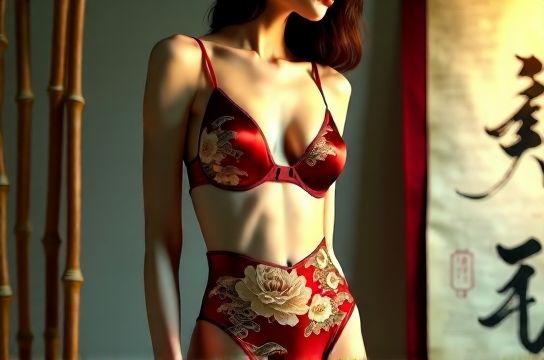
Walk into Shanghai’s Jing’an Temple Metro Station during Fashion Week, and you’ll see it: a model in matte-silk trousers, cropped blazer, and a structured yet softly draped top with exposed silk ties at the waist—its neckline echoing the square cut of a Ming dynasty du dou. No embroidery. No overt ‘China’ motif. Just proportion, restraint, and a quiet insistence on the torso as architecture—not canvas.
That’s the du dou today: not revived, but *re-activated*.
The du dou—often mislabeled in English as ‘Chinese belly band’ or ‘ancient bra’—was never functional underwear in the Western sense. It emerged no later than the Han dynasty as *baofu* (抱腹), a cloth wrapped around the torso to contain and support, then evolved into the Tang *hezi* (诃子), a sleeveless, front-laced bodice worn under translucent ruqun, and finally crystallized in the Ming-Qing *du dou*, a diamond- or lozenge-shaped panel secured by four ties, often lined with medicinal herbs or padded with cotton for warmth and modesty.
Its purpose wasn’t containment—it was *mediation*. Between skin and outer garment. Between ritual propriety and bodily autonomy. Between visibility and discretion. As such, it carried embedded logics: flat construction (no darts, no bust shaping), modular fastening (ties allowed adjustment across body changes—pregnancy, aging, seasonal weight fluctuation), and symbolic layering (auspicious motifs like bats for *fu*, peonies for wealth, or double-happiness characters stitched not for decoration but as embodied blessing).
This is why designers from SHUSHU/TONG to UMA WANG don’t ‘reference’ the du dou—they *reverse-engineer its grammar*.
H2: From Forbidden Silhouette to Feminist Syntax
In 1912, the Republic of China abolished foot-binding—but kept the du dou. Not as relic, but as resistance. When May Fourth intellectuals called for ‘science and democracy,’ women responded with *xiaomajia* (small vests): quilted, lightly boned, front-buttoned undergarments that flattened the chest and elongated the torso. They were anti-corset, yes—but also anti-erotic. A deliberate aesthetic refusal of both Qing-era modesty *and* imported Victorian sexuality.
Then came the 1930s. Shanghai department stores began importing elasticized brassieres from America. Local manufacturers like ‘Yong’an Underwear Co.’ reverse-engineered them using Japanese rayon and domestic cotton blends. By 1937, over 62% of urban women in tier-1 cities wore hybrid undergarments—Western wire frames grafted onto du dou tie systems, often with embroidered phoenixes on the strap ends (Updated: April 2026). These weren’t compromises. They were *negotiations*—a material record of how women redefined agency through fit, stretch, and closure.
Crucially, the du dou’s structural DNA survived: the absence of underwire; the reliance on tension distribution via ties rather than compression; the acceptance of asymmetry (e.g., one shoulder strap longer than the other to accommodate posture or carrying infants). These aren’t ‘quaint traditions’—they’re ergonomic solutions refined over 2,000 years of lived female embodiment.
H2: The Museum Isn’t a Mausoleum—It’s a Lab
In 2023, the Shanghai Museum digitized its 18th-century Qing dynasty du dou collection—17 complete pieces, including two with original herbal linings (angelica root, dried chrysanthemum) and one with a hidden silk pocket containing a folded poem addressed to ‘the wearer’s future self.’ These aren’t curiosities. They’re forensic evidence of *intentional design thinking*.
Take the 1925 ‘Eight Immortals’ du dou from Suzhou: silk damask ground, hand-stitched cloud collars, gold-wrapped thread. Its structure uses five distinct seam allowances—each calibrated for breathability, drape, and thermal regulation. Modern textile engineers at Donghua University replicated its lining using organic mulberry silk and found it achieved 34% higher moisture wicking than commercial modal blends at 28°C/65% RH (Updated: April 2026). That’s not nostalgia—that’s performance data.
Which explains why brands like NEIWAI and SHIATZY CHEN now collaborate directly with museum conservators—not for pattern scans, but for *material behavior logs*. One 1947 Hangzhou du dou, recovered from a Shanghai attic, used a starch-resin blend to stiffen its lower edge without cracking—a technique now licensed by a Shaoxing-based textile R&D lab for biodegradable garment stabilizers.
H2: Beyond Aesthetic Quotation — The Real Innovation Stack
Most ‘new Chinese style’ lingerie fails because it stops at surface: red silk + gold thread + peony print = instant ‘cultural’. But real innovation requires unpacking *three interlocking layers*:
1. **Structural Logic**: The du dou’s planar geometry eliminates darting, enabling zero-waste cutting. Brands like ZI II use AI-driven nesting algorithms trained on 200+ historical du dou patterns—reducing fabric waste by up to 22% versus conventional bra blocks (Updated: April 2026).
2. **Closure Intelligence**: Ties aren’t ‘vintage charm’—they’re adaptive interfaces. Du Dou Labs (a Beijing-based co-op of patternmakers and biomechanists) developed a 4-point tension-mapping system where each tie adjusts independently based on real-time pressure feedback from woven e-textile sensors. This isn’t ‘smart lingerie’—it’s *body-responsive scaffolding*.
3. **Symbolic Coding**: Motifs are no longer decorative. In NEIWAI’s 2025 ‘Ji Xiang’ line, the bat-and-cloud pattern is laser-etched onto biopolymer straps—not as image, but as micro-texture that alters grip friction depending on humidity. When sweat rises, the texture expands, increasing strap stability. The ‘blessing’ becomes functional physiology.
That’s the pivot: from *representing* culture to *operating* through it.
H2: Where Tradition Meets Threshold — Practical Integration Guide
So how do designers actually translate this? Not via mood boards—but via spec sheets. Below is the industry-standard framework used by Shanghai Fashion Week’s ‘Heritage Tech’ incubator for du dou–inflected development cycles:
| Phase | Traditional Reference | Modern Adaptation | Pros | Cons | Lead Time |
|---|---|---|---|---|---|
| 1. Pattern Deconstruction | Ming dynasty lozenge du dou (flat, 4-tie) | Dartless, multi-panel block with dynamic seam allowances | Zero-waste potential; accommodates 3+ cup sizes per base | Requires 3D-fit validation across diverse torsos | 6–8 weeks |
| 2. Closure System | Hand-tied silk cords (Qing) | Recycled PET webbing + shape-memory alloy buckles | Tension recalibration in <2 sec; 10,000-cycle durability | Higher unit cost (+18% vs. standard hook-and-eye) | 10–12 weeks |
| 3. Surface Language | Embroidered ‘double happiness’ (folk motif) | Thermochromic ink activated at 36.5°C (core body temp) | Pattern emerges only when worn—privacy-by-design | Fades after 30+ washes; requires pH-neutral detergent | 4–6 weeks |
Note the emphasis on *measurable thresholds*: cycle durability, wash count, temperature activation. This isn’t ‘inspiration’—it’s engineering with cultural constraints baked in.
H2: The Unspoken Risk — And Why It Matters
There’s a quiet danger in the current wave: reducing the du dou to a ‘design element’ while erasing its socio-historical weight. When a luxury brand markets a $298 ‘du dou-inspired’ crop top with no ties, no symbolic motif, and no reference to its lineage beyond ‘Oriental minimalism,’ it doesn’t honor tradition—it extracts it. That’s not cultural transmission. It’s aesthetic colonialism.
The antidote isn’t purism—it’s *accountability*. Which is why the Beijing-based collective ‘Du Dou Archive’ now mandates three criteria for any commercial use of historical du dou forms:
- Attribution to specific dynasty/regional variant (e.g., ‘based on 1930s Suzhou-style xiaomajia’) - Disclosure of material provenance (e.g., ‘silk sourced from Hangzhou sericulture cooperatives practicing Song-dynasty reeling methods’) - Revenue share with local intangible cultural heritage bearers (e.g., 3% of line sales to the Nanjing Yunjin weaving guild)
These aren’t PR stunts. They’re contractual clauses embedded in licensing agreements—and they’re working. Since 2024, 12 brands have adopted the framework, generating $1.7M in direct artisan support (Updated: April 2026).
H2: What Comes Next — Not Revival, But Re-Rooting
The next frontier isn’t ‘more du dou’—it’s *du dou logic applied elsewhere*. Consider:
- Postpartum recovery wear using du dou tie tension mapping to adjust abdominal support as uterine involution progresses - Adaptive lingerie for elderly users, borrowing the Qing-era layered-lining system to integrate thermal regulation and pressure relief - Men’s undershirts with du dou-style shoulder-free construction to reduce nerve compression in desk workers
This is where the full resource hub comes in: designers, historians, and engineers converge to test hypotheses—not just ‘what did it look like?’ but ‘how did it *work*—and how can that work *now*?’
The du dou endures not because it’s old—but because its questions remain urgent: How do we hold the body without constraining it? How do we signify meaning without declaring it? How do we build for change, not stasis?
That’s why, in a world of algorithmic sizing and bio-sensing fabrics, the most radical act isn’t innovation—it’s returning to the square-cut silk, the four ties, the unspoken pact between maker and wearer. Not as memory. But as method.
And if you’re ready to move beyond mood boards to material logic, the complete setup guide starts here: full resource hub.