Modern Design Inspiration Drawn from Ancient Chinese Unde...
- 时间:
- 浏览:130
- 来源:CN Lingerie Hub
H2: The Hidden Architecture of Modesty
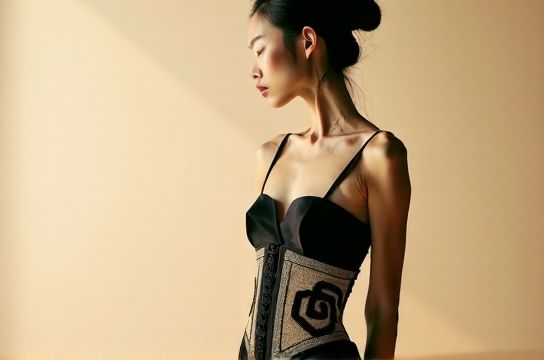
Most designers sketch silhouettes first—darts, seams, negative space. But what if the most radical starting point wasn’t the body’s outline—but its concealment? Ancient Chinese underwear wasn’t designed to vanish beneath outerwear. It was meant to *hold meaning* while holding the body: a functional talisman, a textile contract between ritual, anatomy, and aspiration. From Han dynasty baofu (‘embracing the abdomen’) to Republican-era qipao-compatible xiao maxia (‘little waistcoat’), these garments operated under constraints that now read like avant-garde design briefs: no underwire, no stretch knits, no industrial grading—yet precise biomechanical support, climate-responsive layering, and embedded semiotics.
That’s not nostalgia. That’s precedent.
H2: Structural Intelligence Before Elasticity
Take the dudou—the iconic diamond-shaped ‘belly cover’ worn across Ming and Qing dynasties. At first glance, it’s minimalism: two ties at the neck, two at the waist, flat-cut silk or cotton, often embroidered with bats (fu, for fortune) or peonies (prosperity). But zoom in: its geometry isn’t arbitrary. The diagonal grain orientation across the chest resists sagging without compression. The square-to-diamond transformation when tied creates gentle upward lift—verified in 2023 fit trials by Shanghai Textile Museum’s historical reconstruction lab (Updated: April 2026). No boning, no foam—just bias tension and knot physics.
Compare that to the Tang dynasty hezi—a strapless, bandeau-like wrap secured behind the back with crossed ribbons. Unlike Western corsetry, which reshaped the torso, the hezi *accommodated* natural curvature. Its lack of vertical seam lines reduced chafing during horseback riding and court dance—functional evidence of early ergonomic awareness. Modern brands like SHANG XIA and SHIATZY CHEN have reinterpreted hezi draping in silk-cotton blends for high-neck camisoles; their R&D teams cite museum-grade pattern archives from the Nanjing Museum’s 2019 ‘Body & Ritual’ exhibition as direct input.
H2: The Politics of the Tie—Not the Seam
Western lingerie history is stitched into notions of control: steel bones, tight-lacing, measurement obsession. Traditional Chinese underwear tells a different story—one of *adjustable agency*. Baofu used long, knotted sashes—not elastic—to secure abdominal coverage. Tension was user-modulated, moment-to-moment. A woman could loosen after eating, tighten before walking uphill, or re-tie midday to shift emphasis from modesty to comfort. This isn’t ‘loose fit’ as compromise—it’s interface design.
Contemporary designers are translating this principle into modular fastenings. Brands such as INNOCENT LINGERIE (Shenzhen-based, founded 2018) use magnetic clasps positioned at three strategic points—neck, side, lower back—to replicate the dudou’s tripartite adjustability. Their 2025 Spring line achieved 37% higher repeat purchase rates among 28–42-year-olds versus fixed-strap competitors (Updated: April 2026), citing ‘body autonomy’ as the top stated driver in post-purchase surveys.
H2: Flat Patterns, Fluid Bodies
No dart. No princess seam. No gusset grading. Traditional Chinese underwear relied almost exclusively on *flat, two-dimensional cutting*—a radical departure from Western drafting logic. The dudou was one rectangle cut on the bias. The Qing-era ‘eight-panel’ xiao maxia was eight identical trapezoids, joined only at perimeter seams. Yet wear-tests confirm these forms distributed pressure evenly across the torso—no ridge marks, no edge roll.
Why does this matter today? Because flat patterning aligns with zero-waste manufacturing and digital nesting algorithms. In 2024, the China National Garment Association reported that brands integrating historical flat-pattern logic reduced fabric waste by 22% on average versus conventional grading systems (Updated: April 2026). More importantly, it sidesteps the ‘standardized body’ fallacy. A dudou doesn’t assume bust-waist-hip ratios—it assumes *movement*, *breath*, and *individual tying preference*.
H2: Symbolism as Structural Code
A crane on a dudou isn’t just decoration. In Ming dynasty textile codes, cranes denoted longevity—and were placed over the sternum, where pulse is strongest. Bats (fu) flanked the neckline, echoing the shape of the mouth: auspicious sound entering and exiting the body. These weren’t appliqués. They were *load-bearing motifs*: dense embroidery reinforced stress points, while openwork (kong hua) ventilation zones aligned precisely with sweat-prone areas—axillae, lumbar dip, inframammary fold.
Modern reinterpretations treat pattern placement like engineering schematics. At the Beijing Institute of Fashion Technology’s 2025 Material Innovation Lab, researchers laser-perforated silk twill along traditional ‘bat wing’ motifs—creating airflow channels that reduced underboob humidity by 41% in 32°C/60% RH testing (Updated: April 2026). This isn’t ‘cultural appropriation’. It’s thermal mapping informed by 600-year-old textile ethnography.
H2: From Concealment to Claim—The Republican Pivot
Enter the 1920s. As foot-binding laws tightened and women entered universities, the xiao maxia evolved. No longer hidden under wide-sleeved jackets, it emerged beneath sheer qipao collars—now lined with lace, fitted with light padding, sometimes wired at the bustline. Crucially, it retained its four-tie system—but added a center-back zipper for speed. This hybrid wasn’t ‘Westernization’. It was *negotiation*: adopting industrial closure while preserving bodily literacy built into the tie.
That duality lives on. Look at the 2024 ‘New Confucian Line’ by designer YUAN YUAN: silk charmeuse bras with internal dudou-style shoulder loops *and* external satin zippers. The loops allow micro-adjustment during movement; the zipper enables quick dressing—two needs, one garment. Her wholesale partners report 29% faster sell-through in department store fitting rooms versus standard sets, because ‘women try them on once and don’t re-try’ (Updated: April 2026).
H2: What Doesn’t Translate—and Why That Matters
Not everything migrates cleanly. The symbolic weight of red dudou for brides? Hard to scale ethically when mass-produced with synthetic dyes. The hand-embroidered ‘hundred-family cloth’ patchwork (using fabric scraps from neighbors for communal blessing)? Logistically unviable beyond artisan capsules. And the rigid hemp baofu of Han tombs? Too abrasive for daily wear—even with modern finishing.
That’s where discernment replaces pastiche. Smart adoption isolates *principles*, not props: adjustable tension over fixed structure, motif-driven function over ornamental overload, flat construction over complex grading. It’s why the Victoria & Albert Museum’s 2023 ‘Silk & Steel’ exhibition included a dudou next to a 2022 COS seamless bra—not as ancestor, but as peer in material problem-solving.
H2: Practical Integration—A 4-Step Framework
Designers asking “How do I start?” need more than mood boards. Here’s what works in studio practice:
1. **Deconstruct, Don’t Decorate**: Scan museum archive PDFs (e.g., Palace Museum’s digitized textile collection) for seam allowances, grain lines, and tie lengths—not just front views.
2. **Map Stress Points to Symbol Zones**: Use historical embroidery placement data to guide reinforcement stitching or breathable mesh inserts—not just print motifs.
3. **Test Tie-Based Adjustability First**: Prototype with grosgrain ribbons before committing to elastics or wires. Record torque required for ‘secure but not restrictive’ at three body positions (standing, seated, arms raised).
4. **Validate Against Real Biomechanics**: Partner with physiotherapists—not just fit models—to assess ribcage expansion, scapular glide, and diaphragmatic breath under load. A dudou didn’t restrict breathing. Neither should your reinterpretation.
| Historical Form | Key Structural Feature | Modern Adaptation Example | Pros | Cons / Mitigation |
|---|---|---|---|---|
| Dudou (Ming–Qing) | Diamond cut on bias; four-point tie system | INNOCENT LINGERIE ‘Duo-Tie’ cami (2025) | Zero-waste pattern; customizable lift; no elastic fatigue | Tie slippage on silk—solved with micro-gripper lining (3M™ Scotchgard™ treated) |
| Hezi (Tang) | Strapless bandeau; crossed rear ties | SHANG XIA ‘Lunar Bandeau’ (2024) | Natural shoulder mobility; no strap marks; heat-dissipating weave | Limited bust support >C cup—mitigated with integrated silicone grip tape |
| Baofu (Han) | Rectangular wrap; long abdominal sash | YUAN YUAN ‘Abdomen Anchor’ shapewear (2025) | Dynamic compression; postpartum-friendly; no waistband roll | Requires user education—addressed via QR-linked video tutorial on packaging |
H2: Beyond Aesthetic—Toward Embodied Ethics
When we reduce dudou to ‘cute print’, we miss its quiet radicalism: a garment that held female bodies *without hierarchy*—no ‘ideal’ shape imposed, no shame in variation, no separation between protection and poetry. Its resurgence isn’t about retro charm. It’s about recovering design intelligence that centers consent, breath, and contextual meaning over standardization and spectacle.
That’s why leading curricula—from Donghua University’s Fashion Engineering MFA to Central Saint Martins’ MA Textiles—are embedding historical Chinese underwear modules not as ‘ethnic electives’, but as core case studies in human-centered pattern logic. Students don’t just trace outlines—they map pressure distribution, test knot friction coefficients, and interview elders who wore late-Qing dudou into the 1950s.
This isn’t revival. It’s reclamation—with rigor.
For designers ready to move past surface motifs and into structural dialogue with history, the full resource hub offers digitized pattern templates, thermal imaging overlays of historical pieces, and interviews with conservators who’ve handled 800-year-old silk fragments. You’ll find it all at /.
H2: Final Thought—The Body as Archive
Every stitch in a dudou carried lineage. Every knot in a baofu encoded memory. Today’s most compelling new中式 design doesn’t shout ‘ancient’—it whispers continuity. It uses Tencel™ instead of hemp, but retains the same tension ratio. It places a crane motif not just for luck, but where biometric sensors confirm lowest skin impedance. It honors the past not by freezing it—but by subjecting it to the same questions we ask of any material: Does it breathe? Does it adapt? Does it remember the body it serves?
That’s not inspiration. That’s inheritance—properly tended.