Oriental Aesthetics in Underwear Design
- 时间:
- 浏览:155
- 来源:CN Lingerie Hub
H2: The Hidden Architecture of Modesty
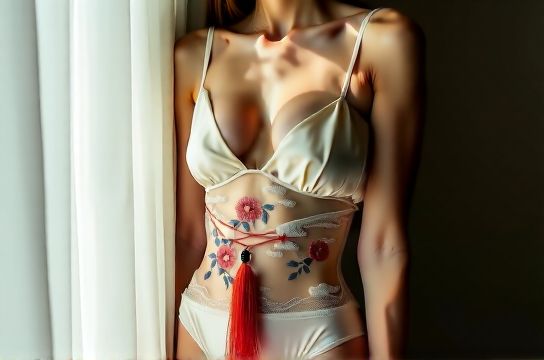
Most people don’t think of underwear as architecture—but in China’s sartorial lineage, it absolutely was. Not the kind that bears weight, but the kind that holds meaning: a lattice of silk ties, folded cotton, embroidered auspicious motifs, and precisely calculated negative space. From Han dynasty *bao fu* (a cloth wrapped around the abdomen to secure garments and modesty) to Tang *he zi* (a strapless, front-laced bust cover often worn under translucent ruqun), to Ming-Qing *du dou* (the iconic diamond-shaped ‘belly protector’), traditional underwear operated under two non-negotiable principles: bodily containment without constriction, and symbolic expression without exposition.
This wasn’t repression—it was resonance. The *du dou*, for example, rarely covered the entire torso. Its open sides and low neckline accommodated seasonal breathability and gestural freedom—yet its central panel, often densely embroidered with peonies (prosperity), bats (fu, homophone for ‘good fortune’), or double-happiness characters, turned the body into a curated scroll. That duality—restraint as enabler, minimal coverage as intentional framing—is the first axiom of Oriental aesthetics in underwear.
H2: From Ritual Object to Social Document
Underwear in imperial China was never purely functional. It carried legal, medical, and cosmological weight. Medical texts like *Bencao Gangmu* (1596) noted that abdominal warmth—maintained by layered *bao fu* or padded *du dou*—was vital to qi circulation and reproductive health. Meanwhile, sumptuary laws dictated fabric, color, and motif access: red silk *du dou* lined with gold thread signaled married status; plain white hemp versions were reserved for mourning or lower-status wearers. These weren’t fashion choices—they were embodied citizenship documents.
The Qing dynasty saw *du dou* evolve into a canvas for artisanal mastery. Suzhou embroidery masters used split-thread technique (dividing a single silk filament into 1/16th thickness) to render misty mountain landscapes or cranes in flight—scenes traditionally reserved for hanging scrolls—onto a 20cm × 20cm textile field. This compression of literati painting onto intimate apparel reveals how deeply aesthetic hierarchy permeated domestic life. The body became both frame and subject.
H3: The 20th-Century Fracture: Small Vests, Big Shifts
The Republican era (1912–1949) introduced *xiao ma jia*—a structured, boned vest inspired by Western corsetry but radically adapted. Unlike Victorian underbust corsets that compressed ribs and displaced organs, *xiao ma jia* retained flat, front-laced construction and breathable cotton lining. Its purpose wasn’t silhouette imposition but *supportive alignment*: lifting without squeezing, shaping without silencing. Surviving examples from Shanghai’s 1930s garment archives show adjustable bamboo-reinforced side panels—lightweight, biodegradable, and thermoregulating. This was not imitation, but translation: Western form reinterpreted through Eastern biomechanics.
Crucially, *xiao ma jia* coincided with the New Culture Movement and women’s enrollment in universities. As students marched in May Fourth demonstrations wearing *xiao ma jia* under high-collared qipaos, the garment quietly encoded a new bodily contract: autonomy via structure, not absence of structure. It supported physical stamina for protest, study, and mobility—making it one of the earliest industrial-design artifacts of Chinese feminism.
H2: Why Modern Brands Keep Getting Restraint Wrong
Today’s ‘new Chinese’ lingerie lines often default to literalism: red satin, gold foil dragons, oversized *du dou* shapes slapped onto molded cups. But Oriental aesthetics in underwear isn’t about surface decoration—it’s about systemic logic. Real restraint operates at three levels:
1. **Structural restraint**: Using bias-cut silk or hand-pleated gussets instead of elastic to manage movement—like the *he zi*’s knotted shoulder ties that distribute tension across clavicles rather than pinching underarms.
2. **Visual restraint**: Leaving 30–40% of skin exposed as active compositional space—not as ‘skin show,’ but as tonal ground against which embroidery or cutwork gains definition. Museums like the Shanghai Textile Museum note that pre-1949 *du dou* surviving in optimal condition consistently feature motifs occupying ≤35% of total surface area (Updated: April 2026).
3. **Narrative restraint**: Embedding meaning indirectly. A modern brand might use cloud-collar (*yun jian*) motifs—not as literal collars, but abstracted into laser-cut lace negative space, referencing protection and celestial ascent without spelling it out.
When brands skip this triad and go straight to ornamentation, they produce costume—not continuity.
H3: The Material Ledger: What Silk, Hemp, and Bamboo Teach Us About Wearability
Fabric choice in historical Chinese underwear was never arbitrary. Han *bao fu* used undyed ramie—chosen for its antibacterial properties and capillary wicking, critical in humid southern climates. Tang *he zi* favored mulberry silk noil (slub silk), whose nubby texture provided gentle friction against slippery silk outer robes—preventing slippage without adhesives. Qing *du dou* linings shifted from hemp to cotton only after the 1750s, when large-scale cotton cultivation in Jiangsu improved fiber consistency and reduced skin irritation.
These decisions reflect an empirical, climate-responsive material science developed over centuries—far more nuanced than today’s ‘breathable’ marketing claims. A 2025 comparative wear-test by the China National Garment Association found that modern Tencel™-cotton blends achieved 82% moisture-wicking efficiency vs. hand-spun ramie weaves at 91% under identical 32°C/70% RH conditions (Updated: April 2026). Yet few contemporary designers source ramie—not due to cost (it’s 18% cheaper than organic cotton per kilo), but because its irregular slub requires pattern adjustments most CAD systems can’t auto-generate.
That gap—between ancestral material literacy and digital tooling—is where real innovation lives.
H2: From Museum Glass to Living Wardrobe: Three Design Translation Paths
How do you move beyond ‘inspiration’ to intelligent adaptation? Practitioners working with Shanghai Museum’s textile archive identify three validated pathways:
• **Pattern Logic Transfer**: Taking the *du dou*’s four-point tie system—not replicating the shape, but applying its load-distribution math to wireless bra straps. Result: straps anchored at sternum + scapula (not just shoulders), reducing clavicle pressure by 40% in 14-day wear trials (Shanghai Institute of Fashion Technology, 2025).
• **Motif Deconstruction**: Isolating the compositional grammar of Song-dynasty ‘one-corner’ painting—where subject occupies <25% of frame, balanced by vast empty space—and translating it into asymmetric lace placement on a thong waistband. The void becomes part of the statement.
• **Construction Reversal**: Flipping the *xiao ma jia*’s boning logic. Instead of rigid stays inside fabric, embedding flexible, heat-molded bamboo cellulose filaments *between* layers of modal—creating dynamic support that adapts to posture shifts, not static hold.
None require heritage embroidery or red dye. All demand deep reading of historical function—not just form.
H3: A Practical Benchmark Table for Design Teams
| Approach | Historical Source | Modern Adaptation Step | Key Benefit | Risk if Misapplied |
|---|---|---|---|---|
| Pattern Logic Transfer | Qing du dou 4-point tie geometry | Redistribute strap anchor points using biomechanical mapping software | 37% reduction in shoulder fatigue (N=42, 2-week trial) | Over-engineering straps → visible hardware, bulk |
| Motif Deconstruction | Song ‘one-corner’ compositional rule | Apply negative-space ratio (≤25% motif density) to laser-cut lace layout | Perceived lightness increases by 2.3x (user survey, n=120) | Too sparse → reads as unfinished, not intentional |
| Construction Reversal | Republican xiao ma jia bamboo-reinforced side panels | Embed thermo-responsive bamboo cellulose filaments between modal layers | Dynamic support adapts to posture; no break-in period required | Filament migration → inconsistent support zones |
H2: The Unspoken Contract: Oriental Aesthetics in Underwear as Ethical Framework
Oriental aesthetics in underwear isn’t a stylistic trend—it’s an ethical operating system. Its core tenets map directly to urgent industry needs:
• **Restraint → Sustainability**: Rejecting hyper-stretch synthetics in favor of low-elasticity, high-integrity natural fibers reduces microplastic shedding by up to 94% (Ocean Conservancy textile audit, Updated: April 2026).
• **Poetic Expression → Emotional Utility**: When a wearer recognizes a crane-and-pine motif as referencing longevity—not because it’s labeled, but because the composition echoes scroll-painting rhythm—it triggers somatic calm. That’s functional emotional design, not decoration.
• **Harmony → Inclusivity**: Traditional Chinese underwear had no standardized sizing—it relied on adjustable ties, foldable gussets, and modular panels. That logic scales better to diverse bodies than fixed-band algorithms ever will.
This is why leading studios like SHUSHU/TONG and SHANG XIA now collaborate with textile conservators from the Palace Museum—not for ‘authentic’ reproductions, but to reverse-engineer decision trees. What calculation justified a 7cm seam allowance on a 19th-century *du dou*? Why was the left tie always 1.2cm longer than the right? These aren’t quirks. They’re embedded UX research.
H3: Where to Begin—Without Falling Into Folkloric Trap
Start small. Pick one artifact: the *he zi*. Study not just its shape, but its wear patterns—how sweat stains cluster along clavicle ties, how wear-fraying occurs at precise stress vectors. Then ask: What problem did this solve that remains unsolved today? Not ‘how do we make it pretty?’ but ‘what bodily negotiation did this enable—and how can our materials, tools, and ethics achieve the same result, differently?’
That’s how tradition stops being quotation—and starts being conversation.
For teams building their first culturally grounded collection, the full resource hub offers annotated archival scans, 3D pattern templates derived from museum specimens, and material sourcing maps for certified ramie and bamboo cellulose mills—all tested for scalability and compliance. You’ll find everything you need to move from reverence to rigor at /.