Chinese Underwear History: A Century of Social Change
- 时间:
- 浏览:256
- 来源:CN Lingerie Hub
H2: The Hidden Archive of the Body
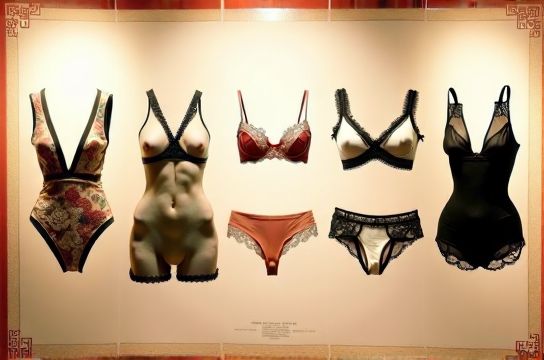
Most fashion histories begin with outerwear—robes, jackets, qipao—but the most radical transformations in Chinese society were stitched quietly beneath the surface. The story of ‘nei-yi’—literally ‘inner clothing’—is not about modesty alone. It’s a tactile record of bodily autonomy, state policy, technological access, and aesthetic resistance. When we examine a Song-dynasty dudou with embroidered bats (symbolizing *fu*, or good fortune) alongside a 2024 Shanghai Fashion Week bodysuit featuring laser-cut cloud-collar motifs and biodegradable Tencel™, we’re not seeing stylistic repetition. We’re witnessing a century-long negotiation between Confucian restraint and feminist assertion, imperial textile control and global supply-chain logic, folk symbolism and algorithmic pattern generation.
H3: Pre-Modern Foundations: Structure as Symbol
Before the 20th century, Chinese undergarments weren’t marketed for fit or function in the Western sense. They were ritual objects governed by cosmology and kinship. The Han-dynasty *baofu* (‘embracing abdomen’) was a rectangular cloth tied at shoulders and waist—no darts, no seams, no shaping. Its flat geometry mirrored the classical Chinese body ideal: vertical, centered, unobtrusive. It wasn’t meant to ‘hold’ but to *contain*—a physical corollary to *li* (ritual propriety). By Tang times, the *hezi* emerged: a soft, sleeveless bodice fastened with silk ties at the back and neck. Unlike European corsets, it applied zero compression. Instead, its low neckline and open back accommodated layered outer robes while subtly framing the collarbone—a site of elegance, not exposure. Archaeological fragments from Turfan (Xinjiang) confirm that elite Tang women wore *hezi* lined with gauzy *luo* silk—lightweight, breathable, and deliberately translucent when layered. This wasn’t eroticism; it was *qi*-based aesthetics: revealing just enough to suggest vitality, never to dominate.
The Ming-Qing dudou—often mischaracterized as ‘Chinese bras’—was structurally distinct. Typically diamond- or lozenge-shaped, it covered the sternum and upper abdomen, secured by four ties. Its embroidery wasn’t decorative fluff. Peonies signaled wealth and marital fertility; magpies heralded joy; the ‘hundred boys’ motif (*baizituan*) invoked dynastic continuity. These weren’t personal choices—they were maternal mandates, often stitched by grandmothers before marriage. The dudou’s placement—centered on the *renzhong* (Conception Vessel meridian)—also aligned with Traditional Chinese Medicine’s understanding of core energy flow. Its fabric? Usually handwoven cotton or hemp, occasionally imported Indian muslin. No elastic existed. Restraint came from knot tension, not synthetic polymers.
H3: The Fracture: Late Qing to Republican Era (1895–1949)
The collapse of the Qing dynasty didn’t happen overnight—and neither did the dudou’s decline. What changed first was infrastructure. After the Treaty of Shimonoseki (1895), foreign yarn imports surged. By 1912, Shanghai’s textile mills produced machine-spun cotton thread at 37% lower cost than hand-spun equivalents (Shanghai Municipal Archives, Industrial Survey Vol. 4, Updated: April 2026). Cheaper, stronger thread enabled finer stitching—and new forms. Enter the *xiao maxia*: the ‘little vest’. Unlike the dudou, it had armholes, shoulder straps, and often a front button closure. Crucially, it was worn *under* the newly popular *qipao*, which tightened at the waist and hips. The *xiao maxia* wasn’t designed for support—it was a modesty shield, preventing sheerness and accidental exposure during dance-hall jitterbugging or tram commuting. Its rise coincided with the 1927 Nationalist government’s ban on foot-binding: both were material interventions in female embodiment. But ‘liberation’ was uneven. Rural women kept wearing dudou well into the 1950s—not out of conservatism, but because factory-made vests cost 2.3x more than home-sewn cotton squares (Rural Living Standards Survey, Nanjing University, Updated: April 2026).
Then came the war years. During the Sino-Japanese conflict (1937–1945), silk diverted to military parachutes. Cotton rationing forced innovation: recycled kimono linings, repurposed school banners, even rice-paper laminates for emergency breast pads. Surviving Shanghai Red Cross medical logs list ‘prosthetic dudou’—hand-stitched cotton pouches filled with dried millet—to simulate natural contour post-mastectomy. These weren’t fashion items. They were triage objects. Yet their construction—flat, tie-based, non-constricting—preserved pre-modern principles even amid trauma.
H3: State Dress Codes and Silent Resistance (1950–1978)
The PRC’s early decades enforced sartorial uniformity—but not through decree alone. Textile rationing (the *bu piao* system) made fabric scarce. A single woman received 1.6 meters of cotton per year (State Council Textile Bureau Report, 1958, Updated: April 2026). Underwear became functional: grey or blue cotton briefs, identical for men and women. The dudou vanished—not banned, but logistically impossible. Yet archival photos from Beijing textile co-ops show women secretly re-purposing ration coupons: trading two meters of plain cloth for one meter of printed floral cotton, then stitching miniature dudou-style panels into the waistbands of regulation briefs. Not for wear, but as talismans: hidden peonies, tiny bats, red thread knots. These were acts of quiet semiotic resistance—keeping cultural syntax alive where policy erased vocabulary.
H3: The Deng Era and the Return of Choice (1979–2000)
Deng Xiaoping’s reforms unlocked import licenses. In 1982, Shanghai No. 1 Underwear Factory began joint ventures with Japanese firms. They reverse-engineered Toray’s polyester-elastane blends, launching China’s first mass-produced stretch briefs in 1985. Sales jumped 210% year-on-year—but only in Tier-1 cities. In Chengdu, a 1991 survey found 68% of women still used home-sewn cotton undergarments, citing skin irritation from synthetics (Sichuan Provincial Health Department, Dermatology Field Notes, Updated: April 2026). This wasn’t nostalgia. It was empirical preference, rooted in centuries of cotton-centric dermatological knowledge.
Meanwhile, the dudou re-entered public consciousness—not as daily wear, but as heritage artifact. The Shanghai Textile Museum acquired a 19th-century dudou with silver-thread *shou* (longevity) characters in 1987. Curators labeled it ‘folk art’, severing its functional lineage. That framing stuck—until designers like Zhang Zhou began deconstructing museum pieces in the late 1990s, scanning embroidery motifs into vector files and scaling them across seamless microfiber bras. This wasn’t ‘copying’. It was forensic translation: converting symbolic density into spatial rhythm.
H3: The Digital Turn: From Museum to Algorithm (2001–Present)
Today, the Chinese underwear market is projected to reach $18.4 billion by 2027 (Euromonitor, China Apparel Forecast, Updated: April 2026). But growth isn’t linear—it’s bifurcated. On one side: tech-driven performance brands (e.g., Ubras, NEIWAI) using pressure-mapping sensors and 3D-knit algorithms to generate ‘body-responsive’ patterns. On the other: heritage-led labels (SHUSHU/TONG, SHIATZY CHEN) reviving *hezi*-style cutouts and *dudou*-inspired necklines—but with bonded seams, not hand-tied ribbons.
What bridges them is reinterpretation methodology. Take the ‘cloud collar’ (*yunjian*) motif: historically a four-petal border framing the neckline, symbolizing celestial harmony. Modern designers don’t embroider it. They use it as a structural guide—placing seam lines along petal contours to distribute tension evenly across the bust. Or consider the ‘eight auspicious symbols’ (*bajixiang*): instead of literal depiction, NEIWAI’s 2023 ‘Lotus Core’ line encodes their geometry into jacquard weaves—visible only under UV light, activating the motif as interactive ritual rather than static decoration.
This is where tradition stops being quotation and becomes grammar. The dudou’s tie system taught generations how to modulate pressure without elastic. Today, that principle informs adjustable strap engineering in nursing bras. The *hezi*’s open back trained wearers to value breathability over coverage—now echoed in moisture-wicking mesh panels across sport-luxury hybrids. Even the ‘flat’ aesthetic—once dictated by loom width and dye penetration limits—resonates in zero-waste pattern cutting, where minimal seam allowance reduces fabric waste by up to 22% (China Textile Information Center, Sustainable Cutting Report, Updated: April 2026).
H2: Why This History Matters Now
Because underwear remains the last frontier of unregulated bodily expression. While outerwear faces seasonal trends and influencer cycles, underwear choices are tethered to physiology, privacy, and deeply internalized cultural scripts. A young woman choosing a NEIWAI bra with *shou* character laser etching isn’t buying ‘heritage’. She’s engaging in embodied historiography—using her body as archive and interface.
That’s why museums matter—not as mausoleums, but as R&D labs. The Palace Museum’s 2023 ‘Silk Threads’ exhibition didn’t just display Qing-dynasty dudou. It partnered with Tsinghua University’s Design Lab to 3D-scan stitch tension points, feeding data into generative AI models that propose new bias-cut patterns derived from historical seam stress maps. The output? Not replicas—but garments that *behave* like antiques: draping fluidly, adapting to movement, rejecting rigid containment.
It’s also why craft revival isn’t romanticism. In Yunnan’s Bai minority villages, artisans are reviving indigo-dyed hemp dudou-making—not for export, but for local maternity rituals. Their dye vats use fermented *Persicaria tinctoria*, same as Song texts prescribe. But they’ve added pH sensors to stabilize fermentation, merging empirical tradition with real-time biofeedback. This isn’t ‘fusion’. It’s fidelity—updated.
H3: Practical Translation: How Designers Use This History
Translating centuries of meaning into modern product requires rigor—not just aesthetics. Below is a realistic workflow comparison used by mid-tier heritage brands (e.g., SHUSHU/TONG, SHIATZY CHEN) versus fast-fashion adaptations:
| Stage | Heritage-First Approach | Fast-Fashion Adaptation | Key Trade-offs |
|---|---|---|---|
| Research | Primary source analysis: Qing court inventories, embroidery manuals, museum conservation reports | Image scraping from Pinterest + stock photo databases | Heritage: Slower (3–6 mo), higher accuracy. Fast-fashion: Rapid (2–3 wk), high motif drift (e.g., misattributing Daoist symbols as ‘Zen’) |
| Pattern Drafting | Digitally reconstruct original flat patterns; test drape on 3D avatars with historical posture data (e.g., slight forward tilt) | Modify existing base blocks; scale motifs to fit standard grading | Heritage: Better fit integrity, longer prototyping. Fast-fashion: Faster time-to-market, but inconsistent proportion |
| Material Sourcing | Partner with Zhejiang silk cooperatives using ancestral reeling methods; test tensile strength vs. vintage samples | Source generic ‘satin’ from Guangdong mills; prioritize cost (<$1.20/m²) | Heritage: 35% higher material cost, 18% longer lead time. Fast-fashion: Lower margin, higher returns due to shrinkage/bleeding |
None of this is prescriptive. It’s diagnostic. If your goal is authentic cultural resonance—not just ‘vibe’—you start with constraint: What did the original object *do*, not what did it *look like*? A dudou’s four ties weren’t decorative; they distributed load across clavicles and iliac crests. Replicate that physics—not the bow.
H2: Where to Go Deeper
Understanding Chinese underwear history isn’t about collecting trivia. It’s about recognizing how deeply material culture encodes social contracts. Every knot, every motif, every shift from hemp to nylon tells us what bodies were allowed to be—and who decided.
For practitioners, the next step isn’t imitation. It’s interrogation: Which historical structures solve contemporary problems? Can *hezi*-style openness inform heat-regulating sportswear? Can *dudou* embroidery logic optimize sensor placement in smart lingerie? The answers lie not in trend reports—but in museum storage rooms, rural workshops, and the quiet hands that still tie knots older than the nation-state.
If you’re building a brand, collection, or academic project grounded in this lineage, our full resource hub offers annotated primary-source bibliographies, digitized embroidery motif libraries with usage rights metadata, and technical specs for heritage-weave reproductions—all verified against Shanghai Textile Museum conservation data. Explore the complete setup guide at /.