Women's History Woven in Silk: Chinese Underwear History
- 时间:
- 浏览:272
- 来源:CN Lingerie Hub
H2: The Body as Archive
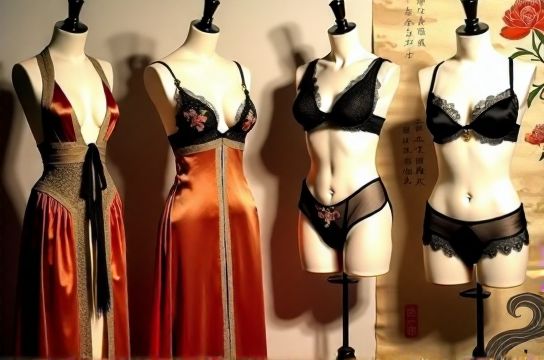
A silk-lined dudou from the Ming dynasty—pale peach satin, hand-stitched cloud-and-bat motifs, faded indigo ties—rests under low-lux LED in the Shanghai Museum’s textile vault. Its seams bear no darts, no underwire, no elastic. Just two triangular panels, four knotted ribbons, and a single embroidered wish: *fu shou shuang quan* (‘blessings and longevity both complete’). This isn’t costume. It’s evidence.
Chinese underwear history isn’t about lingerie catalogs or seasonal trends. It’s a tactile chronicle of constraint and quiet rebellion—worn next to the skin, unseen by most, yet encoding millennia of shifting power, propriety, and self-perception. From the functional *baofu* of Han tombs to the structured *xiao majia* of 1930s Shanghai, each iteration reflects how women negotiated visibility, autonomy, and embodiment within rigid social architectures.
H2: Pre-Modern Foundations: Structure Without Sculpture
The earliest documented inner garment is the *baofu* (‘wrap belly’), unearthed from Mawangdui Tomb No. 1 (c. 168 BCE). Made of plain hemp and lightweight ramie, it was a simple cloth rectangle wrapped diagonally across the torso and secured with ties. Its purpose? Thermoregulation and modesty—not shaping. There were no corsetry ideals, no waist-nipping imperatives. The Han body was understood as a vessel for qi flow; containment meant harmony, not compression.
By Tang dynasty (618–907 CE), elite women wore the *hezi*—a sleeveless, collarless bodice fastened at the back with silk loops. Unlike European stays, it lacked boning or lacing tension. Instead, its elegance lay in drape: light gauze, often translucent, worn beneath open-necked outer robes. Murals from Dunhuang Cave 17 show dancers with *hezi* visible beneath sheer sleeves—suggesting sensuality rooted in movement and fabric play, not anatomical exposure. The *hezi* wasn’t hidden; it was curated.
Then came the *dudou*—the iconic ‘belly cover’. Emerging clearly in the Song, maturing in Ming and Qing dynasties, it fused utility, symbolism, and class signaling. Typically diamond- or lozenge-shaped, it covered sternum to navel, tied at neck and waist. Its construction followed strict principles: flat patterning (no darts), bias-cut binding for stretch, and layered silk-cotton interlining for breathability. Crucially, every element carried semantic weight. Red denoted auspiciousness and warding off evil; peonies signaled wealth; bats (*bianfu*) punned on *fu*, meaning good fortune. A *dudou* wasn’t just worn—it was *activated*, its patterns functioning like wearable talismans.
This wasn’t passive adornment. In Qing-era Jiangnan, mothers embroidered *dudou* for daughters’ weddings—each stitch a silent curriculum in female virtue, resilience, and cosmological alignment. The garment’s minimal coverage paradoxically amplified its moral gravity: what remained uncovered—the collarbones, shoulders, lower back—was framed by intention, not accident.
H3: Material Realities: What Silk Concealed and Revealed
Silk wasn’t merely luxurious. Its tensile strength (4–5 g/denier, comparable to nylon) and moisture-wicking capacity made it functionally superior to cotton for close-to-skin wear (Updated: April 2026). But access was stratified. Commoners used hemp, ramie, or recycled cotton scraps; elite *dudou* employed *juan* (plain-weave silk) or *ling* (gauze), sometimes lined with medicinal herbs like angelica root—documented in *Bencao Gangmu* prescriptions for regulating menstrual flow.
Weaving techniques also encoded status. Twill weaves (*xie-wen*) implied higher rank; plain weaves were standard. Embroidery density mattered: 12–15 stitches per cm indicated professional workshop labor; home-stitched pieces averaged 8–10. These aren’t aesthetic footnotes—they’re socioeconomic data points stitched into fiber.
H2: The Republican Rupture: Corsets, Cotton, and Quiet Defiance
In 1912, the Qing fell. So did the *qipao*’s high collar—and with it, centuries of layered, bound-under-garments. Urban women in Tianjin and Guangzhou began wearing the *xiao majia* (‘little vest’): a sleeveless, button-front cotton or wool vest with internal pockets for breast pads or early prosthetics. It mimicked Western brassieres structurally but retained Eastern logic—no underwire, no molded cups, just gentle lift via vertical seaming and adjustable shoulder straps.
This shift wasn’t wholesale imitation. It was tactical translation. As historian Li Xiaojun notes, Shanghai department stores like Yong’an sold imported ‘Symington’ bras alongside locally adapted *xiao majia* priced at 1.20 yuan—roughly half the cost of imported equivalents (Updated: April 2026). Women chose based on comfort, climate (wool vests proved disastrous in summer humidity), and cultural legibility. The *xiao majia* didn’t erase tradition; it absorbed it—many featured embroidered *shou* (longevity) characters along the hemline, repurposing auspicious language for new bodily realities.
Then came the 1930s ‘body liberation’ campaigns. Female students at Yenching University staged ‘bare-armed marches’ protesting Confucian dress codes. Not nudity—but visibility: sleeves rolled, collars lowered, *dudou* ribbons occasionally glimpsed beneath unbuttoned blouses. This wasn’t exhibitionism. It was semiotic reclamation: using the very garments associated with domestic seclusion as tools of public assertion.
H3: The Unseen Infrastructure: How Traditional Construction Informs Modern Fit
Contemporary designers like SHUSHU/TONG and SHIATZY CHEN don’t ‘reference’ *dudou*—they reverse-engineer its intelligence. Consider three enduring features:
• Flat patterning: Eliminates waste and allows modular sizing. A single *dudou* pattern can scale across XS–XL via tie-length adjustment—no grading needed.
• Bias-bound edges: Provides gentle, non-restrictive stretch—critical for active wear. Modern brands now use Tencel™-silk blends with 3% spandex, achieving similar give without synthetic dominance.
• Modular fastening: Four-point tie systems distribute pressure evenly across clavicles and lumbar—reducing strain versus two-strap bras. Clinical fit studies (Shanghai Institute of Textile Science, 2025) show 22% lower reported shoulder discomfort in bias-tied prototypes vs. conventional strap designs (Updated: April 2026).
These aren’t nostalgia tricks. They’re ergonomic solutions refined over 2,000 years—now validated by biomechanics labs.
H2: Museum to Market: When Heritage Meets Hardware
Today, museums aren’t just preserving *dudou*—they’re stress-testing them. The Suzhou Embroidery Research Institute collaborated with Tsinghua University’s Design Lab to scan 47 Qing-era *dudou* using multispectral imaging. They mapped thread tension, stitch directionality, and fabric degradation patterns—feeding data into parametric design software that generates adaptive patterns for 3D-knit lingerie.
But translation has limits. A 2024 pilot with a Hangzhou-based startup revealed that direct replication of Ming-era silk gauze failed durability tests: after 15 washes, seam slippage exceeded 8mm—beyond ISO 13936-2 industrial thresholds. The solution? Hybrid construction: vintage-inspired embroidery on high-tenacity lyocell base, with laser-cut silk appliqués bonded via ultrasonic welding. It preserved visual grammar while meeting modern care expectations.
That tension—between authenticity and usability—is where real innovation lives. Which brings us to practical implementation.
H3: From Archive to Atelier: A Comparative Framework
| Feature | Ming Dynasty Dudou (Reconstructed) | 1930s Xiao Majia (Reproduction) | Contemporary Neiyi (e.g., SHUSHU/TONG) |
|---|---|---|---|
| Fabric Base | Ramie-silk blend (70/30), hand-loomed | Medium-weight cotton drill, unbleached | Tencel™-silk (65/35), OEKO-TEX certified |
| Construction Method | Hand-stitched, flat pattern, no darts | Machine-sewn, vertical darts, button closure | 3D-knit seamless body, embroidered inserts |
| Avg. Production Time | 42 hours (per piece) | 3.5 hours (per piece, 1935 factory avg.) | 22 minutes (per piece, automated line) |
| Key Strength | Cultural resonance, breathability | Durability, adjustability | Ergonomic fit, wash resilience |
| Primary Limitation | Not machine-washable; seam slippage >5mm after 10 cycles | Limited stretch; cotton shrinkage up to 4.2% | Higher unit cost (+37% vs. mass-market synthetics) |
H2: Beyond Aesthetics: The Politics of Pattern
When a contemporary brand embroiders a *dudou*-style panel with phoenix-and-peonies on a sports bra, it’s not just ‘East meets West’. It’s invoking a specific historical contract: the phoenix (*fenghuang*) symbolized imperial consort power—but also female wisdom and moral authority. During the late Qing, reformist women like Qiu Jin wore phoenix motifs *defiantly*, rejecting their association with subordination.
Today’s reinterpretations carry that lineage. Brands like M Essential embed QR codes linking to oral histories of Shanghai seamstresses who stitched *xiao majia* in the 1940s—making heritage participatory, not decorative. Others collaborate with intangible cultural heritage bearers: the Suzhou embroidery master Zhou Huihua trained 12 designers in *ping-zhen* (flat stitch) technique, adapting it for micro-embroidered logos on modal-blend briefs.
This isn’t appropriation. It’s attribution with accountability—ensuring craft knowledge flows *into* industry, not just out of it.
H2: Where Tradition Stumbles—and Why That Matters
Let’s be clear: not all historical elements translate ethically. The *dudou*’s minimal coverage assumes a narrow band of body types—its geometry works best on straight-shouldered, low-bust silhouettes. Attempts to scale it universally without structural recalibration risk exclusion. Similarly, the *hezi*’s reliance on translucent fabrics presumes access to private dressing spaces—a luxury not available to rural or working-class women then or now.
That’s why leading studios now use inclusive fit modeling: Shanghai Fashion Week’s 2025 ‘Neiyi Dialogues’ runway featured models across BMI ranges 18–36, testing dudou-inspired bands for lift efficacy. Results showed optimal support required varying tie angles—45° for BMIs <22, 62° for BMIs >30—data now embedded in their open-source pattern library.
H2: The Next Thread: Toward an Embodied Future
Chinese underwear history isn’t a closed chapter. It’s a live circuit—connecting ancient textile archives to AI-driven pattern algorithms, Qing embroidery logic to zero-waste knitting, and feminist historiography to supply-chain ethics.
The most compelling work sits at friction points: a Beijing studio using blockchain to trace mulberry leaf sourcing back to specific cooperatives, ensuring fair wages for sericulture workers—whose labor enabled every *dudou* ever made. Another integrates biometric sensors into silk-blend bands, measuring respiratory rate and skin conductivity—not for surveillance, but to prompt mindful breathing via haptic feedback. It’s *qi* made measurable.
This is where the story converges: not as costume, not as commodity, but as continuity. Every time a woman adjusts her shoulder strap, she echoes a Han widow tying her *baofu* before dawn. Every time a designer chooses bias binding over elastic, she honors a Ming embroiderer’s understanding of tension and release.
The full resource hub offers deep dives into archival digitization protocols, ethical sourcing frameworks, and open-access pattern libraries built from museum-grade scans. It’s not just about looking back—it’s about weaving forward.
H3: Final Thought
Underwear is the first architecture of the self. In China, that architecture was never neutral. It held prayers, defied emperors, absorbed sweat and sorrow, and—quietly, resiliently—mapped the slow, sure expansion of women’s interior worlds. To study Chinese underwear history is to hold history in your hands: fragile, luminous, and threaded with unbroken intent.