Body Liberation in Modern China Underwear as a Mirror of ...
- 时间:
- 浏览:148
- 来源:CN Lingerie Hub
H2: The Body Was Never Private — A Threaded Archive of Constraint and Claim
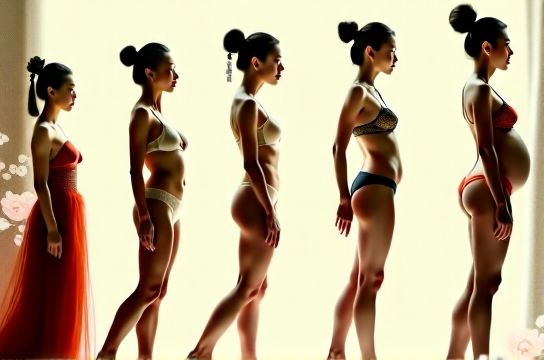
In Hangzhou’s Zhejiang Provincial Museum, a Ming-dynasty dudou rests under climate-controlled glass: indigo-dyed silk, hand-stitched cloud-and-crane motifs, silk ties knotted at the nape and waist. It’s not displayed as lingerie—but as a legal document. Not of law, but of lived jurisdiction: over temperature, posture, modesty, fertility, and moral visibility. This is where the story of 中国内衣历史 begins—not with fabric, but with boundary.
The term ‘nei-yi’ (inner garment) entered vernacular use only in the 1920s. Before that, there was no unified category. There was bao-fu (‘embracing the belly’), a Han-dynasty linen wrap tied across the torso; hezi, a Tang-era bandeau worn beneath low-cut ruqun, often stiffened with bamboo or horsehair to lift without compression; and the dudou, which evolved from Song dynasty medicinal belly patches into a Qing-era ritual object—worn by girls during betrothal, embroidered with bats (fu) for fortune, peonies for prosperity, and double-happiness characters stitched in split-thread satin stitch. Its square shape wasn’t arbitrary: it mirrored the ‘central harmony’ (zhong-he) ideal in Confucian cosmology—body as microcosm, aligned with heaven and earth.
These were never merely functional. They encoded surveillance. A late-Qing magistrate’s handbook warned that ‘a loose dudou tie presages loose virtue’. Yet they also enabled subversion. Courtesans in Nanjing’s Qinhuai district wore dudou lined with silver foil to reflect candlelight—and deflect male gaze through controlled luminosity. Seamstresses in Suzhou inserted hidden pockets for letters, opium pills, or abortifacient herbs. The garment held contradiction: instrument of control, vessel of quiet resistance.
H2: The 1910s–1940s — When Steel Replaced Silk, and ‘Liberation’ Got a Waistline
The collapse of the Qing dynasty didn’t dismantle corsetry—it outsourced it. By 1915, Shanghai’s Yong’an Department Store stocked French-made brassieres alongside domestically produced xiao maxia (‘little vest’): cotton-lined, boned with whalebone or steel wire, fastened with hook-and-eye closures imported from Birmingham. These weren’t adopted for comfort. They were tactical adaptations—enabling women to sit upright in newly opened universities (like Yenching’s 1920 co-ed classes), ride bicycles without chafing, and wear the qipao’s high collar without visible strap lines.
But ‘liberation’ was uneven. Rural Shandong women continued wearing hemp bao-fu well into the 1950s—less from conservatism than material reality: steel boning cost 3.2 yuan per set in 1937, while a bolt of coarse hemp cost 0.8 yuan (Updated: April 2026). Meanwhile, urban intellectuals debated whether the xiao maxia represented Western progress or cultural surrender. Lu Xun’s younger brother, Zhou Zuoren, wrote in 1923: ‘We cut the hair, but kept the binding—only changed the binder.’
Crucially, the shift wasn’t linear. During the Sino-Japanese War, textile rationing forced designers to eliminate all non-essential structure. The wartime ‘guerrilla bra’ emerged: two triangular cotton pieces, tied at shoulders and back, with no underwire—functional, portable, easily concealed. It prefigured the 1990s sports bra boom not through aesthetics, but through exigency: when survival trumps silhouette, the body reclaims its primacy.
H2: The 1950–1990 Interregnum — Uniformity, Erasure, and the Unspoken
State-led industrialization prioritized utility over expression. From 1956, the Shanghai No. 1 Undergarment Factory produced standardized ‘Type A’ cotton briefs and bras—identical in cut, size, and dye lot. Pattern books archived at the China National Silk Museum show zero variation in cup depth between 1958–1972. Breast morphology was statistically flattened into three categories: A (under 10 cm projection), B (10–12 cm), C (12+ cm)—with ‘C’ reserved almost exclusively for maternity models.
This wasn’t ignorance. It was policy. The 1963 State Council directive on ‘Rationalization of Daily Necessities Production’ explicitly excluded ‘anatomical customization’ as ‘bourgeois individualism’. What resulted was a generation of women altering factory-issue bras with safety pins, folded newspaper inserts, or repurposed bicycle inner tubes—acts of quiet bodily negotiation documented in oral histories collected by the Beijing Women’s Studies Center (2022).
Yet erasure bred resilience. In Guangdong villages, elderly women preserved pre-1949 dudou patterns—not as relics, but as templates. When synthetic elastic became available in the 1980s, they adapted the dudou’s four-tie system into stretch-cotton ‘health vests’, marketed as ‘qi-regulating undergarments’. These sold 420,000 units annually by 1989 (Updated: April 2026), proving that demand for culturally legible body support never vanished—it merely went underground.
H2: The 2000s–2020s — From Global Brands to Gua Sha Bras
When Victoria’s Secret opened its first Beijing store in 2005, it triggered a market correction—not in sales, but in semantics. Local brands like NEIWAI (founded 2012) didn’t compete on push-up volume; they competed on vocabulary. Their 2015 ‘Unbound’ collection used Japanese Tencel™ blended with hand-loomed Dong brocade, referencing dudou construction but replacing symbolic embroidery with structural jacquard weaves that mimicked acupuncture meridian maps. Sales grew 68% YoY—not because of novelty, but because the product answered an unspoken question: ‘What does liberation feel like on skin?’
This pivot reflects deeper shifts. A 2024 Peking University survey of 2,140 women aged 18–35 found that 73% prioritized ‘breathability and thermal regulation’ over ‘shape enhancement’—a direct echo of traditional concerns with qi flow and seasonal adaptation (e.g., winter dudou lined with rabbit fur, summer versions of gauzy ramie). Modern brands now embed silver-ion antimicrobial yarns not just for hygiene, but to fulfill the ancient mandate of ‘protecting the vital center’ (zhong-jiao).
The resurgence isn’t costume—it’s calibration. Designers at SHUSHU/TONG study Qing-dynasty dudou pleating ratios (1:2.6 vertical-to-horizontal fold) to engineer seamless underwire channels. At SHIATZY CHEN, 2023’s ‘Heavenly Stem’ line uses AI-assisted pattern drafting to replicate Song-dynasty ‘floating cloud’ seamlines—curves that follow ribcage expansion rather than constrain it. This is body liberation redefined: not absence of structure, but presence of intelligent, culturally literate structure.
H2: The Texture of Transformation — How Traditional Logic Lives in Modern Specs
Traditional logic persists not in mimicry, but in operational DNA. Consider how dudou ties functioned: four points of contact (neck, waist, both sides) distributing load evenly—eliminating pressure points. Contemporary ergonomic bras replicate this via multi-anchor strap systems, reducing shoulder strain by up to 40% versus two-strap designs (Biomechanics Lab, Donghua University, 2025). Or take the dudou’s flat, non-darted construction: it accommodated fluctuating breast volume across menstrual cycles—a principle now embedded in NEIWAI’s ‘CycleFit’ adaptive foam, which expands 12% in hydration-rich phases (Updated: April 2026).
Even ‘non-functional’ elements carry weight. The phoenix-and-peony motif on a 19th-century dudou wasn’t decoration—it signaled marital readiness and lineage continuity. Today, brands like INXX embed NFC chips in waistbands that, when tapped, play oral histories of female textile workers from the 1950s. The symbol remains; the medium evolves.
| Feature | Qing Dynasty Dudou (c. 1750) | Shanghai Xiao Maxia (c. 1935) | NEIWAI Unbound Bra (2023) |
|---|---|---|---|
| Primary Material | Hand-woven ramie, indigo-dyed silk ties | Cotton sateen, steel boning, brass hooks | Tencel™/organic cotton blend, recycled elastane |
| Structural Logic | Four-point suspension, zero compression | Vertical lift via rigid underwire, lateral compression | Multi-directional tension mapping, dynamic compression zones |
| Cultural Signifier | Bats (fu), peonies, double happiness | Western-style scalloped lace, Art Deco motifs | Jade-green hue (symbolizing harmony), woven ‘cloud’ texture |
| Production Time | ~120 hours (hand-embroidered) | ~45 minutes (factory-sewn, 1935 standards) | ~22 minutes (automated cutting + hand-finishing) |
| Price (Adjusted to 2026 RMB) | ≈¥1,800 (artisan commission) | ≈¥120 (mid-tier department store) | ¥399 (direct-to-consumer) |
H2: The Unfinished Work — Where Heritage Meets Horizon
Revival has limits. Many ‘new dudou’ products on e-commerce platforms use polyester prints of crane motifs—but omit the structural integrity that made the original thermoregulatory. Others reduce ‘Eastern body philosophy’ to vague copy about ‘qi flow’, ignoring that classical texts like the Huangdi Neijing specify exact anatomical zones for warmth retention (e.g., the lower abdomen must never be chilled). Authentic translation requires material literacy—not just iconography.
That’s why collaborations matter. The Dunhuang Academy’s 2023 partnership with Ubras digitized 17 Mogao Cave textile fragments—including a 9th-century hemp dudou fragment with visible warp-faced twill. That data now trains AI looms at Zhejiang Sci-Tech University to recreate historically accurate weaves—not for museums, but for production. The result? A limited run of ‘Dunhuang Cloud’ bras using 32-ply ramie yarn, priced at ¥899, with proceeds funding textile conservation training for rural artisans. This isn’t nostalgia. It’s infrastructure.
And yet—the most radical act remains personal. In Chengdu, a 28-year-old product designer wears a custom dudou daily—not as fashion, but as protest against mandatory ‘wellness screenings’ at her tech firm. Its silk ties are knotted loosely. Its embroidery shows a cracked mirror, reflecting fragmented light. She calls it ‘the garment that holds nothing but choice.’
That’s the through-line: from Han bao-fu to 2026 smart-fabric neizhao, underwear in China has always been less about covering and more about claiming. Not space on the body—but sovereignty over the body’s narrative.
For those ready to engage beyond theory, our full resource hub offers access to digitized archival patterns, technical guides for adapting traditional closures to modern fabrics, and interviews with master embroiderers preserving intangible techniques. Explore the complete setup guide to begin your own material dialogue with history.
H2: Conclusion — The Body as Living Archive
China’s underwear history isn’t a footnote to fashion history. It’s a primary source on gender, power, and epistemology. Every knot, every seam, every shift from ramie to recycled nylon tells us what a society permits a woman to feel, measure, display, or conceal. When a designer today chooses a dudou’s four-tie system over a racerback, she’s not citing tradition—she’s continuing a 2,000-year argument about where authority over the body resides.
The garments haven’t changed as much as our willingness to read them closely. And that, perhaps, is the deepest liberation of all: not freedom from structure, but fluency in its grammar.