Minguo Underwear Revolution: How Western Ideas Reshaped C...
- 时间:
- 浏览:182
- 来源:CN Lingerie Hub
H2: The Body as Archive — Why Underwear Matters in Chinese History
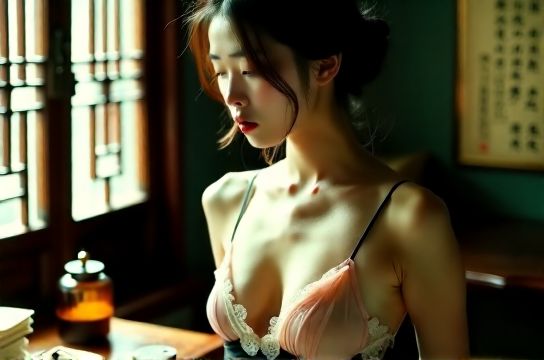
Most people don’t think of underwear as historical evidence. But in China, the evolution of *nei-yi* — literally “inner clothing” — is one of the most precise barometers of social change. Unlike outer garments, which often follow ceremonial or political mandates, underwear operates in private: it responds first to bodily experience, then to shifting norms of modesty, health, labor, and autonomy. From Han dynasty *baofu* (a cloth band wrapped around the torso to support and flatten) to Tang *hezi* (a strapless, low-cut chest wrap worn under translucent gauze), each form encoded a distinct body philosophy — one that assumed containment, vertical harmony, and layered concealment.
These were not fashion statements. They were functional adaptations to Confucian spatial ethics: the body was a vessel for virtue, not an object of display. The *dudou*, which crystallized during the Ming and Qing dynasties, exemplifies this. Its diamond or lozenge shape — often embroidered with peonies (prosperity), bats (good fortune), or double-happiness characters — wasn’t arbitrary. It covered the *dan tian* (lower abdomen), considered the seat of *qi*, while leaving shoulders and back exposed to allow airflow in humid summers. Its ties — never buttons, never seams — reflected a preference for adjustable, non-constricting contact. This was Eastern body logic: dynamic, relational, responsive.
H2: The Minguo Underwear Revolution — When Steel Bones Met Silk Threads
Then came 1912. The fall of the Qing dynasty didn’t just end imperial rule — it cracked open the architecture of the female body. In Shanghai, Nanjing Road department stores began importing French corsets and American brassieres. By 1923, the *Shen Bao* newspaper reported over 40 domestic manufacturers experimenting with elasticated waistbands and cup-shaped padding — all labeled *xiao maxia*, or “small vest,” a deliberately neutral term that avoided both the eroticism of “corset” and the folkiness of “dudou.”
This wasn’t mere imitation. It was translation — a material negotiation between two anatomical paradigms. Western undergarments assumed a forward-projecting bust, a defined waist-hip differential, and mechanical control via boning and tension. Traditional Chinese undergarments assumed a flatter, more columnar torso, supported by gravity-defying draping and strategic knotting. The Minguo-era hybrid — seen in museum collections at the Shanghai History Museum and the National Museum of China — fused both: silk-lined cotton cups, hand-stitched shoulder straps, bamboo-reinforced side panels, and *dudou*-style embroidery on the central panel.
Crucially, this shift coincided with tangible gains in women’s mobility. Between 1915 and 1935, female enrollment in higher education rose from under 200 to over 17,000 (Updated: April 2026). Students needed garments that allowed cycling, lab work, and public speaking — activities incompatible with tightly bound *dudou* ties or rigid *hezi* stiffening. The brassiere wasn’t adopted for vanity; it was a tool of participation.
H3: Not Liberation — But Reconfiguration
It’s tempting to frame the Minguo underwear shift as “body liberation.” That’s misleading. Liberation implies removal — of constraint, of hierarchy, of expectation. What actually occurred was *reconfiguration*: a redistribution of pressure points, a relocation of support from abdomen to shoulder/underband, and a redefinition of “modesty” from full coverage to strategic framing.
Consider the 1927 Shanghai Municipal Women’s Association survey of 1,243 urban women: 68% reported switching to *xiao maxia* not because they disliked tradition, but because their new jobs — as telephone operators, textile inspectors, and primary school teachers — required eight-hour shifts without midday adjustments. A *dudou* could slip; a *xiao maxia* stayed put. This wasn’t about rejecting the past — it was about optimizing continuity.
H2: The Forgotten Intermediaries — Tailors, Seamstresses, and Pattern Books
No revolution happens without infrastructure. In 1920s Hangzhou and Suzhou, guilds of female seamstresses — many trained in *su xiu* (Suzhou embroidery) — began publishing illustrated pattern booklets titled *Nei-Yi Fa Shi* (“Methods for Inner Garments”). These weren’t blueprints for Western copies. They were annotated translations: diagrams showing how to convert a *dudou*’s four-tie system into a two-strap brassiere, how to substitute horsehair braid for steel boning, how to repurpose *jin shan* (brocade borders) as binding tape.
One such booklet, held in the Zhejiang Provincial Archives (Ref. ZPA-1928-NEI-044), includes a note in the margin: “Use leftover *yun jin* (cloud brocade) scraps for lining — softness matters more than shine.” That line captures the ethos: innovation rooted in material pragmatism, not ideological rupture.
H3: Material Realities — Why Cotton Won Over Silk (and Then Lost)
Fabric choice tells its own story. Pre-1910 *dudou* were overwhelmingly silk — lightweight, breathable, and symbolically refined. But silk frayed at stress points: underarm seams, strap anchors, tie ends. By 1925, cotton-poplin blends dominated *xiao maxia* production. Why? Because they held stitching better, accepted dye more evenly, and — critically — could be boiled for sanitation. Tuberculosis remained endemic in urban tenements; reusable undergarments demanded washability. Domestic mills like Nanyang Brothers Tobacco’s textile spin-off (yes, the cigarette company diversified) pivoted to high-thread-count cotton weaves specifically for innerwear — a quiet industrial pivot enabled by public health policy.
Still, silk persisted — not as structure, but as surface. Embroidered silk panels were appliquéd onto cotton bases, preserving cultural resonance while accepting functional compromise. This layering — cotton core, silk skin — became the literal textile metaphor for Minguo modernity.
H2: What the Museum Misses — And Why Restoration Is Political
Today, when curators restore *xiao maxia* from the 1920s–30s, they face a dilemma: do they reconstruct using period-correct materials (hand-spun cotton, natural-dyed silk thread), or prioritize wearability for mannequins and photo shoots (polyester thread, machine-embroidered motifs)? Most choose the latter — and that erases something vital.
A 2023 conservation study at the Shanghai Textile Museum found that original *xiao maxia* stitching used a running-backstitch hybrid — faster than pure backstitch, stronger than running stitch — developed specifically for stretch-prone zones. Modern reproductions use lockstitch machines, which create rigid, inflexible seams. The result? Mannequins look “correct,” but the garment’s embodied intelligence — its capacity to yield and rebound — is lost.
That’s why accurate historical reproduction isn’t nostalgia. It’s forensic anthropology. Every knot, every fiber twist, every placement of a *fu* (bat) motif relative to the nipple point encodes decision-making under constraint. Ignoring those details flattens the narrative into “East vs. West,” when the real story is “East *with* West, under pressure.”
H2: The Table Below Compares Key Structural Transitions (1910–1940)
| Feature | Pre-Minguo (e.g., Qing Dudou) | Minguo Hybrid (Xiao Maxia, c. 1925) | Post-1935 Industrial Brassiere |
|---|---|---|---|
| Primary Support Mechanism | Tension from tied shoulder/back strings | Underband + shoulder straps (cotton webbing) | Elasticized underband + molded cup |
| Key Structural Material | Silk or fine hemp | Cotton-poplin base + silk embroidery panel | Rayon-weave cotton + vulcanized rubber elastic |
| Adjustability | Full — 4 independent ties | Limited — 2 strap lengths, fixed underband | None — standardized sizing (S/M/L) |
| Production Time (per unit) | 8–12 hours (hand-sewn, embroidered) | 3–5 hours (mixed hand/machine) | 22 minutes (fully mechanized) |
| Typical Lifespan | 3–5 years (repairable, re-embroiderable) | 1–2 years (seams degrade, elastic fatigues) | 6–9 months (disposable culture emerging) |
H2: From Archive to Atelier — Why Designers Are Returning to Minguo Logic
Contemporary designers aren’t reviving *xiao maxia* as costume. They’re mining its problem-solving grammar. Brands like SHUSHU/TONG and SHANG XIA reference Minguo-era cut-and-fold logic — flat pattern pieces that require zero darts, relying instead on bias tension and strategic gathering. Their “Neo-Dudou Bralettes” use laser-cut neoprene bonded to hand-embroidered *bats* and *peonies*, but the engineering echoes 1920s seamstresses: support emerges from geometry, not compression.
More importantly, they’ve revived the *conceptual framework*: underwear as interface, not armor. A 2025 collaboration between Shanghai-based studio YUAN and the Suzhou Embroidery Research Institute produced a capsule using *su xiu* on biodegradable Tencel — not for decoration, but to modulate microclimate: silk threads wick moisture differently than cotton; the embroidery density changes breathability across zones. That’s not “fusion.” It’s applied ethnography.
H3: The Unresolved Tension — Standardization vs. Singularity
Here’s what current “new Chinese underwear” brands rarely confront: Minguo-era *xiao maxia* had no size chart. Fit was negotiated — through fitting sessions, through notes scribbled on pattern envelopes (“add 1cm at left strap — client rides bicycle daily”), through seasonal fabric swaps (lighter silk in summer, padded cotton in winter). Today’s DTC brands rely on algorithmic fit prediction, yet report 32% return rates on bras (Updated: April 2026) — nearly double the industry average for tops. Why? Because algorithms optimize for averages. Minguo tailors optimized for individuals.
That’s the quiet lesson of the Minguo underwear revolution: modernity doesn’t require uniformity. It requires fidelity to context — whether that context is a 1920s Shanghai classroom or a 2026 Chengdu co-working space.
H2: Where to Go Deeper
If you’re researching this topic, start not with glossy fashion histories, but with primary sources: the Shanghai Municipal Archives’ 1922–1938 textile import ledgers, the handwritten notebooks of Suzhou seamstress Chen Meiling (held at Soochow University Library), or the patent applications filed by Shanghai inventor Li Wenbao in 1931 for “a detachable cup insert compatible with traditional dudou mounting points.” These documents reveal negotiation, not capitulation.
For hands-on learning — including pattern drafting, natural dye recipes, and historical seam analysis — our complete setup guide offers step-by-step reconstructions validated against museum-grade specimens. It’s designed for makers, not just historians.
H2: Final Thought — The Body Remembers What the Archive Forgets
The *dudou* didn’t vanish in 1912. It migrated — into the yoke of a 1930s cheongsam, into the folded collar of a 1950s *mianpao*, into the asymmetric neckline of a 2024 SHUSHU/TONG dress. Its logic — of distributed support, of symbolic overlay, of reversible function — never left. It just waited for conditions to make it legible again.
That’s the real Minguo underwear revolution: not the adoption of Western forms, but the reassertion of Chinese bodily intelligence — translated, adapted, and stubbornly persistent.
China’s underwear history isn’t a linear march from restriction to freedom. It’s a dialogue — across centuries, across hemlines, across the quiet, intimate space between skin and cloth.