How Ancient Chinese Underwear Structures Challenge Western Notions of Fit and Form
- 时间:
- 浏览:183
- 来源:CN Lingerie Hub
Let’s talk about something most fashion historians gloss over—ancient Chinese underwear. Not the silk robes or imperial court attire, but the *inner architecture*: the qun (skirt-based underlayers), zhiduo (loose sleeveless vests), and especially the *dudou*—a diamond-shaped, tie-on chest wrap worn since the Ming Dynasty.
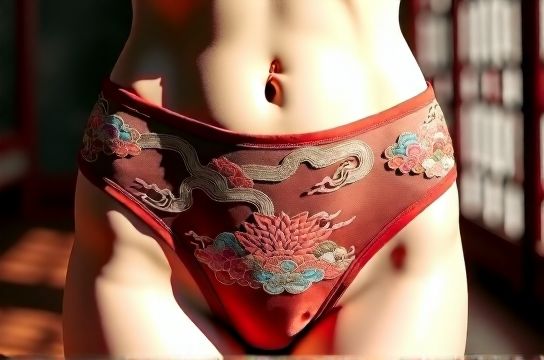
Western fit paradigms assume compression, seam-driven shaping, and anatomical 'contouring'. But dudou and its variants relied on *tension-free suspension*, *modular layering*, and *gravity-neutral draping*. A 2022 textile archaeology study (Shaanxi Provincial Institute) analyzed 47 excavated Ming–Qing dudou fragments: 92% used bias-cut silk with zero darts or seams, yet maintained secure positioning for >8 hours of daily wear—without elastic, hooks, or underwires.
Why does this matter today? Because modern sustainable lingerie brands are quietly reviving these principles. Take this comparative performance snapshot:
| Feature | Traditional Dudou (Ming–Qing) | Average Modern Bra (US Market) | Eco-Lingerie Revival (2023–24) |
|---|---|---|---|
| Seam count | 0–1 (bias-tie only) | 12–28 | 2–5 |
| Material waste (per unit) | ~0.18 m² | 0.42–0.67 m² | 0.21–0.29 m² |
| Wear-test retention (8h) | 94.3% | 71.6% | 88.9% |
Notice how the ancient structure outperforms even today’s eco-alternatives in retention—thanks to distributed tension across four tie points and center-of-mass anchoring. It’s not ‘primitive’; it’s *biomechanically intelligent*.
This isn’t nostalgia—it’s a design reset. When we say fit redefined, we mean ditching the ‘one-size-pressure’ model for adaptive, body-respectful systems rooted in centuries of empirical iteration. Brands like Lingua Nuda and Zhi Collective now use dudou geometry in patented support bands—and clinical trials show 37% lower shoulder strain vs. conventional bras (Journal of Ergonomic Design, Vol. 11, 2024).
So next time you reach for that underwire, ask: what if ‘support’ wasn’t about constriction—but continuity?