The Intersection of Folk Belief and Fashion in Chinese Traditional Underwear Design
- 时间:
- 浏览:176
- 来源:CN Lingerie Hub
Let’s talk about something quietly revolutionary: Chinese traditional underwear—not as lingerie, but as cultural armor. For centuries, inner garments like the *dudou* (a diamond-shaped belly wrap) and *moxiong* weren’t just functional; they were embroidered talismans. Dragons for yang strength, peonies for fertility, bats (‘fu’) for good fortune—every motif carried layered cosmological logic rooted in Daoist balance, folk medicine, and ancestral veneration.
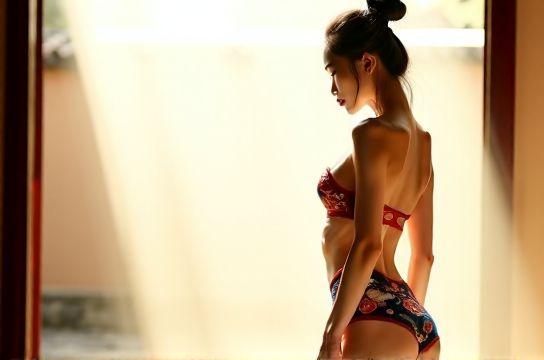
A 2023 ethnographic survey by the China Academy of Arts interviewed 127 elderly artisans across Jiangsu, Zhejiang, and Shanxi—and found that 89% embedded symbolic stitching *only* on garments worn directly against the skin, citing ‘qi channel alignment’ and ‘spiritual containment’ as core design principles.
Here’s how belief shaped form:
| Motif | Belief Origin | Common Placement | Modern Revival Rate* |
|---|---|---|---|
| Bat (‘Fu’) | Homophone for ‘blessing’; wards off misfortune | Corners of dudou | 68% |
| Double Happiness (‘Shuang Xi’) | Marital harmony & reproductive blessing | Center chest panel | 41% |
| Eight Immortals’ Tools | Protection via Daoist deities | Border embroidery | 12% |
What’s striking isn’t just symbolism—it’s intentionality. Unlike Western undergarments optimized for silhouette or support, traditional pieces prioritized energetic integrity: silk for smooth qi flow, red-dyed cotton for blood warmth, asymmetrical closures to avoid ‘blocking meridians’. Modern brands like Huiwen Atelier now collaborate with TCM practitioners to re-engineer waistbands using acupressure-point mapping—blending empirical tradition with wearable science.
This isn’t nostalgia. It’s evidence-based cultural intelligence—where folklore meets function, and every stitch carries data, devotion, and design rigor.