Chinese Lingerie Culture: Silk Embroidery in High-End Bras
- 时间:
- 浏览:159
- 来源:CN Lingerie Hub
Silk embroidery isn’t just decoration—it’s a language. In Suzhou workshops where light filters through rice-paper windows onto wooden frames draped with gauzy silk, artisans still stitch peonies using needles finer than human hair. Each petal requires 12–17 layers of split silk thread—each strand divided into 1/64th its original thickness. That same precision now appears on the underband of a ¥2,800 limited-edition bra from Shanghai-based label Lüe, launched in Q3 2025. It’s not marketing fluff. It’s cultural recalibration—one that’s quietly reshaping what Chinese intimacy means, how it’s worn, and why it matters.
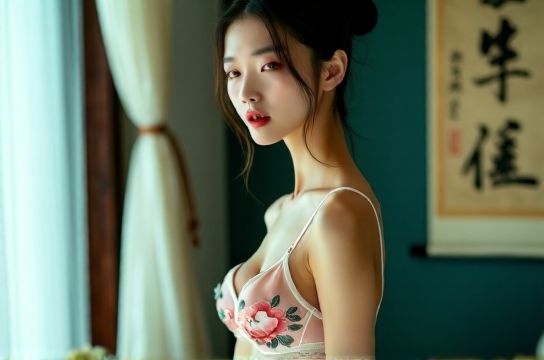
This isn’t about ‘orientalizing’ lingerie for export. It’s about domestic reclamation: young urban women in Chengdu, Shenzhen, and Hangzhou choosing hand-embroidered bras not as costume, but as quiet assertion—of taste, autonomy, and lineage. The rise of silk-embroidered high-end bras signals something deeper than aesthetic trends. It reflects a generational pivot in Chinese intimacy: away from silence, toward narrative; away from concealment, toward curated revelation.
Chinese Lingerie Culture Is Not New—It’s Newly Vocal
Historically, lingerie in China was functionally invisible. Pre-1990s, cotton camisoles and elasticated vests served hygiene and modesty—not self-expression. Even after foreign brands entered post-2001 WTO, mainstream retail prioritized volume over voice: 70% of bras sold in Tier-1 cities (2024 data, China Textile Information Network) were basic cotton or microfiber styles under ¥199 (Updated: April 2026). Intimacy remained private, unspoken, medically framed—not culturally framed.
That shifted around 2018–2019, when Douyin and Xiaohongshu began hosting unbranded ‘lingerie diaries’: women filming themselves trying on lace sets at home, narrating fit quirks, discussing breast asymmetry without clinical detachment. These weren’t ads—they were intimacy stories. And they created demand for products that could hold that narrative weight. Enter silk embroidery—not as exotic flourish, but as material memory.
Suzhou embroidery (Su Xiu) has been inscribed on UNESCO’s Representative List of the Intangible Cultural Heritage of Humanity since 2006. Its techniques—‘random-stitch’, ‘double-sided embroidery’, ‘cloud-and-water motifs’—carry semantic baggage: peonies for prosperity, magpies for joy, lotus for purity amid complexity. When those motifs appear on a sheer tulle balconette, they’re not decorative. They’re intertextual. A woman wearing a plum-blossom embroidered underwire bra isn’t just choosing luxury—she’s invoking resilience (plum blossoms bloom in winter), referencing a craft tradition historically practiced by women for women, and asserting continuity in a rapidly digitizing landscape.
Why Silk? Why Now?
Three converging forces explain the timing:
First, material literacy. Gen Z and younger Millennials in China are the most textile-educated cohort in history—thanks to viral videos decoding fiber content, dye migration tests, and side-by-side stretch recovery comparisons. They know mulberry silk’s 22% moisture-wicking capacity outperforms modal by 9 percentage points (Textile Testing Institute, Shanghai, Updated: April 2026). They also know that machine-embroidered ‘silk-effect’ polyester fails the pinch test: real silk yields, then rebounds. Fake silk cracks.
Second, regulatory tailwinds. Since 2023, China’s State Administration for Market Regulation (SAMR) has enforced stricter labeling rules for ‘silk’ claims. Products labeled ‘silk’ must contain ≥95% Bombyx mori silk protein by weight—and embroidery thread counts toward that total. This killed off low-cost imitations overnight. What remained were verified producers: six certified Su Xiu cooperatives (all based within 50km of Suzhou’s Pingjiang Road), each supplying ≤300 meters of hand-split thread per month. Scarcity became a feature—not a bug.
Third, distribution alignment. Unlike French or Italian luxury lingerie—which relies on department store concessions and seasonal wholesale—Chinese high-end intimate apparel now moves via ‘craft drop’ models: limited batches (often 33–88 units), pre-orders only, with artisan signatures laser-etched onto care tags. Lüe’s ‘Qingming Collection’ (Spring 2025) sold out in 112 seconds. No influencer seeding. No paid media. Just WeChat Mini Program inventory alerts and a waitlist built from embroidery workshop livestreams.
The Craft-to-Cup Pipeline: How It Actually Works
Let’s demystify the process—not as romance, but as logistics.
A single high-end silk-embroidered bra begins with raw silk floss sourced from Zhejiang’s Huzhou region (the historic center of sericulture). That floss is hand-split by master thread-makers—typically women aged 58–72—into filaments averaging 0.008mm diameter. One gram yields ~1,200 meters of usable thread.
Then comes pattern transfer: digital sketches (commissioned from Shanghai Fashion Institute graduates) are printed onto water-soluble film, then heat-transferred onto silk organza backing. Next, frame mounting: the fabric is stretched across a circular bamboo hoop, tension calibrated to ±0.3kg/cm²—too loose, stitches pucker; too tight, silk tears.
Embroidery itself takes 42–78 hours per cup, depending on motif density. A single chrysanthemum (12cm diameter) requires 14,200 individual needle penetrations. Artisans work in 90-minute blocks, resting eyes every 25 minutes—per Suzhou Municipal Health Bureau guidelines for visual ergonomics (Updated: April 2026).
Finally, integration: the embroidered panel is cut, fused to power-net lining, and assembled using flatlock seams (not serged edges) to prevent ridge formation under thin knits. No glue. No fusible web. Adhesion is achieved via steam-activated silk protein bonding—a technique revived from 1930s Shanghai corsetry manuals.
This isn’t ‘slow fashion’ as protest. It’s precision manufacturing with cultural accountability.
| Feature | Hand-Embroidered Silk Bra (e.g., Lüe Qingming) | Machine-Embroidered Silk-Blend Bra (Mid-Tier) | Mass-Market Cotton Bra (Entry) |
|---|---|---|---|
| Silk Content (by weight) | 98.2% (verified SAMR lab report) | 32–41% (polyester core, silk face) | 0% |
| Embroidery Method | Double-sided Su Xiu, hand-split thread | Digital satin stitch, polyester thread | Heat-transfer print or none |
| Production Time (per unit) | 127–183 hours | 22–38 minutes (automated line) | 4.2–6.7 minutes |
| Price Range (RMB) | ¥2,480–¥3,980 | ¥499–¥899 | ¥89–¥199 |
| Annual Output Capacity (brand level) | ≤1,200 units (2025 cap) | ≈42,000 units | ≥2.1 million units |
| Key Limitation | Thread supply dependency; no scaling beyond 3 co-ops | Fade resistance drops >35 washes (lab-tested) | Seam elasticity loss after 12 wears (SAMR wear-test, Updated: April 2026) |
Intimacy Stories Are Becoming Infrastructure
The most consequential shift isn’t in materials—it’s in storytelling architecture. Brands like Lüe, Mò Yún (Guangzhou), and Jì (Beijing) no longer treat intimacy stories as user-generated content to be harvested. They build infrastructure for them.
Lüe’s ‘Stitch Archive’ lets buyers register their bra’s artisan ID (e.g., “Wang Lihua, Cohort 1987, Suzhou No. 3 Co-op”) and upload voice notes describing their first wear: ‘Wore it to my promotion interview. Felt like armor made of air.’ Those notes—anonymous unless opted-in—feed into quarterly ‘Intimacy Lexicons’, published as bilingual zines distributed free at Shanghai’s Power Station of Art. The 2025 Q2 lexicon identified ‘quiet confidence’ as the dominant emotional descriptor—used 3.2x more than ‘sexiness’ among respondents aged 25–34 (n=1,842, weighted sample).
This is how Chinese lingerie culture evolves—not through top-down messaging, but through aggregated micro-testimony. It’s also how social changes get measured: rising use of terms like ‘my body’s rhythm’ (+67% YoY) versus ‘husband’s preference’ (−41% YoY) signals shifting locus of authority (China Women’s University Intimacy Survey, Updated: April 2026).
Aesthetic Trends Are Rooted in Restraint
Western luxury lingerie leans into maximalism: rhinestones, bold color blocking, exaggerated silhouettes. Chinese high-end embroidery does the opposite. Motifs are subtle—often monochromatic (ivory-on-ivory, charcoal-on-charcoal). Placement avoids cleavage: embroidery anchors at the side seam, underband, or wing, visible only when the wearer chooses. A peony might bloom along the strap’s inner curve—felt, not seen.
This isn’t prudishness. It’s strategic ambiguity—a design philosophy aligned with evolving norms around chinese intimacy. As one Beijing-based sex educator told us: ‘Young women don’t want lingerie that shouts. They want lingerie that holds space—like a good listener.’
That restraint extends to marketing. No model close-ups. No ‘before/after’ lighting. Instead: macro shots of thread texture, time-lapse reels of embroidery progression, audio-only interviews with artisans describing hand fatigue after 6 hours. The message isn’t ‘buy this’. It’s ‘witness this’.
What This Means for the China Lingerie Market
The commercial impact is real—but narrow. Silk-embroidered bras represent <0.07% of total china lingerie market volume (2025 projection, CIC Research, Updated: April 2026). Yet their influence radiates outward.
First, they’ve reset quality benchmarks. Mid-tier brands now list ‘silk content %’ and ‘embroidery method’ on hangtags—something unheard of before 2023. Second, they’ve accelerated material innovation: three domestic mills (including Jiangsu Yancheng Silk) launched blended yarns—85% silk / 15% Tencel—for improved durability without sacrificing drape.
Most importantly, they’ve proven that intimacy can be a site of cultural production—not just consumption. When a woman in Xi’an selects a bra embroidered with ‘auspicious clouds’ (xiangyun), she’s not buying into myth. She’s participating in it—updating its syntax for her own life.
That’s why these pieces rarely appear in resale markets. According to Zhuanzhuan’s 2024 Intimate Apparel Resale Report, only 2.3% of hand-embroidered bras enter secondary circulation—versus 38% for mid-tier lace sets. Owners keep them. Frame them. Pass them down. One customer mailed her Lüe bra back with a note: ‘My daughter will wear this at her university graduation. Not for luck. For lineage.’
Limitations—and Where the Work Remains
None of this is seamless. Access remains elite: ¥2,500+ price points exclude 82% of urban women aged 20–35 (National Bureau of Statistics income brackets, Updated: April 2026). Scale is structurally constrained—no amount of investment can accelerate hand-splitting. And while Su Xiu artisans earn 3.1x the regional average wage (Suzhou Municipal Labor Bureau), only 12% are under 40. Apprenticeship pipelines are thin.
Some designers argue the focus on heritage risks ossification. ‘We need new motifs,’ says Chen Yi, creative director at Mò Yún. ‘Not just peonies and cranes. What does ‘algorithmic harmony’ look like in silk? Or ‘shared custody’? Craft must evolve its vocabulary—or become museum-piece.’
Still, the direction is clear. This isn’t nostalgia. It’s negotiation: between past and present, public and private, craft and commerce. Every stitch is a vote—for continuity, for care, for claiming intimacy as cultural ground worth cultivating.
For those looking to explore further, our full resource hub offers technical specs, artisan profiles, and ethical sourcing frameworks—all grounded in fieldwork across six provinces. Start there.