AQL Standards Explained for Lingerie Quality Control
- 时间:
- 浏览:319
- 来源:CN Lingerie Hub
If you're sourcing lingerie—whether you're a brand owner, quality manager, or startup founder—you’ve probably heard the term AQL thrown around. But what exactly is AQL in quality control, and why does it matter so much for delicate garments like bras, panties, and bodysuits?
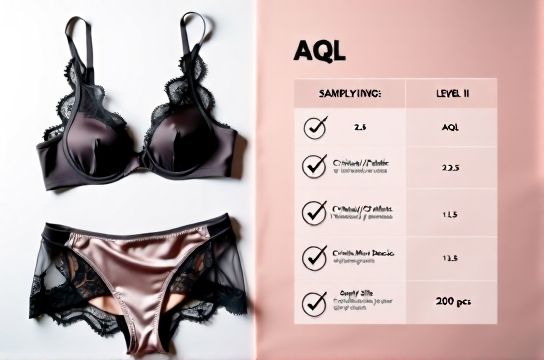
AQL stands for Acceptable Quality Limit, and it’s the global standard used in fashion manufacturing to determine how many defects are ‘acceptable’ in a production batch. Think of it as a quality safety net: inspect too few pieces, and flawed products slip through; inspect too many, and you’re wasting time and money.
Why AQL Matters More for Lingerie
Lingerie isn’t just clothing—it’s precision engineering with lace, elastics, underwires, and microfibers. A single stitching error can ruin comfort or support. That’s why most lingerie brands use AQL Level II with tightened inspection standards for critical defects (like broken hooks or mismatched cups).
Here’s a breakdown of common AQL levels used in apparel:
| Defect Type | AQL Limit (Level II) | Example in Lingerie |
|---|---|---|
| Critical | 0.0 | Sharp wire poking out, toxic dye |
| Major | 2.5 | Misaligned seams, wrong size labeling |
| Minor | 4.0 | Loose thread, slight color variation |
As you can see, **critical defects have a 0.0 AQL**—meaning even one can trigger a failed inspection. This makes sense when you consider safety and customer trust.
How Sampling Works: Real-World Example
Say you’re importing 5,000 units of lace bras from Vietnam. Based on ISO 2859-1 (the standard behind AQL), here’s your sample size:
- Lot Size: 3,201–10,000 units
- Sample Size: 200 pieces
- Acceptable Major Defects: Up to 10 units
- Acceptable Minor Defects: Up to 14 units
Find 11 major defects? The entire batch may be rejected or require 100% sorting. That’s costly—but far less than a product recall or angry unboxing videos on TikTok.
Tips from the Trenches
After auditing over 200 lingerie shipments, here’s what I’ve learned:
- Inspect at 80% production—not at the end. Catches issues early.
- Test functionality: Stretch every elastic, fasten every hook, check cup symmetry.
- Use a third-party inspector with lingerie-specific checklists.
And don’t forget fabric shrinkage! Always pre-wash samples. One client skipped this—result? 30% of bras shrank unevenly after first wash. Nightmare.
Final Thoughts
Understanding AQL standards for lingerie isn’t just about passing inspections—it’s about building a reputation for quality. In an era where customers demand perfection in fit and finish, cutting corners on QC is a gamble you can’t afford.
So next time you approve a production run, ask: “Have we inspected using the right AQL level?” Your brand’s credibility depends on it.