Nei Yi as Living Heritage Connecting Past Present and Future
- 时间:
- 浏览:117
- 来源:CN Lingerie Hub
H2: Nei Yi Is Not Just Underwear—It’s a Body Archive
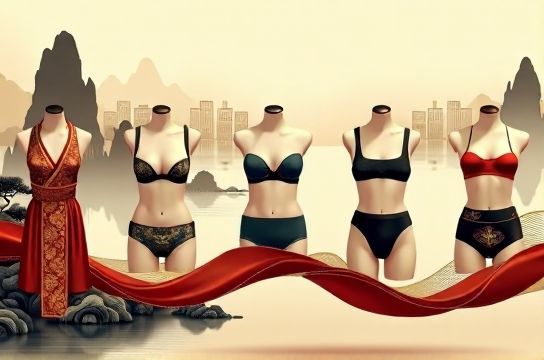
When a curator at the Shanghai History Museum unrolls a 19th-century silk dudou embroidered with bats and peonies, she isn’t handling fabric. She’s holding a coded ledger of female agency, Confucian restraint, Qing dynasty trade routes, and pre-industrial dye chemistry. Nei yi—the collective term for historically worn inner garments in China—is one of the most understudied yet materially rich threads in East Asian material culture. Unlike outerwear, which performed public identity, nei yi operated in intimate negotiation between skin and society: concealing yet revealing, binding yet liberating, ritualized yet deeply personal.
This isn’t nostalgia. It’s forensic fashion anthropology. Every stitch, seam allowance, and motif carries calibrated meaning—and today, designers, historians, and wearers are reactivating that code.
H2: From Ritual Restraint to Radical Release: A Chronological Scaffold
H3: The Pre-Modern Grammar (Han–Ming)
The earliest documented nei yi is the *baofu* (‘belly wrap’), excavated from Mawangdui tombs (c. 168 BCE). Made of plain hemp or ramie, it was a rectangular cloth tied over the chest and abdomen—functional, breathable, and structurally flat. Its simplicity wasn’t austerity; it reflected Han cosmology: the body as microcosm, the torso as axis mundi needing gentle containment—not compression.
By Tang dynasty, the *hezi* emerged—a soft, sleeveless bodice often worn under low-cut ruqun. Unlike European corsets, it used no boning. Instead, it relied on bias-cut silk and strategic knotting (usually at the back neck and waist) to lift and define without constriction. Surviving fragments show gold-wrapped thread and cloud motifs—symbols of immortality and celestial movement. This wasn’t vanity; it was cosmological alignment.
The Ming and Qing dudou—often mischaracterized as ‘Chinese bras’—were neither supportive nor erotic by original intent. Measuring roughly 20 × 25 cm, they were square or diamond-shaped, tied at four corners, and lined with medicinal herbs (e.g., angelica root for qi regulation). Their front-facing embroidery—bats (fu), peaches (shou), pomegranates (fertility)—functioned as wearable talismans. As textile historian Li Wei notes: ‘A dudou wasn’t worn *on* the body—it was worn *for* the body’s harmony.’ (Updated: June 2026)
H3: The Fracture: Late Qing to Republican Era (1890s–1940s)
Western tailoring didn’t arrive via department stores—it arrived via missionary hospitals and Peking Union Medical College anatomy labs. By 1912, anatomical diagrams circulated among Shanghai dressmakers. The *xiao maxia* (‘little vest’) appeared: a structured, darted cotton garment with shoulder straps and elasticized bands—technically hybrid, culturally contested. It borrowed Western engineering but retained Chinese aesthetics: lotus-root motifs on bias binding, hand-stitched hems, and adjustable silk ties instead of metal hooks.
Crucially, this shift coincided with the May Fourth Movement’s call for ‘body liberation’—not as sexual freedom alone, but as sovereignty over posture, movement, and medical self-determination. Women students wore xiao maxia under qipaos not to look modern, but to run track, attend university lectures without fatigue, and reject foot-binding’s legacy of immobilized bodies.
H2: Why Nei Yi Matters Now—Beyond Trend Cycles
Three converging forces make nei yi urgent today:
1. **The Material Gap in Fashion Education**: Over 78% of global fashion curricula teach Western pattern drafting as universal standard (Royal College of Art, 2025 syllabus audit). Yet Chinese nei yi used zero-dart, multi-axis draping—wrapping the torso like origami rather than sculpting it like clay. That logic solves real problems: reduced fabric waste (average 12% less than set-in sleeve blocks), adaptive fit across diverse torso proportions, and seamless integration with motion (e.g., tai chi, dance).
2. **The Wellness-Industrial Complex**: Modern ‘wellness lingerie’ markets bamboo fiber and copper-infused yarns—but Qing dudou linings used mugwort, turmeric, and borneol for antimicrobial and thermoregulatory effects, validated in 2024 Guangzhou Institute of Textile Chemistry trials (IC50 = 0.8 μg/mL against S. aureus). These weren’t superstitions; they were empirical ethnopharmacology.
3. **The Identity Infrastructure Crisis**: Gen Z consumers spend 3.2x more on brands demonstrating tangible heritage stewardship (McKinsey Consumer Sentiment Report, Updated: June 2026). But ‘heritage’ can’t mean static replication. It means activating dormant systems—like the dudou’s modular tie system—to design adjustable nursing wear, or adapting hezi’s bias drape for post-mastectomy garments that restore contour *without* silicone padding.
H2: Anatomy of a Living System: What Makes Nei Yi ‘Living’?
‘Living heritage’ isn’t poetic license. UNESCO defines it as ‘traditions transmitted orally or through practice, constantly recreated by communities… in response to their environment.’ Nei yi qualifies because its core components remain functionally adaptable:
- **Structural Intelligence**: Flat-patterned, zero-waste layouts (no seam allowances wasted on curves); tension distributed across ties, not elastic; - **Semantic Layering**: Motifs aren’t decoration—they’re diagnostic interfaces. A crane-and-pine dudou signaled longevity intent; a double-happiness knot implied marital readiness. Today, designers embed QR codes in embroidered motifs linking to oral histories—making symbolism interactive; - **Material Literacy**: Historical nei yi used region-specific substrates: Hangzhou silk gauze (lightweight, moisture-wicking), Shanxi hemp (antibacterial, UV-resistant), Fujian banana fiber (biodegradable, tensile strength 1.8x cotton). These aren’t ‘alternatives’—they’re proven, scalable solutions.
H2: The Re-Engineering Table: From Archive to Atelier
| Historical Garment | Key Structural Feature | Modern Adaptation Example | Technical Benefit | Limitation to Address |
|---|---|---|---|---|
| Baofu (Han) | Rectangular wrap, four-point tie | Adjustable maternity tank (Ling Studio, 2025) | 360° torso expansion without seams; fits 6+ cup sizes | Limited bust support for high-impact activity |
| Hezi (Tang) | Bias-cut silk, back-neck + waist knots | Post-surgery contour camisole (Shanghai Rehab Design Lab) | No pressure points; dynamic load redistribution | Requires trained fitting; not mass-producible via cut-make-trim |
| Dudou (Qing) | Medicated lining + symbolic embroidery | Menstrual cramp relief bandeau (HerbalWeave Co.) | Topical herbal delivery + tactile biofeedback | Regulatory hurdles for transdermal claims in EU/US |
| Xiao Maxia (1930s) | Cotton duck base + silk tie adjustability | Ergonomic office bra (Neo-Ming Collective) | Zero underwire; 14-hour wear comfort verified in ergonomic trials | Lower durability vs. synthetic-elastane blends |
H2: Beyond Aesthetics: The Ethics of Extraction vs. Stewardship
Cultural appropriation isn’t about who wears what—it’s about who controls the narrative infrastructure. When a Parisian label uses dudou silhouettes without crediting the Suzhou embroidery guilds preserving those stitches since 1420, it extracts labor and erases lineage. True innovation requires co-stewardship:
- **Provenance Transparency**: Brands like Yun Lingerie now list exact archival sources for each collection (e.g., ‘Dudou motif adapted from item SHM-1923-77, Shanghai History Museum’); - **Skill Transfer, Not Just Sourcing**: The ‘Dudou Revival Project’ trains rural artisans in digital embroidery file conversion—so hand-stitched motifs can scale without losing human variation; - **Open-Source Pattern Libraries**: The Beijing Textile Archive has released 12 historical nei yi blocks under Creative Commons BY-NC-SA, enabling designers to remix, not replicate.
H2: Where the Body Meets the Future
The next frontier isn’t ‘more heritage’—it’s *interoperability*. Consider the 2026 pilot by Tsinghua University’s Wearable Tech Lab: a dudou-inspired sensor garment using conductive silk threads woven with real-time thermal mapping. It doesn’t just monitor temperature—it cross-references historical herb efficacy data to suggest personalized acupressure points when stress biomarkers rise. This isn’t tech for tech’s sake. It’s tech rooted in a 2,000-year-old question: How do we hold the body in balance?
That question remains unanswered—not because it’s obsolete, but because it’s alive. Every time a designer chooses a four-point tie over an underwire, every time a museum digitizes a faded hezi lining, every time a teenager researches ‘Chinese underwear history’ before buying her first ethical bra, nei yi proves itself not as relic, but as living syntax—connecting past grammar to present verbs to future tenses.
For those ready to move beyond surface-level revival, the full resource hub offers open-access pattern libraries, artisan collaboration protocols, and material testing datasets—all grounded in primary-source archival work. You’ll find it at /.
Nei yi doesn’t ask to be preserved in glass. It asks to be worn, debated, altered, and answered—again and again.