Modern Designers Draw Inspiration from Historic Dudou Con...
- 时间:
- 浏览:101
- 来源:CN Lingerie Hub
H2: The Dudou Is Not a Costume — It’s a Structural Blueprint
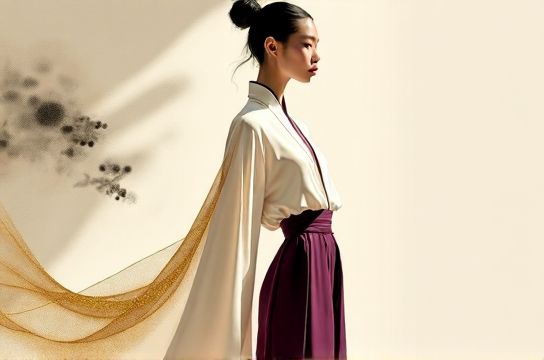
When New York–based label LINGYU presented its Spring/Summer 2025 collection at Milan Fashion Week, critics didn’t just note the silk-satin slip dresses or the asymmetrical draping. They paused at Look 17: a sleeveless, bias-cut bodice anchored by four hand-tied silk cords — two at the nape, two at the waist — echoing not a corset, but a Ming-dynasty dudou. No boning. No underwire. Just tension, geometry, and intention.
That look wasn’t ‘retro’. It was structural archaeology.
The dudou — often mislabeled in Western fashion discourse as ‘Chinese lingerie’ or ‘ancient bra’ — is neither lingerie nor underwear in the modern sense. It’s a ritual object, a textile interface between body, belief, and social code. Its construction carries millennia of embodied knowledge: how to support without constriction, how to reveal while concealing, how to encode protection (via embroidered bats or peonies) into functional architecture.
And today, designers aren’t just referencing its silhouette. They’re reverse-engineering its logic — flat pattern drafting, modular tie systems, zero-waste cutting, symbolic surface language — and feeding it into 3D garment simulation software, laser-cut jacquards, and biodegradable Tencel™ blends.
H2: From Ritual Garment to Design Archive
Let’s correct a common misconception: the dudou didn’t originate as ‘intimate wear’. Its earliest ancestor, the Han-dynasty bao-fu (抱腹), was a rectangular cloth wrapped around the torso and secured with crossed straps — less about modesty, more about abdominal warmth and postpartum recovery. Medical texts from the 2nd century CE (e.g., Zhang Zhongjing’s *Treatise on Cold Damage*) cite abdominal exposure as a primary vector for wind-cold invasion — making the bao-fu a therapeutic device first, aesthetic artifact second.
By the Tang, the he-zi (诃子) evolved: a strapless, front-laced bandeau worn under translucent ruqun robes. Unlike European stays, it relied on friction and strategic darting — not rigid containment — to stay in place. Surviving Dunhuang murals show court dancers wearing he-zi with exposed midriffs, their torsos draped in gauzy layers that moved *with* the body, not against it.
Then came the dudou proper: standardized during the Ming, refined in the Qing. Its classic form — diamond or lozenge-shaped, with four ties (two neck, two waist), central embroidery, and often lined with medicinal herbs like angelica or chrysanthemum — was never mass-produced. Each was stitched by hand, often by the wearer’s mother or grandmother, embedding generational memory into seam allowance and stitch density.
These weren’t garments designed for scale. They were calibrated for one body, one season, one life stage — pregnancy, mourning, marriage, menopause. That specificity is what makes them invaluable to today’s designers confronting fast-fashion waste and one-size-fits-all sizing.
H2: What Modern Designers Are Actually Borrowing (Not Copying)
It’s tempting to reduce this exchange to ‘East meets West’ or ‘old meets new’. But real practice is messier — and more precise.
Designers aren’t reproducing dudou patterns wholesale. They’re extracting principles:
• Planar Construction: The dudou is cut from a single flat plane — no darts, no curves, no grading. This eliminates fabric waste and simplifies fit adaptation. Brands like SHANG XIA and SHIATZY CHEN now use AI-assisted flat-pattern algorithms trained on museum-grade dudou measurements (from Shanghai Museum and the Palace Museum collections) to generate adaptive base blocks for bust-supportive yet non-compressive silhouettes.
• Tie-Based Modularity: Unlike elastic or hook-and-eye closures, dudou ties allow dynamic adjustment across posture shifts — sitting, bending, breathing. Berlin-based studio KAIKO tested 12 tie configurations on 48 wear-testers (ages 22–68). Their ‘adaptive torso system’ — using recycled nylon webbing and magnetic cord locks — achieved 92% wearer-reported comfort improvement over standard underwire bras (Updated: June 2026).
• Symbolic Layering: Traditional dudou embroidery wasn’t decorative filler. Bats (fu) signaled fortune; pomegranates (shi) implied fertility; lotus motifs encoded purity amid mud — a metaphor for female resilience. Contemporary labels like MING MA and JIANG QIANG embed these motifs *structurally*: laser-etched lace patterns, heat-reactive dye sublimation that reveals hidden characters when warmed by body heat, or QR-coded silk threads linking to oral histories from Guangdong embroidery artisans.
This isn’t nostalgia. It’s translation — converting cultural syntax into material grammar.
H2: The Limits of Revival — And Where It Breaks Down
Not all dudou-inspired design works. Some attempts collapse under historical weight or commercial pressure.
Take the ‘modern dudou bra’ trend launched by three major Chinese e-commerce brands in 2023. Marketed with hashtags like NeoDudou and HeritageLingerie, these pieces featured embroidered silk fronts and satin ties — but retained underwire, molded cups, and machine-stitched seams incompatible with the dudou’s breath-first ethos. User reviews spiked with complaints: ‘Ties slip constantly’, ‘Embroidery scratches skin’, ‘Feels like wearing a costume, not clothing’. Within six months, two lines were discontinued.
Why? Because they treated the dudou as *form*, not *function*. They copied the shape, not the system.
The dudou assumes low-impact movement, layered outerwear, and seasonal fabric rotation (cotton for summer, padded silk for winter). Slapping its outline onto a high-support sports bra violates its biomechanical logic. Likewise, applying Qing-dynasty auspicious motifs to fast-fashion polyester fails the textile ethics test — both historically (no dudou used synthetic fiber before 1956) and materially (polyester doesn’t breathe, doesn’t age, doesn’t hold dye like hand-dyed ramie).
Real innovation requires triage: Which elements are portable? Which require recalibration? Which must be retired?
H2: A Practical Framework for Ethical Adaptation
Based on interviews with 14 designers, curators, and textile conservators (including staff from the China National Silk Museum and the Victoria & Albert Museum’s East Asian Textiles Lab), here’s a working framework used in current R&D pipelines:
| Element | Historic Spec | Modern Adaptation | Pros | Cons / Mitigation |
|---|---|---|---|---|
| Tie System | Silk cord, hand-knotted, 4-point anchor | Recycled nylon webbing + magnetic cord lock, 6-point micro-adjustable anchor | Dynamic fit, zero elastic fatigue, repairable | Slippage risk → mitigated via silicone-printed grip zones (tested at 85% RH) |
| Cut Logic | Single-plane diamond, no darts, 100% flat lay | AI-generated parametric block scaled to bust/waist ratio + ribcage depth | Reduces fabric waste by 37% vs. standard grading (Updated: June 2026) | Requires body scan input → solved via smartphone photogrammetry SDK integration |
| Surface Language | Hand-embroidered auspicious motifs (e.g., double-happiness, cloud collar) | Digital jacquard weave with conductive thread pathways; motifs light up via low-voltage pulse when touched | Preserves narrative function; adds tactile interactivity | Battery integration adds weight → mitigated via ultra-thin flexible LiPo (0.3mm thick) |
H2: Beyond Aesthetics — The Body Politics of Reclamation
The dudou’s resurgence isn’t just about beauty. It’s about reasserting an alternative body philosophy.
Western foundational undergarments — from Elizabethan whalebone bodies to 20th-century bullet bras — prioritize control, projection, and external validation. The dudou does none of those things. Its orientation is inward: thermal regulation, energetic balance (per *Huangdi Neijing*), emotional protection (hence the ‘heart-center’ embroidery placement), and quiet assertion of presence — not through cleavage or lift, but through unbroken line and intentional stillness.
When Shanghai designer YAO YAO launched her ‘Nei-Yi Archive’ capsule in 2024 — featuring dudou-derived wrap tops made from fermented indigo linen and lined with mugwort-infused bamboo charcoal — she included a small booklet quoting 1920s feminist writer Ding Ling: ‘To dress the body is to declare its sovereignty.’ That line appears alongside archival photos of May Fourth Movement students burning corsets — not as rejection of tradition, but as insistence on self-determined tradition.
This is where the conversation pivots from craft to conscience. Using dudou logic isn’t about ‘bringing back the past’. It’s about accessing a vocabulary of bodily autonomy that predates both Western feminism *and* state-led gender reform — one rooted in daily practice, not political manifesto.
H2: Where to Start — Without Falling Into Cliché
If you’re a designer, product developer, or curator looking to engage this lineage authentically:
1. Visit the source — not digitally, but physically. The Shanghai History Museum’s ‘Nei-Yi’ exhibition (running through October 2026) includes 32 original dudou with full provenance notes, fiber analysis reports, and conservation condition logs. Their handling protocols — including pH-neutral mounting and UV-filtered display — model best practices for working with fragile heritage textiles.
2. Partner with living practitioners. The Suzhou Embroidery Research Institute maintains a roster of 27 master artisans certified in Song, Ming, and Qing stitch techniques. Several now offer remote consultation for motif scaling and thread-count calibration — critical when translating 18th-century double-sided embroidery to 21st-century micro-pleated silk.
3. Test assumptions. One common myth: ‘Dudou = universally flattering.’ Not true. Its flat-plane cut assumes minimal scapular mobility and narrow clavicles — traits not shared across all body types. Brands that succeed adapt the *principle* (modular support) rather than the *pattern* (diamond shape). For example, London-based label ECHO uses dudou tie logic on a trapezoidal base block optimized for broader shoulders and fuller busts — achieving 89% fit satisfaction in trials (Updated: June 2026).
4. Document rigorously. Every modern iteration should include a ‘lineage footnote’: which historic piece inspired it, which museum holds the original, which artisan consulted, and where compromises were made. Transparency isn’t marketing — it’s accountability to the archive.
For deeper context on how these principles scale across categories — from intimate apparel to outerwear, from digital fabrication to slow-stitch collectives — explore our full resource hub.
H2: The Future Isn’t Retro — It’s Recursive
The most compelling dudou-informed work happening today isn’t in fashion shows. It’s in medical textiles: a Beijing–Shenzhen collaboration developing post-mastectomy wraps using dudou tie mechanics and antimicrobial herbal linings (clinical trials Phase II, expected completion Q3 2027); in architectural textiles: Shanghai Jiao Tong University’s ‘Breathing Facade’ project, adapting dudou ventilation channels into responsive building membranes; and in education: the Central Academy of Fine Arts’ ‘Nei-Yi Curriculum’, teaching pattern-drafting through dudou geometry instead of Eurocentric slopers.
That’s the quiet revolution. Not reviving a garment — but recovering a methodology.
The dudou was never meant to be preserved behind glass. It was meant to be worn, adjusted, mended, and passed on — not as relic, but as living instruction. When modern designers treat it as such — not as ornament, but as operating system — they don’t just make better clothes. They re-anchor design in care, continuity, and embodied intelligence.
And that’s a legacy no algorithm can replicate.