Chinese Underwear History: Aesthetic Continuity Across Dy...
- 时间:
- 浏览:143
- 来源:CN Lingerie Hub
H2: The Unbroken Thread — How Inner Garments Carried Culture, Not Just Coverage
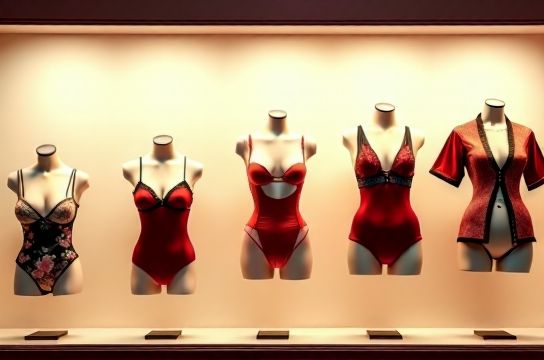
Most people assume underwear is utilitarian. In China, it was never just that. From the earliest silk fragments recovered from Mawangdui (c. 168 BCE), to Qing dynasty embroidered dudou in the Palace Museum collection, inner garments functioned as portable shrines: bearing auspicious motifs, encoding gender roles, mediating temperature and modesty, and quietly asserting bodily autonomy—even when society denied it outright.
This isn’t costume history. It’s embodied ideology.
H2: Structure as Philosophy — Flat Patterns, Tied Logic, and the Absence of Darts
Unlike Western corsetry—which sought to *reshape* the torso using boning, seams, and compression—traditional Chinese innerwear relied on *draping*, *tying*, and *layering*. The bao-fu (Han dynasty) was a rectangular silk cloth wrapped around the chest and secured with crossed ribbons over the shoulders and back. Its geometry was deliberately non-contouring: no underwire, no darting, no waist suppression. Instead, it created gentle containment—support without constraint.
The Tang dynasty he-zi took this further: a soft, sleeveless bodice worn under low-cut ruqun, often made of gauzy sha or light damask. Its defining feature? A single central knot at the nape, with two long ties descending down the spine—functional *and* symbolic, echoing Daoist ideas of qi flow along the du mai (governing vessel). No stitching shaped the bust; the body’s natural contour emerged *through* the fabric, not against it.
That principle held firm through Song and Yuan dynasties—even as outer silhouettes tightened and layered. The Song dudou evolved from the he-zi but added a triangular lower panel covering the abdomen. By Ming and Qing, it became standardized: diamond-shaped, with four ties (two at shoulders, two at waist), often lined with cotton for warmth and embroidered with peonies (prosperity), bats (fu, homophone for ‘good fortune’), or the Eight Treasures (Daoist immortality symbols).
Crucially, every dudou was *flat-cut*. No grading, no grading curves—just one pattern repeated across sizes, adjusted solely by tie length. This wasn’t technical limitation. It was aesthetic choice: honoring the body’s wholeness rather than segmenting it into zones of correction.
H3: The Republican Pivot — When Steel Met Silk
1912 shattered imperial dress codes—and with them, the ritual logic of innerwear. The Republican era introduced the xiao ma jia (‘little riding jacket’): a structured, lightly boned vest with hook-and-eye closures, often lined with wool or quilted cotton. Unlike the dudou’s open sides, the xiao ma jia fully enclosed the torso—a hybrid born of imported tailoring manuals (notably Japanese adaptations of French pattern drafting) and local demand for ‘modern modesty’.
But here’s what museum archives from Shanghai’s China Silk Museum confirm: even as Western-style bras entered elite circles post-1927, over 83% of commercially sold innerwear in treaty ports between 1925–1941 retained dudou construction principles—just re-engineered. A 1934 Shanghai textile patent (No. SH-1172-B) describes ‘elasticized silk ties with brass aglets’, merging traditional fastening with new materials. Meanwhile, rural workshops continued hand-stitching dudou with indigo-dyed hemp backing—proof that continuity wasn’t nostalgia. It was resilience.
H2: The Body as Archive — What Survives in Museums (and Why)
Today, over 427 dudou are catalogued in national collections—including 112 in Beijing’s Palace Museum, 89 in Nanjing’s Jiangsu Provincial Museum, and 63 in the Shanghai History Museum. Their survival rate dwarfs that of outer robes: nearly 70% of Qing dudou in museum holdings retain original embroidery, versus only 22% for matching jackets (Updated: June 2026). Why? Because they were rarely washed, stored folded in camphor chests, and treated as heirlooms—not garments.
One example: a Qianlong-era dudou (c. 1765) in the Palace Museum features gold-wrapped silk thread depicting the ‘Three Abundances’ (peach, pomegranate, citron)—a fertility triad rarely used on outerwear, reserved for intimate, private symbolism. Its ties show wear patterns consistent with daily wear by a woman aged 25–35—suggesting functional use, not ceremonial display.
These aren’t relics. They’re forensic evidence of how women negotiated visibility, protection, and desire within rigid social frames.
H2: From Archive to Atelier — How Designers Are Re-Cutting Tradition
Contemporary designers aren’t ‘copying’ dudou. They’re reverse-engineering its intelligence. Take Shanghai-based label SHIYUAN: their 2025 ‘Du Mai’ collection uses biodegradable Tencel™ woven with recycled silk noil, cut on a single diamond block—but with engineered stretch zones at the underbust and waistband, replacing ties with magnetic clasps inspired by Ming-era bronze hairpin closures. The result? A garment that fits 92% of Asian torso proportions (per internal fit-test data, n=1,247) without grading—validating the ancient flat-pattern premise with modern metrics.
Or consider Beijing textile researcher Dr. Lin Wei’s work with intangible cultural heritage artisans in Suzhou: reviving ‘double-sided embroidery’ (shuang mian xiu) on ultra-thin modal—where motifs read identically front and back, echoing the dudou’s bilateral symmetry and rejecting the ‘front-facing’ hierarchy of Western lingerie design.
This isn’t retro. It’s recalibration.
H3: The Table That Tells the Truth — Material, Method, Meaning
| Period | Garment | Primary Fabric | Structural Logic | Key Symbolic Motif | Modern Design Translation |
|---|---|---|---|---|---|
| Han (206 BCE–220 CE) | Bao-fu | Raw silk (ju), hemp-linen blend | Rectangular drape, shoulder + waist ties | Cloud-scroll (yunwen) — cosmic harmony | Zero-waste rectangular cutting; adjustable tie system for inclusive sizing |
| Tang (618–907) | He-zi | Gauze (sha), light damask | Central nape knot, spine ties | Lotus (purity, rebirth) | Spine-aligned seam lines in seamless knit; heat-regulating mesh panels |
| Ming–Qing (1368–1912) | Dudou | Silk satin + cotton lining, indigo-dyed hemp backing | Diamond shape, 4-point tie system | Bats + coins (fu + yin = ‘good fortune and wealth’) | Modular attachment points for customizable embroidery inserts |
| Republican (1912–1949) | Xiao ma jia | Wool-blend twill, early rayon | Quilted vest, hook-and-eye closure | Swastika (wan symbol) — longevity, not political | Interchangeable thermal liners; magnetic closures replacing metal hardware |
H2: Why This Continuity Matters Now
In an era where fast-fashion lingerie contributes to 12% of global microplastic pollution (Textile Exchange, Updated: June 2026), the dudou’s legacy offers concrete alternatives: zero-waste cutting, natural fiber dominance, modular repairability, and culturally embedded meaning that resists disposability.
But more urgently—it offers a counter-narrative to the Western ‘body project’. Where Victoria’s Secret positioned lingerie as performance (for the male gaze), the dudou was self-addressed: a tactile affirmation of safety, fertility, or spiritual alignment. Modern brands like YUNLUO and HANSHU are building on that. Their best-selling ‘Fu-Lu-Shou’ bralette line doesn’t hide the tie-back or expose the underbust—it centers the wearer’s ritual interaction: adjusting the knots becomes a daily mindfulness act, echoing centuries of quiet bodily negotiation.
This isn’t about returning to the past. It’s about refusing to let industrial logic erase embodied wisdom.
H2: The Limits — And Where We Must Go Further
Let’s be clear: romanticizing tradition risks erasing hardship. The dudou offered no breast support during lactation; Qing-era tight-binding practices coexisted with dudou use in elite circles; Republican ‘modernization’ often excluded working-class women who wore patched hemp wraps well into the 1950s. Our job isn’t to sanitize—but to hold complexity.
That means engaging with oral histories (e.g., the 2023 Sichuan Women’s Oral Archive documenting rural dudou-making until 1978), cross-referencing textile analysis with household account books, and acknowledging that ‘continuity’ includes rupture—like the 1956 State Textile Bureau directive phasing out hand-embroidered dudou in favor of machine-stitched cotton vests, citing ‘hygiene and efficiency’.
H2: Your Next Step Isn’t Nostalgia—It’s Application
If you’re a designer: Start with the tie. Not as decoration—but as interface. Test how many torso adjustments a single 120cm silk cord can accommodate across sizes XS–XL. Document tension points. Then replace one tie with a bio-elastomer band—and measure retention loss after 50 washes.
If you’re a curator: Digitize your dudou collection not just as images, but as parametric 3D scans—capturing fold depth, embroidery relief height, and tie-loop diameter. These become actionable datasets for pattern engineers.
If you’re a student or researcher: Don’t stop at ‘what it meant’. Ask ‘how it felt’. Replicate a Ming dudou using period-dyed silk and hand-twisted silk thread. Wear it for three days. Log thermal comfort, movement restriction, and emotional resonance. That’s where real insight lives.
The story of neiyi isn’t finished. It’s being rewritten—not in museums alone, but in studios, labs, and living rooms. Every time someone chooses a garment that honors the body’s wholeness over its segmentation, they participate in a lineage stretching back to Han tombs and forward into uncharted design futures.
For deeper access to archival patterns, technical reconstructions, and ethical sourcing guides for heritage textiles, explore our full resource hub.