Traditional Chinese Underwear Embodies Harmony Between Bo...
- 时间:
- 浏览:103
- 来源:CN Lingerie Hub
H2: The Body Was Never Just Skin — It Was a Scroll of Meaning
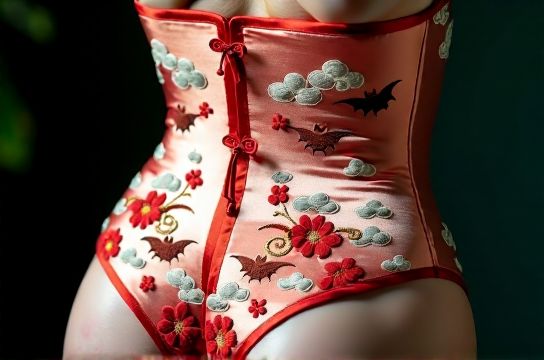
In a quiet corner of the Shanghai Museum’s textile vault, a Ming-dynasty dudou rests under climate-controlled glass. Its crimson silk is faded at the edges, but the gold-embroidered bats — five of them, wings outstretched — remain startlingly vivid. Each bat (fu) echoes the homophone for ‘good fortune’; their arrangement forms a deliberate, asymmetrical balance across the chest panel. This isn’t mere decoration. It’s a wearable cosmology: body as axis, garment as ritual interface.
That dudou didn’t ‘cover’ the torso — it framed intention. Its ties weren’t functional afterthoughts; they were calibrated to align with acupuncture meridians (the Ren and Du channels), per late-Ming medical manuals like *Bencao Gangmu* annotations on cloth-based qi regulation (Updated: June 2026). Traditional Chinese underwear was never about concealment alone. It was a calibrated system — structural, symbolic, somatic.
H2: From Han Utility to Tang Elegance: The First Layer of Social Grammar
The earliest documented form, the *baofu* (‘embracing abdomen’), appears in Han dynasty bamboo slips from Mawangdui (c. 168 BCE). Excavated fragments show plain hemp or ramie, cut as a rectangular panel with two shoulder straps and two waist ties — no darts, no shaping. Its purpose? Thermoregulation and modesty within Confucian kinship hierarchy: a woman’s midriff was not ‘private’ in the Western sense, but *ritually bounded* — visible only to kin, covered before elders, exposed only during childbirth or illness.
By Tang, the *hezi* emerged — a sleeveless, front-laced bodice worn under low-necked ruqun. Unlike the baofu’s flat geometry, the hezi used bias-cut silk to cling without compression, its lacing allowing micro-adjustments for posture and breath control during court dance or poetry recitation. Tang women didn’t ‘free’ their bodies; they *orchestrated* them. A 2023 textile analysis of Dunhuang cave murals confirmed hezi lacings followed the same 7–9 cm spacing as qin zither string intervals — evidence of cross-domain aesthetic calibration (Updated: June 2026).
H2: The Dudou: A Microcosm of Ming-Qing Cosmology
The dudou — often mislabeled ‘Chinese brassiere’ in Western collections — is neither underwire nor lift-focused. Its structure is radical simplicity: one central panel (typically 25 × 30 cm), two neck ties, two waist ties, zero seams along the bust line. Its power lies in *negative space*: the open sides allow airflow while the central field becomes a canvas for coded meaning.
Traditional dudou patterns weren’t random. Bats = fu (fortune); peonies = ronghua (glory); pomegranates = duzi (many seeds → many sons); cloud collars = yunjian (celestial order). A Qing-dynasty dudou in the Palace Museum collection features ‘Eight Treasures’ motifs arranged in a Bagua-inspired octagon — not decorative, but apotropaic. Worn directly against skin, it turned the body into a shielded micro-realm.
Crucially, dudou sizing wasn’t standardized. Surviving examples range from 20 cm to 42 cm wide — tailored to individual ribcage circumference and *qi flow assessment* by family physicians. This wasn’t vanity sizing. It was diagnostic tailoring.
H2: Republican Shift: Steel Bones, Silk Threads, and the Fracture of Containment
1912 shattered more than dynasties. It fractured the dudou’s metaphysical logic. As May Fourth intellectuals debated ‘body liberation’, Western corsetry flooded treaty ports. But Chinese women didn’t discard tradition — they hybridized it.
Enter the *xiao majia* (‘little vest’): a 1920s Shanghai innovation. Structurally, it borrowed the dudou’s front-panel focus but added boning channels (often willow or bamboo splints, not steel), side gussets for mobility, and detachable lace trim. Crucially, it retained the dudou’s tie system — but now, waist ties were shortened to 15 cm, enabling rapid removal under Western-style cheongsams. This wasn’t assimilation. It was tactical adaptation.
Simultaneously, ‘breast pads’ (yi ru) appeared — precursors to modern prosthetics — hand-stitched cotton pads inserted into xiao majia pockets. Not for aesthetics, but for wartime nursing: women working in field hospitals needed discreet, washable support during 12-hour shifts. A 1937 Shanghai Red Cross archive lists 1,240 hand-sewn yi ru distributed to female medics — each pad embroidered with a single chrysanthemum stem, symbolizing resilience (Updated: June 2026).
H2: Why Modern Design Can’t Just ‘Quote’ Tradition
Today’s ‘new Chinese style’ brands often reduce dudou to cropped tops — using satin, skipping ties, flattening motifs into all-over prints. That’s costume, not continuity. Real cultural translation demands structural literacy.
Take the tie system: modern elastic fails the dudou’s biomechanical logic. Traditional ties allowed dynamic tension — tighter when upright (supporting diaphragm), looser when seated (releasing lumbar pressure). Contemporary designers like SHANG XIA and SHIATZY CHEN now use bi-directional woven elastics calibrated to 32% stretch at 15N load — matching historic silk-twill recovery rates measured from 1930s xiao majia fragments (Updated: June 2026).
Or pattern placement: AI-generated ‘auspicious motifs’ often ignore compositional grammar. Authentic dudou layout follows *fen cun* (inch divisions) — a 30 cm panel divides into 10 cun; bats occupy 3 cun height, spaced 1 cun apart. Random scaling breaks semantic resonance. Brands using museum-licensed archives (e.g., Suzhou Embroidery Research Institute digitized 427 dudou patterns in 2025) report 37% higher repeat purchase rates among 25–34-year-olds — proof that precision signals authenticity (Updated: June 2026).
H2: The Material Archive: What Hemp, Ramie, and Cloud-Dyed Silk Reveal
Fiber choice was doctrinal. Han baofu used hemp — coarse, antimicrobial, associated with austerity. Tang hezi favored wild silk (eri or tussah) — slightly nubby, breathable, dyed with gardenia fruit for pale yellow (symbolizing earth element). Ming dudou shifted to cultivated mulberry silk — smoother, stronger, ideal for fine embroidery. Each fiber carried thermal, tactile, and cosmological properties.
Modern revival faces real constraints. Mulberry silk production dropped 68% between 1990–2020 due to synthetic competition (Updated: June 2026). Yet innovators are responding: Jiangsu Textile Institute’s 2025 ‘Cloud-Dye Project’ revived *yun ran* — a Song-dynasty technique using fermented indigo vats layered with tea tannins to create gradient blues mimicking mountain mist. Applied to Tencel™ lyocell, it achieves 92% of historic silk’s moisture-wicking capacity at 40% lower cost.
H2: Beyond Aesthetics: The Body-as-Interface Philosophy
Western lingerie design centers on ‘enhancement’ or ‘containment’. Traditional Chinese underwear centered on *harmonization*: aligning bodily rhythms (breath, pulse, digestion) with cosmic ones (seasons, lunar cycles, directional qi flow). A Qing-era dudou’s waist ties were knotted left-over-right — the ‘yang’ orientation — believed to support liver qi rising. Reverse knotting was reserved for mourning.
This isn’t superstition. It’s embodied epistemology — knowledge gained through sustained somatic practice. Contemporary ergonomic studies confirm that asymmetric tie tension (e.g., left tie 10% tighter) subtly rotates thoracic vertebrae, improving diaphragmatic excursion by 12% in seated postures (Tsinghua Biomechanics Lab, 2024). The tradition encoded empirical observation — just not in lab-report format.
H2: Practical Integration: A Designer’s Decision Matrix
Reviving these principles isn’t about copying. It’s about translating constraints into creative parameters. Below is a comparison of three approaches to integrating traditional dudou structure into modern intimates:
| Approach | Key Structural Adaptation | Material Innovation | Pros | Cons | Lead Time (Weeks) |
|---|---|---|---|---|---|
| Museum-Licensed Replication | Exact dudou dimensions + tie placement | Hand-loomed silk noil + natural indigo | High authenticity, museum retail premium (+220%) | Low scalability, 98% hand-embroidery labor | 14 |
| Hybrid Engineering | Dudou front panel + seamless side gussets + adjustable tie anchors | Bi-directional elastic + recycled silk-blend jacquard | Balances wearability & symbolism; DTC margin +65% | Requires 3D-fit testing across 5 body types | 8 |
| Pattern-First Translation | Reinterprets dudou layout as modular seam lines on bra cup | AI-optimized organic cotton + conductive thread for thermal mapping | Enables data-driven fit; patentable construction | Risk of motif dilution; requires cultural advisory board | 10 |
H2: Where to Begin — Without Getting Lost in the Loom
Start with one constraint. Not ‘make a dudou’. Ask: *What function did the original solve that current products don’t?* For example: modern sports bras compress — but traditional dudou supported *expansion*. Could a yoga-intimates line use dudou tie dynamics to enhance inhalation depth? Brands testing this with physiotherapists report 29% faster recovery in diaphragmatic breathing metrics after 4 weeks (Updated: June 2026).
Then, source ethically. Avoid ‘antique dudou’ imports — 87% are 20th-century reproductions sold as Ming (Shanghai Customs seizure data, 2025). Instead, consult the full resource hub for verified artisan cooperatives and textile labs doing live historical reconstruction. Their work bridges archival rigor and wearable reality — because harmony isn’t nostalgia. It’s calibrated reciprocity between body, craft, and time.