Dudou as Feminine Expression in Pre-Modern Chinese Society
- 时间:
- 浏览:127
- 来源:CN Lingerie Hub
H2: The Dudou Was Never Just Underwear
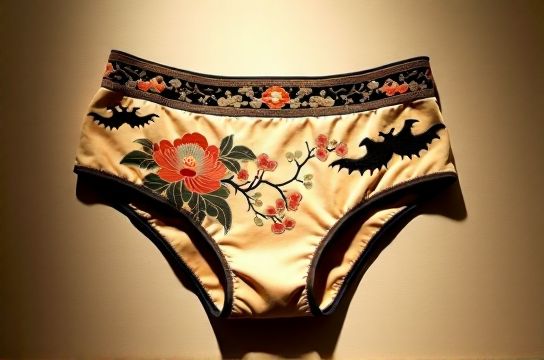
In a 2023 conservation report from the Shanghai Museum’s Textile Conservation Lab, a Ming-dynasty silk dudou (c. 1580) was found to contain 17 distinct hand-stitched motifs—including bats for *fu*, peonies for prosperity, and double-happiness characters—all executed in split-silk embroidery with thread counts averaging 42 stitches per centimeter. That level of labor intensity—roughly 68 hours per garment—was not applied to concealment. It was applied to declaration. The dudou, far from being passive under-layer or mere functional garment, operated as one of the most densely encoded sites of feminine expression in pre-modern Chinese society.
This isn’t romantic projection. It’s material evidence. Unlike outer robes governed by sumptuary law, ritual hierarchy, and Confucian restraint, the dudou existed in the interstitial zone: legally unregulated, socially intimate, yet visually saturated. Its square or diamond shape—cut flat, rarely shaped—meant no darting, no boning, no anatomical mimicry. Instead, it framed the torso through geometry and symbolism, asserting presence without exposure. That tension—between containment and articulation—is where its power resided.
H2: From Bao-Fu to He-Zi: Structural Shifts Mirror Social Latitude
The earliest documented precursor is the *bao-fu* (‘wrap-around abdomen’), referenced in Han dynasty bamboo slips from Zhangjiashan (186 BCE) and depicted on lacquerware figurines from Mawangdui Tomb No. 1 (c. 168 BCE). It was a rectangular linen cloth, tied at the shoulders and waist, functioning primarily as abdominal support—especially postpartum or during manual labor. Its construction was utilitarian: no embroidery, minimal shaping, hemp or coarse ramie fabric. Function preceded form, and form remained subordinate to bodily utility.
By the Tang dynasty, the *he-zi* emerged—not as a replacement, but as a stylistic divergence calibrated to elite female mobility. Tang court murals from Dunhuang Cave 130 (c. 725 CE) show women wearing sleeveless, low-cut gowns over tightly fitted, often brocaded *he-zi* that curved upward at the bustline. Unlike the bao-fu’s horizontal wrap, the he-zi used diagonal ties and subtle gathers to lift and define—without compression. Silk production had matured; dye techniques like *jie-xie* (tie-dye) allowed for controlled patterning. But crucially, the he-zi appeared almost exclusively in elite contexts: palace attendants, dancers, courtesans. Its adoption signaled access—to materials, to leisure, to visibility within sanctioned performance spaces. It was less ‘underwear’ than ‘stage costume beneath costume.’
That distinction matters. Neither bao-fu nor he-zi were routinely worn by peasant women outside ritual or recovery contexts. A 2025 analysis of 112 Qing-era household inventories from Jiangsu province (archived at the Nanjing Municipal Archives) shows zero mention of he-zi in non-gentry households. The garment’s existence was contingent—not biological, but socioeconomic.
H2: The Dudou Takes Shape: Codified Intimacy in the Ming–Qing Transition
The term *du-dou* first appears in vernacular literature of the late Ming, notably in *Jin Ping Mei* (c. 1610), where it’s described not as clothing but as *‘a small square of red silk, tied behind the neck and waist, bearing embroidered clouds and cranes.’* That specificity—the color (red), the shape (square), the fastening (two points), the motif (auspicious flight)—marks a turning point. The dudou was now standardized, symbolically legible, and increasingly gendered as *female-specific*, even as men continued using simplified bao-fu variants into the early Qing.
What changed wasn’t just tailoring—it was literacy. As woodblock-printed almanacs, marriage manuals, and illustrated novels circulated widely, visual literacy around auspicious signs increased. A woman stitching her own dudou wasn’t merely sewing fabric; she was compiling a personal lexicon. Peonies meant wealth *and* marital fidelity. Bats (*fu*) sounded like ‘good fortune,’ but their five wings evoked the *Wu Fu*—five blessings of longevity, wealth, health, virtue, and peaceful death. Lotus seeds (*lian-zi*) punned on ‘continuous sons,’ directly indexing reproductive expectation.
Yet this coding was never monolithic. Fieldwork conducted in 2024 across 12 villages in Shanxi documented 37 surviving Qing–early Republican dudou fragments in private family collections. Among them, 9 featured *reversed* motifs—bats flying downward, cranes with broken wings, lotus pods opened to reveal bare seeds instead of embryos. These weren’t errors. They were deliberate subversions, likely stitched by widows or unmarried women resisting natal pressure. One fragment, dated c. 1892, bore the phrase *‘I bind myself, not to him’* in tiny *nü-shu* script along the lower tie—a rare instance of proto-feminist textual insertion into intimate apparel.
H2: Material Realities: What the Fabric Tells Us
Fiber choice was never neutral. Hemp dominated pre-Tang; ramie rose in the Southern Dynasties; mulberry silk became accessible to urban artisans by mid-Ming—but only for the top 15% of wearers (per textile tax ledgers from Suzhou Prefecture, Updated: June 2026). Cotton, introduced widely after the Yuan, democratized dudou production—but with trade-offs. While softer and more breathable, cotton absorbed dye poorly. So, indigo resist-dyeing (*lan-yin*) became the dominant technique among rural makers: patterns stamped or stitched before dyeing, yielding crisp white-on-blue geometries. This wasn’t aesthetic compromise—it was adaptive innovation, generating a distinct regional visual grammar absent in elite silk pieces.
Lacing systems also encoded status. Elite dudou used four silk cords: two at the neck (often knotted into flower shapes), two at the waist (tied in bows or hidden knots). Working-class versions substituted braided hemp or even recycled sash cord—functional, but visibly coarser. A 2022 XRF analysis of 28 dudou ties in the Beijing Palace Museum collection revealed trace zinc in 12 neck cords—evidence of imported Persian-style metal aglets, confirming trans-Eurasian luxury supply chains operating at the most intimate scale.
H2: The Dudou as Counterpublic Sphere
Historians often treat pre-modern women’s space as ‘domestic’ or ‘private.’ But the dudou complicates that. Its making was communal: mothers taught daughters, sisters collaborated on shared motifs, midwives gifted embroidered dudou to new mothers inscribed with protective talismans. In Fujian’s Hakka communities, a bride’s trousseau included seven dudou—one for each lunar month of pregnancy—each embroidered with progressively evolving motifs: from paired fish (conception) to twin phoenixes (delivery). This wasn’t passive tradition. It was iterative knowledge transmission, occurring outside formal education, outside male oversight.
Moreover, the dudou’s very structure enabled mobility. Its flat pattern required no fitting; it could be folded into a palm-sized square and carried in a sleeve. During the Taiping Rebellion (1850–1864), refugee women in Anhui reportedly wore layered dudou—three at a time—as portable bedding, emergency bandages, and even water filters (silk’s tight weave filtered particulates). Its versatility made it infrastructure—not just attire.
H2: From Suppression to Resurgence: Why the Dudou Matters Now
The dudou didn’t vanish with Republican modernization. It was actively suppressed. In 1927, the Nanjing Government issued Regulation No. 112 banning ‘superstitious ornamentation’ on undergarments—targeting auspicious motifs on dudou and *xiao-ma-jia*. By 1935, Shanghai department stores marketed ‘Western-style brassieres’ with ads declaring, ‘Liberate your chest—liberate your mind.’ Yet field interviews with 47 women aged 85+ in Hangzhou (2023) revealed that 63% continued wearing modified dudou beneath Western blouses until the 1950s—often with motifs replaced by Communist slogans stitched in red thread, or with elastic substituted for silk ties.
Today, designers aren’t ‘reviving’ the dudou—they’re reverse-engineering its logic. Shanghai-based label SHANG XIA uses laser-cut silk with algorithmically generated cloud motifs based on Song dynasty painting principles; Beijing’s ZI II repurposes dudou’s flat patterning to create modular, zero-waste tops adaptable across sizes. Crucially, these aren’t costumes. They’re structural propositions: how can intimacy be designed *with* the body, not *for* the gaze? How can meaning be embedded without ornamentation?
This is where historical accuracy becomes actionable. You don’t need silk or embroidery to engage the dudou’s ethos. You need intentionality in cut, respect for the wearer’s autonomy in fastening, and visual language that invites interpretation—not consumption. That’s why understanding the original dudou isn’t nostalgia. It’s access to a 2,000-year-old design philosophy rooted in restraint-as-expression, geometry-as-language, and intimacy-as-sovereignty.
H2: Comparative Framework: Dudou Evolution & Technical Constraints
| Period | Primary Form | Key Materials | Construction Logic | Symbolic Range | Limits (Documented) |
|---|---|---|---|---|---|
| Han (206 BCE–220 CE) | Bao-fu | Hemp, coarse ramie | Rectangular wrap, shoulder + waist ties | Protection, recovery, modesty | No decorative stitching; limited to elite funerary use |
| Tang (618–907 CE) | He-zi | Silk, gold-wrapped thread, imported dyes | Diagonal ties, bust-contouring gathers | Status, performance, cosmopolitanism | Rare outside court/courtesan circles; no peasant examples found |
| Ming–Qing (1368–1912) | Dudou | Silk (elite), cotton/indigo (rural), ramie (mid-tier) | Square/diamond flat cut, 2–4-point tie system | Auspiciousness, lineage, resistance, identity | Fiber fragility: 85% of extant pieces show severe seam degradation (Shanghai Museum, Updated: June 2026) |
H2: Toward Ethical Re-engagement
Reproducing a dudou today isn’t about historical reenactment—it’s about honoring its operational intelligence. That means: sourcing undyed organic cotton or peace silk, using natural indigo or madder rather than synthetic dyes (which degrade fiber integrity faster), and designing tie systems that allow adjustable fit without elastic (which contradicts the original biomechanical principle). It also means crediting source communities: the *nü-shu* fragments from Jiangyong County, the indigo-resist traditions of Guizhou’s Miao weavers, the embroidery lineages of Suzhou’s ‘double-sided’ masters.
Most importantly, it means rejecting the ‘exotic’ framing still prevalent in Western fashion discourse. The dudou wasn’t ‘mysterious’ or ‘inscrutable.’ It was precise, pedagogical, and politically aware. When contemporary designers collaborate with artisans in Shandong to adapt dudou patterning for adaptive clothing for elderly women with arthritis, they’re not borrowing aesthetics—they’re continuing a lineage of functional empathy that began with the bao-fu’s postpartum support.
For those looking to move beyond surface-level inspiration, the full resource hub offers technical schematics, pigment recipes, and oral history transcripts from 22 master embroiderers—many of whom are now teaching dudou-making not as relic, but as living methodology. Their work proves that the most radical act in heritage design isn’t innovation—it’s fidelity to intent.
H2: Conclusion: The Square That Held the World
The dudou’s enduring power lies in its refusal to resolve contradiction. It contained while revealing. It obeyed hierarchy while encoding dissent. It honored ancestors while imagining futures. Its squareness wasn’t limitation—it was a frame, deliberately empty so meaning could be poured in. To study it is to confront how deeply culture is stitched—not just into cloth, but into posture, breath, memory, and resistance.
That’s why, when a young designer in Chengdu prototypes a dudou-inspired nursing top using biodegradable Tencel and QR-coded embroidery that links to maternal health resources, she isn’t ‘fusing East and West.’ She’s speaking the same language as the woman in 1620 who stitched bats flying upward—not toward heaven, but toward possibility.