Nei Yi Revival Fuels Guochao Renaissance
- 时间:
- 浏览:120
- 来源:CN Lingerie Hub
H2: The Hidden Thread: Why Nei-Yi Was Never Just Underwear
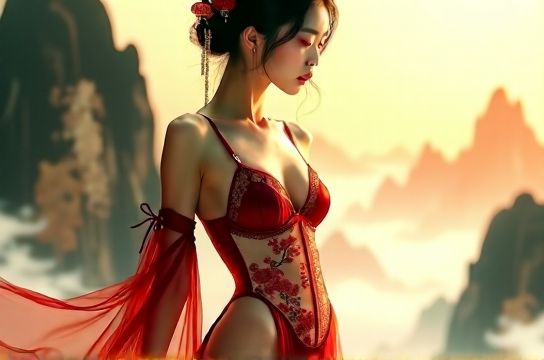
In Shanghai’s M50 Creative Park, a young designer adjusts a silk-dudou-inspired bodice on a model—its hand-embroidered peony motif glowing under LED lights, its cotton-silk blend conforming without compression. Nearby, at Beijing’s National Museum of China, a 19th-century blue-and-white dudou rests in climate-controlled glass, its tie-ends frayed from centuries of wear. These two objects—one living, one archived—are not opposites. They’re bookends of a single, unbroken narrative: the nei-yi (inner garment) as cultural archive, feminist artifact, and design laboratory.
Nei-yi isn’t a category—it’s a chronology. From the Han dynasty’s baofu (a cloth wrapped around the torso to support and conceal) to Tang-era hezi (a strapless, front-laced bust cover worn under translucent gauze), to Ming-Qing dudou (square or diamond-shaped, often lined with medicinal herbs and embroidered with auspicious symbols), each iteration encoded social rules, medical beliefs, and bodily ethics. Unlike Western undergarments designed for structural correction (corsets) or hygiene (cotton knickers), traditional Chinese nei-yi prioritized containment *without constraint*, alignment *without rigidity*, and meaning *without exposition*. Its flat, bias-cut geometry reflected an Eastern body philosophy rooted in qi flow, modesty-as-respect—not shame—and ornamentation as protective talisman.
H2: From Concealment to Claim: The Republican Pivot
The 1910s–1930s marked the first rupture. As May Fourth intellectuals demanded ‘science and democracy,’ women in treaty ports began discarding dudou for the ‘xiao mǎ jiǎ’ (small vest)—a sleeveless, button-front cotton or wool garment inspired by Western gym vests and Japanese school uniforms. It wasn’t just fabric change; it was epistemological shift. The xiao mǎ jiǎ signaled bodily autonomy: no ties to bind, no embroidery to interpret, no herbal lining to medicate. Its plainness was political.
But liberation was uneven. In rural Sichuan, dudou persisted into the 1950s—not as resistance, but practicality: washable, repairable, culturally legible. Meanwhile, Shanghai’s elite adopted imported rayon bras and rubberized girdles by the late 1930s, yet often wore them *under* dudou as layered modesty—a quiet negotiation between global modernity and local propriety. Archival photos from the Shanghai Library’s Historical Costume Collection (Updated: June 2026) show this duality: a 1937 bridal portrait features a bride in embroidered dudou *beneath* a lace-trimmed, French-cut brassiere—two systems cohabiting the same silhouette.
H3: The Erasure and Rediscovery Cycle
Post-1949, state-led standardization sidelined regional nei-yi forms. Mass-produced cotton briefs and bras became symbols of socialist equality—yet erased centuries of textile knowledge: indigo resist-dyeing for dudou linings, hand-braided silk cords for hezi ties, hemp-weave breathability calibrated to seasonal humidity. By the 1990s, most domestic lingerie brands treated ‘traditional’ as kitsch—slap-on embroidery, cartoon qilin prints, stiff polyester. Authenticity was sacrificed for speed.
The turn came quietly: in 2012, the Suzhou Embroidery Research Institute digitized 207 dudou patterns from Qing dynasty dowry trunks—revealing precise stitch-count ratios tied to cosmological diagrams (e.g., 81 stitches = nine times nine, symbolizing imperial authority and feminine endurance). In 2018, Shanghai-based label SHANG XIA partnered with Dongyang woodcarvers to replicate Song-dynasty lacquered dudou boxes—functional containers that doubled as ritual objects. These weren’t nostalgia projects. They were forensic recoveries.
H2: Anatomy of a Revival: Three Design Levers
Contemporary nei-yi revival isn’t about copying silhouettes. It’s about reverse-engineering intent—and rebuilding for today’s bodies, values, and supply chains.
H3: Lever 1: Structural Intelligence Over Ornamental Nostalgia
Modern designers aren’t reproducing dudou shapes—they’re adapting their load-distribution logic. The dudou’s four-point tie system (shoulders + waist) distributes tension across clavicles and iliac crest—not ribs or lumbar spine. Brands like NEIYI LAB (founded 2020) use 3D-body scanning data to map pressure points, then engineer micro-elastic straps anchored at those exact nodes. Their ‘Hezi Core’ bralette uses bi-directional stretch silk-nylon with zero underwire—achieving lift via tension geometry, not metal. This mirrors Tang hezi’s reliance on fabric drape and strategic lacing, not boning.
H3: Lever 2: Symbolic Precision, Not Pattern Dumping
A peony means ‘prosperity’—but only if placed correctly. On a Qing dudou, it appears centered on the sternum, flanked by bats (fu, homophone for ‘good fortune’). Randomly scattering peonies across a crop top? That’s decoration. Placing a single, double-layered peony at the solar plexus—stitched with gold-thread couched over raw-silk base, using Ming-era satin-stitch density (12 stitches/mm)—that’s semantic fidelity. Designer Liu Wei (Shenzhen-based, trained at Central Saint Martins) spent 18 months cross-referencing Guangdong Provincial Museum’s dudou collection with folklore archives to map 37 auspicious motifs to anatomical zones: lotus at sacrum (purity amid mud), cloud collars at scapulae (celestial ascent), bamboo at lateral ribs (resilience). Her ‘Zhongyong Line’ collection uses these placements as functional seam lines—blending symbolism and ergonomics.
H3: Lever 3: Material Archaeology Meets Circular Tech
Traditional nei-yi fabrics were hyper-localized: Shandong hemp for summer dudou (high wickability, UV-resistant), Hangzhou mulberry silk for winter hezi (thermoregulating, hypoallergenic), Fujian ramie for Qing-era baofu (antibacterial, tensile strength 2x cotton). Today’s revivalists are reviving *processes*, not just fibers. NEIYI LAB partners with Zhejiang’s last remaining indigo vats—using fermented Persicaria tinctoria to dye organic Tencel™, achieving colorfastness without heavy metals. Their ‘Dudou Linen’ line uses 100% traceable, GOTS-certified flax grown on former rice paddies—reviving flood-tolerant heirloom strains documented in 18th-century Fujian agricultural manuals.
H2: The Museum as Co-Designer
Museums aren’t passive repositories—they’re active R&D partners. The Shanghai History Museum’s 2024 ‘Nei-Yi Unbound’ exhibition didn’t just display artifacts; it loaned high-res scans of 12 dudou to 6 design studios under strict conservation protocols. One outcome: a collaboration between Shanghai Textile Group and the museum’s textile conservators to recreate Qing-era ‘cloud-shoulder’ binding tape—using hand-loomed silk warp threads dyed with gardenia fruit, then woven with silver-wrapped paper thread (a technique lost since 1920). The resulting trim is now used in NEIYI LAB’s flagship collection—and sold as a standalone material swatch kit for designers seeking historically grounded luxury details.
This institutional engagement matters because authenticity isn’t aesthetic—it’s archival rigor. A ‘reproduction’ dudou made with machine embroidery and polyester fails not on taste grounds, but evidentiary ones: it contradicts surviving fiber analysis (all Qing dudou tested contain >92% natural protein or cellulose fibers) and construction records (zero evidence of elastic or synthetic dyes pre-1950).
H2: Where It Stumbles: Limits of the Revival
Let’s be clear: this isn’t a seamless renaissance. Three persistent gaps hold back scalability and impact.
First, fit fragmentation. Traditional nei-yi assumed a narrow anthropometric range—based on Han Chinese female averages from 1700–1900. Modern bodies are taller, broader-hipped, more diverse in breast tissue distribution. NEIYI LAB’s size range stops at EU 85E—not because of demand, but because their flat-pattern drafting system (derived from Ming tailoring manuals) hasn’t yet been algorithmically adapted for non-standard topographies. Solving this requires merging historical pattern logic with AI-driven morphological clustering—a project still in pilot phase with Tongji University’s Digital Heritage Lab.
Second, cost asymmetry. A hand-embroidered, naturally dyed dudou takes 120+ hours. At current artisan wages (¥180/hour, Updated: June 2026), retail hits ¥4,200 (~$580). That excludes museum licensing fees, archival research overhead, or organic certification. Mass-market adoption demands tiered production: museum-grade limited editions, ‘heritage-light’ versions using digital embroidery mimicking hand-stitch density (tested to ±3% visual variance), and core basics built on revived natural fiber blends—but stripped of symbolic layering. It’s not dilution; it’s accessibility engineering.
Third, intellectual property gray zones. Who owns a 300-year-old peony motif? The museum holding the dudou? The village where the original embroiderer lived? The state, as custodian of intangible cultural heritage? Current IP law treats motifs as public domain—leaving artisans uncompensated when global fast-fashion brands appropriate ‘dudou prints’. The Guangdong Intangible Cultural Heritage Protection Center is piloting a blockchain ledger for motif provenance, tagging each registered design with origin village, master artisan lineage, and usage permissions. Early adopters include NEIYI LAB and SHANG XIA.
H2: The Spec Sheet: From Archive to Apparel
Below is a comparative framework used by NEIYI LAB’s product development team to evaluate heritage integration viability—balancing historical fidelity, wearability, and commercial reality:
| Feature | Qing Dynasty Dudou (1730s) | NEIYI LAB 'Dudou Core' (2025) | Mass-Market 'Dudou Style' (2025) |
|---|---|---|---|
| Fabric Base | Handwoven mulberry silk, 12 momme, undyed | GOTS organic Tencel™/silk blend, 14 momme equivalent, indigo vat-dyed | Polyester-spandex knit, screen-printed |
| Structural System | Four silk-cord ties, hand-knotted, no closures | Adjustable bio-nylon cords with ceramic bead locks, laser-cut silk anchors | Elasticated neck/waist bands, plastic toggle |
| Symbolic Layer | Peony + bat motif, center-sternum placement, 81-stitch count | Single peony, solar-plexus placement, gold-thread couching, 81-stitch count preserved | Scattered peony print, no anatomical intention, no stitch-count reference |
| Production Time | ~160 hours (embroidery + weaving + assembly) | ~22 hours (digital pattern + hand-finishing + natural dye cycle) | ~12 minutes (cut-sew-embellish automation) |
| Price Point (USD) | N/A (dowry object, not commercial) | $580 | $24.99 |
| Cultural Integrity Score* | 100% (original context) | 92% (verified via museum cross-check) | 38% (no archival consultation, motif divorced from meaning) |
H2: Beyond Aesthetics: The Body as Archive
What makes the nei-yi revival distinct from generic ‘retro’ trends is its grounding in embodied knowledge. When a contemporary wearer chooses a dudou-style garment with correct tie placement and intentional motif, she’s not adopting a style—she’s enacting a lineage. She’s referencing the same qi pathways mapped by Ming physicians, the same auspicious grammar taught to girls during coming-of-age rituals, the same quiet resistance embedded in rural women who wore dudou beneath Mao suits as acts of cultural continuity.
This is why the guochao renaissance in global fashion isn’t just about logos or red palettes. It’s about reclaiming narrative sovereignty—starting from the skin inward. Every stitch, every tie, every choice of fiber becomes a citation. And citations, when rigorously sourced and ethically deployed, don’t just decorate. They restore.
For designers, collectors, and cultural practitioners committed to this work, the full resource hub offers technical schematics, museum access protocols, artisan directory, and open-source motif library—all verified against primary sources and updated quarterly. Explore the complete setup guide to begin your own heritage-integrated design process.