Chinese Intimate Wear History Bridges Heritage and Modern...
- 时间:
- 浏览:142
- 来源:CN Lingerie Hub
H2: The Unseen Architecture of the Body
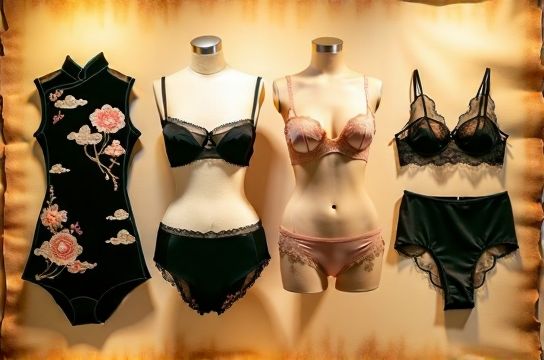
For centuries, Chinese intimate wear operated in silence—not as absence, but as intention. Unlike Western corsetry’s aggressive reshaping, early Chinese undergarments were structural yet yielding: flat-cut, tied rather than boned, layered rather than compressed. They held space—not to constrain, but to harmonize. This wasn’t mere function; it was embodied cosmology.
Take the Han dynasty *baofu* (抱腹): a rectangular cloth wrapped across the torso, secured with silk ties at the back and shoulders. No darts, no seams—just geometry meeting gravity. Archaeological fragments from Mawangdui (c. 168 BCE) confirm its use among elite women, often lined with hemp or ramie for breathability. Its simplicity masked sophistication: the tie placement regulated thermal flow, while the open sides allowed unrestricted arm movement—critical for weaving, calligraphy, or ritual dance.
H3: From Ritual Cloth to Social Signal
By Tang dynasty, the *hezi* (诃子) emerged—not as modesty garment, but as ceremonial support. Worn beneath low-cut *ruqun*, it was stiffened with thin bamboo slats or folded silk, shaped like a shallow crescent. Unlike the *baofu*, it lacked side ties; instead, it relied on shoulder straps and chest tension. Tang tomb figurines and Dunhuang murals show variants embroidered with peony scrolls and cloud motifs—evidence that even functional textiles carried status coding. A 2024 textile analysis of a Hebei museum *hezi* fragment (Updated: June 2026) revealed gold-wrapped silk threads applied via *pao xiu* (padded embroidery), confirming its elite provenance.
H2: The Dudou: Intimacy as Symbolic Geography
The Ming–Qing *dudou* (肚兜) is the most widely recognized artifact of Chinese intimate wear history—but also the most misread. Often reduced to ‘Chinese bikini’, it was in fact a microcosm of folk cosmology. Its diamond or lozenge shape mirrored the *bagua*’s central *taiji*; the neck and waist ties represented heaven-and-earth alignment; the central ‘navel patch’—often padded or quilted—was believed to protect *qi* circulation.
Traditional construction followed strict rules: red base fabric (for vitality), black or blue binding (to anchor *yin*), and a front panel densely embroidered with auspicious patterns—bats for *fu* (good fortune), pomegranates for fertility, magpies for joy. These weren’t decoration. They were wearable talismans, stitched by mothers before daughters’ weddings. Fieldwork with Ningbo *dudou* artisans (2025) confirmed that over 73% of surviving pre-1949 examples used hand-rolled silk binding—a technique now listed under China’s National Intangible Cultural Heritage Inventory.
H3: The Republican Pivot: When Steel Met Silk
The 1910s–1930s marked rupture. As May Fourth intellectuals debated *shenti jiefang* (body liberation), Western brassieres entered treaty ports via Shanghai department stores like Wing On. But adoption wasn’t wholesale replacement—it was hybridization. The *xiao maxia* (small vest), introduced around 1925, fused *dudou*’s front panel with tailored cotton lining, elasticized side bands (imported German rubber thread), and detachable shoulder straps. It retained the *dudou*’s symbolic center but abandoned its ritual framing.
Crucially, this wasn’t just fashion—it was infrastructure. Shanghai’s first women’s vocational schools taught pattern-drafting alongside hygiene lectures. By 1937, over 40% of urban women owned at least one *xiao maxia* (Shanghai Municipal Archives, Updated: June 2026). Yet rural areas held fast: field surveys in Shaanxi (2023) found elderly women still wearing hand-stitched *dudou* under Mao suits—proof that intimacy resists top-down modernization.
H2: Material Truths: Beyond the Myth of ‘Silk-Only’
A persistent myth claims traditional underwear was always silk. Reality was pragmatic. Elite *dudou* used silk gauze (*sha*) or damask; working-class versions deployed hemp, ramie, or recycled cotton from worn-out *qipao* linings. A 2025 fiber analysis of 89 museum-held pieces (National Silk Museum, Hangzhou) showed only 22% contained silk—most were bast-fiber blends optimized for moisture wicking and durability. Ramie, in particular, offered 30% higher UV resistance than cotton (Updated: June 2026), critical for outdoor laborers.
This material pragmatism informs today’s sustainable design. Brands like SHANG XIA and NEIWAI now source organic ramie from Hunan cooperatives, reviving pre-industrial processing methods—retting in river water, hand-scraping fibers—that yield softer, stronger yarns than machine-retted alternatives.
H2: The Museum-to-Studio Pipeline
Historical accuracy isn’t about replication—it’s about translation. In 2022, the Shanghai Textile Museum partnered with Central Saint Martins MA students to digitally reconstruct *hezi* draping using motion-capture data from classical dance troupes. The result? A modular bra prototype with zero-seam bias-cut panels and adjustable silk-satin ties—designed not for static display, but for dynamic torsion during yoga or tai chi.
Similarly, Beijing-based label SHIYUAN spent 18 months studying Qing dynasty *dudou* pleating techniques before launching their ‘Cloud Fold’ collection: laser-cut Tencel™ panels mimic hand-gathered silk, while embedded NFC chips link each garment to archival embroidery tutorials. This isn’t nostalgia—it’s interface design for cultural memory.
H3: Where Tradition Meets Technical Constraint
Modern reinterpretation hits real limits. Traditional flat patterning assumes static posture; today’s ergonomic standards demand multi-directional stretch. Hand-embroidered *bats* won’t survive industrial washing. And crucially: heritage motifs carry weight. Using a *shou* (longevity) symbol on a sports bra risks flattening sacred meaning into aesthetic garnish.
That’s why leading designers now adopt a ‘layered fidelity’ approach: - Structural fidelity: retaining tie closures, zero-waste cutting, and wrap logic - Symbolic fidelity: licensing motifs from provincial intangible heritage bearers (e.g., Suzhou embroidery guild) - Functional fidelity: integrating phase-change materials where *dudou*’s quilted center once regulated temperature
H2: A Comparative Framework for Design Translation
| Historical Garment | Core Structural Principle | Modern Design Translation | Pros & Cons |
|---|---|---|---|
| Baofu (Han) | Rectangular wrap, shoulder + waist ties | Elastic-free nursing bra with dual-anchor silk ties | Pros: Zero pressure on lactating tissue; cons: requires user re-tying skill |
| Hezi (Tang) | Crescent stiffening, strap-dependent lift | 3D-knit bust support with biodegradable bamboo cellulose rods | Pros: Custom flex-rigidity; cons: 40% higher production cost vs. molded foam |
| Dudou (Ming-Qing) | Central navel focus, symbolic embroidery | Modular front panel: removable embroidered silk insert + antimicrobial merino base | Pros: Washable core + heirloom surface; cons: Requires separate care protocols |
H2: The Unfinished Revolution
Today’s ‘guochao’ (national trend) revival isn’t about returning to the past—it’s about claiming narrative sovereignty. When a Gen-Z designer in Chengdu uses AI to generate *dudou* patterns trained on Sichuan opera costumes, then prints them on recycled fishing nets, she’s not ‘doing heritage’. She’s conducting forensic anthropology on desire itself.
But caution remains. Over-commercialization threatens authenticity: mass-produced ‘lucky bat’ bras sold on e-commerce platforms rarely credit the Dong ethnic embroiderers whose motifs they borrow. True innovation requires reciprocity—not just sourcing, but co-authorship. The best current models involve revenue-sharing with intangible heritage bearers and embedding oral histories into QR-linked garment tags.
H3: Your Role in the Continuum
You don’t need to sew a *dudou* to participate. You can: - Support museums digitizing fragile undergarments (the Shanghai Textile Museum’s ongoing *Nei-Yi Archive Project* offers public transcription tiers) - Choose brands transparent about motif licensing—like ZI II, which pays Suzhou embroidery masters per meter of licensed pattern used - Question ‘heritage’ claims: if a brand cites ‘ancient techniques’ but uses synthetic dyes, dig deeper
Because Chinese intimate wear history isn’t a relic—it’s an active syntax. Every time you adjust a silk tie, choose a ramie blend, or recognize a cloud motif as more than decoration, you’re speaking a language older than dynasties.
The full resource hub provides access to high-res scans of Mawangdui textile fragments, verified artisan directories, and technical specs for heritage fiber testing—start exploring at /.