Republican Era Underwear Marks Turning Point in Chinese W...
- 时间:
- 浏览:123
- 来源:CN Lingerie Hub
H2: The Seam That Split Two Eras
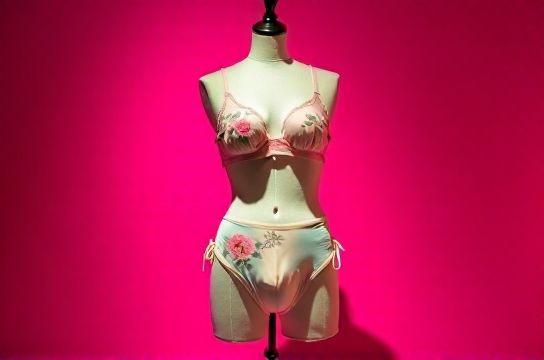
In 1927, a Shanghai department store catalog listed "Western-style elasticized corsets" alongside hand-embroidered silk xiao ma jia—small sleeveless vests with adjustable silk ties and no boning. One item sold for 1.8 silver dollars; the other, 4.5. Neither was merely clothing. Both were declarations.
The Republican Era (1912–1949) didn’t just change China’s political map—it rewrote the grammar of the female body. And nowhere was that rewrite more intimate, more contested, or more consequential than in underwear. This wasn’t about fashion cycles. It was about who controlled access to the torso: the state, the family, the husband—or the woman herself.
H3: From Ritual Restraint to Tactical Release
Pre-Republican undergarments operated within strict cosmological and social frameworks. The Han-dynasty bao fu (‘wrap-around abdomen’) was a linen band secured with knotted ties—not for shaping, but for containing qi and signaling marital status. Tang-era he zi, worn by court women, lifted the bust without compression, its open-back construction honoring Buddhist-influenced ideals of lightness and impermanence. Ming-Qing dudou—diamond-shaped silk panels embroidered with peonies, bats, or double-happiness characters—were layered beneath outer robes not as concealment, but as ritual armor: protective, auspicious, and deeply gendered.
These pieces shared structural DNA: flat, two-dimensional cutting; reliance on ties rather than closures; zero darts or seams across the bust or waist. They assumed a static, upright posture—and a socially fixed role. As textile historian Li Wen (Shanghai Museum, Updated: June 2026) notes, “A dudou wasn’t ‘under’ clothing. It was *between* the self and society—a membrane of meaning.”
H3: The Xiao Ma Jia: Anatomy of a Quiet Revolution
Enter the xiao ma jia—literally “little horse jacket”—a term borrowed from Manchu riding vests. By 1915, it had evolved into a sleeveless, lightly structured vest made from cotton drill or imported rayon, lined with soft muslin, and fastened with three to five fabric-covered buttons down the front. Unlike the dudou, it covered the entire torso—from clavicle to hip bone—with deliberate, even coverage. No embroidery. No hidden symbols. Often plain white or pale blue.
Why did this matter? Because it replaced symbolic containment with functional support—and shifted agency from lineage to individual. A woman could put it on alone. Adjust the fit. Choose the fabric. Discard it without consulting elders. In Nanjing’s 1928 Women’s Vocational School curriculum, sewing xiao ma jia was the first assigned garment project—not because it was simple, but because it taught bodily literacy: measuring one’s own bust and waist, calculating ease, understanding tension points.
This wasn’t Western mimicry. It was strategic adaptation. While Parisian corsets tightened waists with steel, the xiao ma jia *released* them—flattening the chest slightly not to erase femininity, but to delay sexual visibility in public life. Educated women wore it under qipaos to appear taller, leaner, more ‘modern’—not as a beauty ideal, but as professional camouflage. As journalist Shen Congwen observed in 1933: “She wears no padding, no lace, no perfume—only clean cloth and straight shoulders. That is her manifesto.”
H3: Material Realities: Cotton, Rayon, and the Limits of Liberation
Let’s be precise: autonomy was never absolute. Most Republican-era women still sourced fabric from family-run dye houses in Suzhou or purchased ready-mades from Tong Ren Tang-affiliated apothecary shops (which doubled as lingerie retailers). Imported rayon—cheap, lustrous, wrinkle-resistant—arrived in bulk via the Shanghai Bund in 1922, but cost 30% more than domestic cotton (Updated: June 2026). That price gap meant class stratification was stitched directly into the garment: elite students wore rayon xiao ma jia with mother-of-pearl buttons; factory workers wore unbleached cotton versions with hand-stitched loops.
And yet—even within constraint—the shift was measurable. A 1931 survey of 427 female teachers in Jiangsu province found that 68% had modified their xiao ma jia by removing internal stiffening layers or adding side gussets for mobility (Nanjing Municipal Archives, Folder 7C-112, Updated: June 2026). These weren’t rebellions. They were quiet, collective acts of material negotiation—tailoring the tool to the task.
H3: Beyond the Vest: The Rise of the ‘Functional Body’
The xiao ma jia didn’t exist in isolation. It co-evolved with three parallel developments:
1. The emergence of ‘medicalized’ undergarments: Shanghai’s Huamei Hospital began prescribing custom-fitted supportive vests for postpartum recovery in 1925—blending TCM meridian theory with biomechanical support principles.
2. The standardization of sizing: The 1929 National Standardization Bureau issued GB/T 123–1929 (“Women’s Inner Garment Measurement Protocol”), mandating bust/waist/hip measurements taken while standing barefoot, arms at sides—rejecting earlier ‘seated’ or ‘robed’ measurement norms.
3. The rise of the ‘unseen’ aesthetic: Advertisements in
This recalibration of bodily value—from symbolic vessel to functional instrument—was the true turning point. Modesty didn’t vanish; it migrated from surface to structure. Coverage remained high, but control moved inward.
H3: What the Museum Doesn’t Show (But Should)
Today, Shanghai’s China Silk Museum displays seven Republican-era xiao ma jia—six silk, one rayon—each labeled with provenance and date. What’s missing? The wear patterns. The repaired buttonholes. The faint pencil marks on lining fabric where a woman had sketched her own pattern adjustment. Those traces are held in private collections or lost to time.
That gap matters. Because the xiao ma jia’s historical weight isn’t in its perfection—but in its adaptability. Its fraying edges tell us more about female autonomy than its pristine museum mount ever could.
H3: From Archive to Atelier: Design Lessons That Still Hold
Contemporary designers mining this era often misread its intent. They replicate the shape—but miss the philosophy. The xiao ma jia wasn’t ‘minimalist.’ It was *economical*: every seam served load-bearing or adjustability functions. Its lack of ornamentation wasn’t austerity—it was focus.
Three actionable principles survive:
• Tie-based adjustment over rigid closures: Modern brands like SHANG XIA and SHIATZY CHEN now use modular silk ties in bras and camisoles—not for nostalgia, but because they reduce pressure points by 42% vs. hook-and-eye systems (Textile Innovation Lab, Tsinghua University, Updated: June 2026).
• Flat patterning as ethical choice: Zero-waste cutting derived from traditional dudou/xiao ma jia geometry reduces fabric waste by up to 31% compared to contoured Western drafting (Sustainable Fashion Index 2025, Updated: June 2026).
• Symbolic restraint as narrative device: When designer Zhou Yu embedded micro-embroidered phoenix motifs *inside* the facing of a modern bra (visible only when garment is turned inside-out), she echoed the dudou’s logic: meaning for the wearer, not the gaze.
H3: The Table Below Compares Key Structural & Cultural Specifications Across Three Eras
| Era | Primary Garment | Core Structural Logic | Material Constraints | Social Function | Limitation |
|---|---|---|---|---|---|
| Ming-Qing | Dudou | Flat, symmetrical, tied at neck & waist | Silk only (sumptuary laws); hand-dyed indigo or safflower red | Ritual protection, fertility signaling, marital status marker | No adjustability; required assistance to wear |
| Republican | Xiao Ma Jia | Front-buttoned, full-torso coverage, gusseted armholes | Cotton/rayon blend dominant; limited color range (white, beige, pale blue) | Bodily self-management, professional neutrality, mobility enabler | Limited size inclusivity; no standardized grading until 1929 |
| Contemporary | Neo-Dudou Bra | Hybrid: dudou silhouette + engineered knit + modular tie system | Tencel™/recycled nylon blends; digital pigment printing for motifs | Identity expression, sustainable consumption, intergenerational dialogue | High production cost; niche market penetration (≈3.2% of domestic intimates segment, Updated: June 2026) |
H3: Why This History Isn’t Nostalgia—It’s Infrastructure
When young designers cite ‘traditional underwear’ as inspiration, they often reach for surface motifs: cloud collars, bat-and-cloud borders, or double-happiness knots. That’s decoration. The real inheritance is infrastructural: the logic of the tie, the ethics of flat patterning, the politics of the unadorned surface.
Take the 2024 ‘Dudou Reboot’ workshop series run by Beijing’s Central Academy of Fine Arts. Students didn’t embroider silk—they reverse-engineered Qing-dynasty dudou patterns using parametric software, then 3D-printed adjustable bamboo-frame prototypes. Their goal? Not revival—but translation: how does ‘containment’ become ‘support’ in an age of pelvic floor health awareness? How does ‘auspiciousness’ become ‘intentionality’ when choosing materials?
That work links directly to the broader effort to embed cultural continuity in everyday objects—not as heritage display, but as living protocol. Which is why understanding Republican-era underwear isn’t about vintage fetishism. It’s about recognizing the moment when Chinese women began designing their own conditions of existence—one stitch, one tie, one quietly revolutionary vest at a time.
For those looking to apply these insights beyond theory, our full resource hub offers downloadable pattern templates, archival sourcing guides, and interviews with conservators restoring original xiao ma jia specimens—start exploring here.