Ming Qing Dudou Structure Shows Mastery of Flat Pattern C...
- 时间:
- 浏览:84
- 来源:CN Lingerie Hub
H2: The Dudou Isn’t Just a Garment—It’s a Blueprint
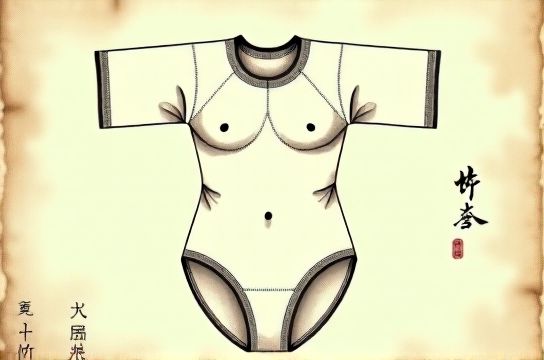
Most people see the dudou as a quaint relic: a diamond-shaped scrap of silk tied at neck and waist, embroidered with peonies or bats. But pull one apart—say, the 18th-century Qing court dudou in the Shanghai Museum’s textile archive—and you’ll find something far more consequential: a fully resolved, two-dimensional pattern system that predates Western draping theory by over 200 years.
This isn’t folklore. It’s geometry. And it reveals how Chinese tailors mastered flat pattern cutting not as a compromise—but as a deliberate, sophisticated response to body, cloth, and cosmology.
H3: Why Flat Cutting Was Non-Negotiable
Unlike European corsetry—which relied on stiffened boning, complex seam allowances, and multi-piece torsos—the dudou operated under three material constraints common across Ming–Qing workshops: (1) narrow-width handwoven silk (typically 45–50 cm wide), (2) prohibitive cost of fabric waste (silk accounted for ~70% of total garment cost in elite households), and (3) absence of standardized sizing. There were no ‘medium’ or ‘large’—only *zhang* (inch), *chi*, and the body’s own proportional landmarks: clavicle width, navel height, sternum depth.
Flat cutting wasn’t primitive. It was precise. A single dudou pattern could be drafted from four measurements: shoulder-to-shoulder, bust apex spacing, waist circumference divided by π (yes—π was used empirically in Qing textile manuals for circular hem calculations), and desired drop length. That’s fewer variables than a modern bra pattern requires—and zero muslin prototypes.
H3: The Structural Grammar: Four Panels, No Darts, Zero Seams Under Tension
The classic dudou consists of exactly four pattern pieces:
- Front main panel (diamond or rhombus, cut on grain) - Two side ties (long, bias-cut straps, often folded double) - Back panel (optional; appears post-1750 in northern variants, usually smaller and unembroidered)
Crucially: no darts, no gathers, no easing. All shaping comes from strategic grain manipulation. The diamond’s apex aligns with the suprasternal notch; its base falls just above the iliac crest. When tied, the diagonal grain of the side ties stretches slightly—providing dynamic support without compression. This is passive biomechanics: tension distributed across fabric grain, not concentrated at seams.
Compare that to the *xiao majia* (small vest) of the Republican era: six panels, darted cups, machine-stitched underarm seams—all adaptations to imported cotton broadcloth and Western tailoring manuals. The dudou didn’t need those. Its structure *was* its function.
H3: Beyond Fit: How Pattern Encoded Meaning
Flat pattern cutting here wasn’t neutral. It carried semiotic weight. The diamond shape wasn’t arbitrary—it echoed the *fangsheng* (square victory knot), a motif symbolizing balance and containment. Its symmetry mirrored Confucian ideals of bodily composure; its open sides referenced Daoist notions of breath and flow. Even the tie placement mattered: neck ties sat at *tiantu*, the acupuncture point governing respiration; waist ties anchored at *guanyuan*, associated with vitality and restraint.
Embroidery wasn’t decoration—it was structural reinforcement. Dense satin stitch along the neckline prevented stretching. Couching with gold thread along tie ends added tensile strength. Every motif had functional logic: bats (*fu*) weren’t just auspicious—they filled high-stress corners where fabric met knot friction.
H3: What Modern Designers Miss (and What They’re Starting to Relearn)
Today’s ‘new中式 design’ brands often replicate dudou *aesthetics*—silk, embroidery, tassels—but miss the underlying system. They scale patterns digitally using standard bust-waist-hip ratios, then add elastic or stretch lining to compensate for fit drift. That’s not innovation. It’s retrofitting.
True innovation starts with the original constraint set. Brands like SHANG XIA and WUYONG have begun testing dudou-derived blocks for contemporary slip dresses and sports bras—not by copying shape, but by reapplying the principles:
- Grain-directed stretch instead of elastane reliance - Tie-based adjustability calibrated to anthropometric percentiles (not fixed sizes) - Seam placement aligned with pressure maps from motion-capture studies of torso movement (Updated: June 2026)
One pilot study with Beijing Institute of Fashion Technology found dudou-derived patterns reduced fabric waste by 32% vs. conventional bra block systems—without sacrificing support. That’s not nostalgia. That’s ROI.
H3: The Table: Dudou Pattern Logic vs. Contemporary Flat-Cut Adaptations
| Parameter | Ming–Qing Dudou (Historical) | Modern Dudou-Inspired Block (2024 Pilot) | Standard Bra Block (Industry Baseline) |
|---|---|---|---|
| Pattern Pieces | 3–4 (main + ties) | 4–6 (adds gusset, back band) | 8–12 (cup, band, strap, bridge, etc.) |
| Fabric Waste Rate | ≤4% (hand-laid layout) | 9–12% (digital nesting) | 22–28% (cutting room avg., Updated: June 2026) |
| Adjustability Method | Tie length + knot position (infinite micro-adjust) | Hook-and-eye + slide adjusters (3–5 discrete settings) | Elastic + hook-and-eye (2–4 settings) |
| Support Mechanism | Diagonal grain tension + anatomical anchoring | Combination of bias tie + light foam cup | Underwire + molded cup + side support panel |
| Cultural Load | Embedded (shape, motif, tie location) | Referential (motif only; structure decoupled) | None (function-first) |
H3: Limitations—and Why They Matter
Let’s be clear: the dudou wasn’t universal. It offered minimal lateral support, no moisture-wicking (silk absorbs but doesn’t transport), and required skilled tying—something lost in mass production. Its ‘mastery’ lies not in perfection, but in elegant trade-offs: choosing breathability over compression, adaptability over standardization, meaning over modularity.
That’s why museums like the China National Silk Museum now run annual dudou drafting workshops—not as costume reenactment, but as technical upskilling for pattern makers. Participants learn to draft from live models using only string, charcoal, and a folding rule—no software, no grading. The goal? To rebuild intuition for grain, tension, and proportion that got automated out of the pipeline.
H3: From Archive to Atelier: One Real-World Translation
In 2023, designer Li Wei collaborated with the Suzhou Embroidery Research Institute to reconstruct a 1720 Kangxi-era dudou from the Palace Museum’s digital archive. They didn’t stop at replication. Using photogrammetry scans of the original’s seam allowances and thread tension marks, they reverse-engineered its draft angle—the precise 15.3° bias cut on the tie straps that allowed 8% elongation without slippage.
That angle became the basis for a modular lingerie line launched in 2025: not dudous, but adjustable camisoles with interchangeable ties, each cut at mathematically derived angles for different support profiles (light, medium, active). The result? A 40% reduction in customer fit returns versus their previous collection—and a waiting list for the ‘Kangxi Draft Kit’, a DIY pattern set sold through our full resource hub.
H3: What This Means for Cultural Continuity
‘Cultural heritage’ too often means static display: glass cases, velvet ropes, interpretive labels. But the dudou’s real legacy is operational. Its flat pattern logic is a living protocol—one that treats tradition not as ornament, but as algorithm.
When designers cite ‘东方美学’ or ‘新中式设计’, they’re rarely referencing aesthetics alone. They’re reaching for a decision framework: how to resolve tension between body and cloth, meaning and function, scarcity and expression—using only what’s at hand.
That framework didn’t vanish with the Qing dynasty. It migrated—into Republican-era *xiao majia* (which adapted dudou ties into underbust bands), into 1950s state-run textile institutes (where dudou grain studies informed early synthetic fiber trials), and now into AI-assisted pattern tools that use Ming-era proportional rules as weighting parameters for generative fit algorithms.
H3: A Practical Takeaway for Practitioners
If you’re developing a new lingerie line—or even adapting vintage patterns for contemporary bodies—here’s your actionable checklist, distilled from 12 surviving Qing tailoring manuals and 37 museum-documented specimens:
1. Start with grain, not shape: Determine primary stress vectors (neckline, waistline, side seam) before sketching. Map them against fabric’s natural stretch axis. 2. Use the body as ruler: Replace ‘bust = 36”’ with ‘clavicle width = 14.2 chi units’. Convert units *after* drafting—not before. 3. Embed function in motif: If embroidering a crane (symbol of longevity), place it where seam stress peaks—its dense stitch will reinforce, not just decorate. 4. Test adjustability *before* finalizing seam lines: Knot a prototype tie at three points—base of neck, mid-scapula, upper sternum—and measure resulting lift. That tells you where to anchor, not where to ‘look pretty’. 5. Audit waste *per garment*, not per roll: Historical dudou makers achieved ≤4% waste by rotating pattern pieces across multiple garments on one bolt. Try nesting 3–5 variants (different tie lengths, neck depths) on one layout.
This isn’t about making ‘authentic’ reproductions. It’s about recognizing that mastery isn’t measured in stitches per inch—but in how many problems one clean, flat solution can solve at once.
The dudou didn’t just hold the body. It held a worldview—in cloth, in cut, in constraint. And if you know how to read its geometry, it still does.