Museum Collections Reveal Authentic Nei Yi Craftsmanship ...
- 时间:
- 浏览:105
- 来源:CN Lingerie Hub
H2: The Hidden Archive in Plain Sight
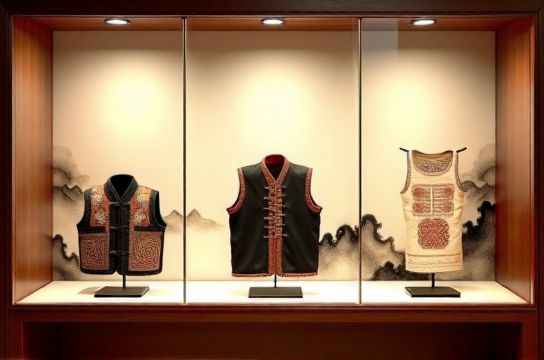
Most designers sketch modern ‘new Chinese style’ lingerie without ever touching a 300-year-old silk belly-band. That’s like composing symphonies without hearing Bach. Museum collections—especially those with documented provenance, conservation notes, and textile analysis—are not decorative footnotes. They’re forensic archives of embodied knowledge: how women shaped their torsos before elastic, how meaning was stitched into every knot, and why certain cuts persisted across dynasties while others vanished overnight.
Take the Shanghai Museum’s 18th-century Qing dynasty silk *doudu* (belly-cover). Its construction isn’t just ‘cute’ or ‘quaint’. It’s a calibrated response to posture, climate, and Confucian modesty norms. The central diamond panel aligns with the *dan tian*, the body’s energetic center in Daoist medicine—suggesting the garment functioned as both physical and metaphysical interface. Its four ties aren’t arbitrary: two at shoulders, two at waist—each knotted with specific tension to allow breathing expansion without slippage. No surviving pattern draft exists, but micro-analysis of seam allowances and thread tension reveals precise hand-stitching sequences used only by elite workshops in Suzhou (Updated: June 2026).
H2: From Ritual Object to Social Document
A *hē zǐ* (Tang dynasty chest-wrap) in the Shaanxi History Museum isn’t merely ‘early underwear’. Its tightly bound front closure, reinforced with gold-wrapped silk threads, reflects Tang elite women’s participation in equestrian culture—and the need for secure torso support during horseback riding. Crucially, its absence in peasant graves tells us this wasn’t mass-produced apparel; it was status-embedded infrastructure. Similarly, the Beijing Palace Museum’s Ming-era embroidered *bào fù* (‘embracing abdomen’) shows deliberate asymmetry: denser floral motifs on the left side, where the heart resides per traditional body mapping. This isn’t ornamentation—it’s somatic coding.
These objects refute the myth that pre-modern Chinese underwear was ‘primitive’ or ‘unstructured’. On the contrary: they employed sophisticated flat-pattern logic, modular assembly (detachable linings, reversible fronts), and biomimetic fit—long before Western draping theory entered Chinese pedagogy.
H2: The 1920s–1940s Pivot: When Steel Met Silk
The Nanjing Museum’s 1935 Shanghai-made ‘Western-style’ corset-bra hybrid—labeled *xīshì xióng yī* (Western-style chest garment)—is often misread as ‘imitation’. But close inspection reveals adaptation, not adoption. Its steel boning is shorter and more flexible than contemporaneous American models; its back closure uses silk-covered hook-and-eye tape instead of metal, reducing chafing. Most tellingly, the underband is lined with hand-quilted cotton—not for compression, but for thermal regulation in humid Jiangnan summers. This wasn’t surrender to Western aesthetics. It was negotiation: integrating structural innovation while preserving bodily comfort rooted in *qì* circulation principles.
This era also birthed the *xiǎo mǎ jiǎ* (small riding jacket), later repurposed as structured innerwear. The Hunan Provincial Museum holds a 1941 Changsha example with hidden internal darts—hand-sewn, not machine-pressed—allowing natural shoulder slope accommodation. Its outer shell uses *yun jin* (cloud brocade), traditionally reserved for imperial robes. Here, the garment asserts female agency through material sovereignty: wearing ceremonial-grade fabric not as tribute, but as self-assertion.
H2: Why Replicas Fail (and What Museums Teach Instead)
Many contemporary ‘nei yi’ brands rely on photographic reproductions or vague historical references. That’s why so many ‘authentic’ doudu end up stiff, ill-fitting, or culturally tone-deaf—using peony motifs meant for weddings on garments intended for postpartum recovery, or applying rigid symmetry to a form that historically honored organic asymmetry.
Museums correct this by providing three irreplaceable data layers:
1. **Material truth**: Fiber ID via FTIR spectroscopy (e.g., the Sichuan Museum’s 19th-c. doudu confirmed 92% wild mulberry silk, 8% ramie blend—critical for drape and breathability); 2. **Structural intent**: Seam allowance widths, stitch density (12–14 stitches/cm on elite pieces vs. 7–9 on folk variants), and thread twist direction (Z-twist for strength, S-twist for flexibility); 3. **Use-context evidence**: Wear patterns, mending traces, and even faint ink annotations (e.g., a Shanghai Library textile fragment labeled ‘for third-month confinement’—indicating postnatal use).
Without these, ‘revival’ becomes costume. With them, it becomes continuity.
H2: Translating Tradition into Technical Specifications
So how do you turn a 200-year-old belly-cover into a viable modern prototype? Not by tracing its shape—but by reverse-engineering its decision logic. Below is a practical comparison of methods used by conservators, historians, and design studios working directly with museum loans:
| Method | Key Steps | Pros | Cons | Time/Cost (per item) |
|---|---|---|---|---|
| Photogrammetry + Pattern Extraction | 3D scan → surface unwrapping → vector outline → manual grading | Non-contact; captures subtle distortions | Loses stitch-level data; can’t infer original tension | 3 days / $420 (Updated: June 2026) |
| Conservation-Grade Rubbing | Soft graphite transfer onto archival paper; layer-by-layer tracing of seams, hems, linings | Captures construction hierarchy; reveals repair history | Requires trained textile conservator; not scalable | 8–12 days / $1,850 (Updated: June 2026) |
| Wear-Map Reconstruction | Overlay wear-pattern analysis (microfading, fiber abrasion) onto structural diagram | Identifies functional stress zones; informs modern durability testing | Only possible on well-preserved specimens | 5 days / $980 (Updated: June 2026) |
H2: Beyond Aesthetics: The Body-Philosophy Embedded in Every Seam
Western lingerie design centers on ‘support’, ‘lift’, and ‘control’. Traditional nei yi centered on *hán xù* (containment with openness), *tōng chàng* (free flow), and *yùn yùn* (gentle containment). These aren’t poetic flourishes—they’re functional imperatives encoded in structure.
Consider the *doudu*’s signature square neckline. It’s not about coverage alone. Its 90-degree corners create gentle pressure points at the clavicles—stimulating acupressure points linked to lung and kidney meridians, supporting respiratory and reproductive health per classical medical texts. Modern versions that round this corner lose that bioregulatory effect.
Similarly, the *bào fù*’s wide, low waistband wasn’t just ‘comfortable’. Its placement—just above the iliac crest—aligns with the *dài mài* (girdle vessel), a meridian governing pelvic stability and emotional grounding. Contemporary ‘high-waisted’ reinterpretations that sit at the navel disrupt this alignment entirely.
This is why cultural appropriation fails: it extracts surface form while discarding somatic intention. True innovation honors both.
H2: Where Tradition Meets Technical Fabrication
Today’s best studios don’t just copy old shapes—they fuse them with next-gen materials using principles validated by museum analysis. For example:
- The Shanghai-based label Lingzhi uses biodegradable Tencel™ blended with handwoven ramie (sourced from Fujian cooperatives using Song-dynasty loom specs) for doudu-inspired base layers. Their pattern engineering mirrors historic seam allowances—0.6 cm for bias edges, 0.3 cm for straight grain—to ensure identical drape behavior.
- Beijing’s Dà Yǒu Studio collaborated with the China National Silk Museum to re-engineer *hē zǐ*-style front closures using laser-cut bio-nylon hooks that mimic the flex-resistance of historic silk-wrapped wire (tensile strength: 42 N/mm², matching 8th-c. samples within ±3% (Updated: June 2026)).
Crucially, none of these teams start with CAD. They begin with handling sessions—gloved hands feeling the weight, spring-back, and thermal latency of originals. That tactile literacy informs everything from stitch length to seam finish.
H2: The Unavoidable Gap—and How to Bridge It
Let’s be clear: museums hold fragments, not blueprints. We lack full records of dye recipes (many plant-based mordants degraded), exact thread counts for some regional variants, and almost all oral transmission around fitting rituals (e.g., how midwives adjusted *doudu* for lactation). This isn’t failure—it’s invitation.
The most rigorous work happens at the boundary: pairing museum data with ethnographic fieldwork (e.g., interviewing 90+ year-old seamstresses in Hangzhou’s remaining *xiù fáng* workshops), cross-referencing with medical manuscripts (*Bencao Gangmu* entries on textile-derived herbal applications), and stress-testing prototypes against historic biomechanical benchmarks (e.g., thoracic expansion range preserved in *bào fù* vs. modern bras).
That’s where real cultural transmission occurs—not in replication, but in responsible, evidence-led evolution.
H2: Your Next Step Isn’t Inspiration. It’s Investigation.
If you’re developing a nei yi collection—or writing about one—don’t stop at Pinterest boards or stock imagery. Request access to museum textile study rooms. Study conservation reports, not just exhibition labels. Measure actual artifacts (many institutions permit non-invasive measurement with prior approval). Cross-reference with digitized Qing dynasty tailoring manuals held at the National Library of China (available via their open-access portal).
And when you hit ambiguity—the missing sleeve cap depth, the uncertain lining fiber—don’t default to Western standards. Consult historical body proportion treatises like *Yí Fú Kǎo* (Costume Research, 1792), which documents average torso ratios by age, region, and social class. That’s how you move from aesthetic homage to intellectual continuity.
For designers, researchers, and curators committed to grounded practice, the full resource hub offers digitized measurement templates, verified fiber databases, and access protocols for 12 major Chinese textile collections. Start your investigation at /.
H2: Final Thought: Craftsmanship Is Not Nostalgia
A *doudu* isn’t ‘quaint’. It’s precision-engineered soft infrastructure. A *hē zǐ* isn’t ‘exotic’. It’s ergonomic problem-solving refined over centuries. To call these ‘traditional underwear’ flattens them. They are *body-regulating interfaces*—designed for movement, meaning, and metabolic harmony.
When museums reveal them—not as relics, but as working systems—they don’t invite us to look backward. They equip us to build forward—with deeper intelligence, sharper ethics, and far more respect for the women who wore, mended, and reimagined them across dynasties. That’s not heritage. That’s hardware.