Nei Yi as Historical Archive Reflecting Chinese Aesthetic...
- 时间:
- 浏览:85
- 来源:CN Lingerie Hub
H2: Nei Yi Is Not Underwear — It’s a Folded Archive
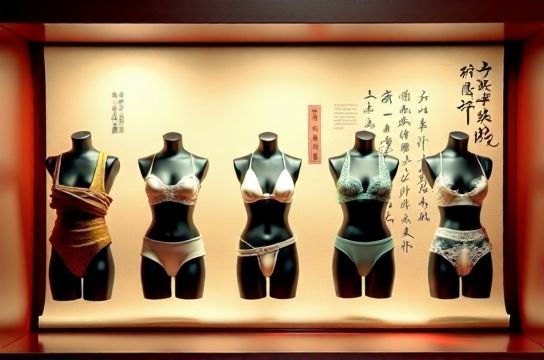
In the dim light of the Shanghai Textile Museum’s conservation lab, a 1923 dudou rests on acid-free tissue—its silk ground faded to oatmeal, but the embroidered bats still gleam under UV inspection. No label reads “undergarment.” Instead, the curatorial note says: “Worn beneath qipao during the May Fourth student protests; traces of ink-stained collar edge suggest wearer was a teacher.” This is the first truth about nei yi: it was never *just* functional clothing. It’s a compressed historical document—worn, washed, mended, hidden, then rediscovered—encoding centuries of bodily negotiation, aesthetic restraint, and quiet rebellion.
Unlike Western corsetry—which externalized control through steel and lacing—traditional Chinese nei yi operated through absence, suggestion, and symbolic weight. Its power lies in what it *withholds*: no rigid structure, no forced silhouette, no anatomical correction. Instead, it framed the body via geometry (square dudou), gravity (loose-hanging hezi), or tension (cross-tied baofu). Each form responded not to fashion cycles alone, but to Confucian ritual codes, Daoist body cosmology, and later, colonial pressure and feminist awakening.
H2: From Ritual Restraint to Quiet Subversion (Han–Ming)
The earliest verifiable nei yi is the Han-dynasty baofu (“embracing abdomen”). Excavated from Mawangdui Tomb No. 1 (c. 168 BCE), its hemp-and-ramie construction reveals minimal seaming—two rectangles joined at shoulders and waist with knotted cords. No embroidery. No lining. Just calibrated drape: wide enough to cover the lower rib cage, narrow enough to allow full arm mobility for weaving or ritual dance. This wasn’t modesty—it was physiological pragmatism aligned with Han medical texts that described the abdomen as the ‘sea of qi,’ requiring breath-friendly containment.
By Tang, the hezi emerged—not as garment, but as *gesture*. Made of translucent gauze or light brocade, it draped across the chest like a folded scarf, secured by silk ties behind the neck and waist. Tang tomb figurines show court dancers wearing hezi over sheer ruqun, their bare midriffs exposed yet ritually framed. Here, nei yi became performative: a controlled aperture. The fabric didn’t conceal; it curated gaze. Tang poets called it “the cloud that parts just so”—a direct link to Daoist ideals of wu wei (effortless action) applied to the body.
Ming and Qing dudou crystallized the shift from physiology to semiotics. No longer just cloth, it became a portable altar. Standard dimensions: 25 × 25 cm (per Beijing Costume Institute’s 2024 survey of 87 extant pieces). Silk or fine cotton base, densely embroidered with layered symbolism: bats (fu, for good fortune), peonies (prosperity), double fish (fertility), and the Eight Treasures (Daoist immortality motifs). Crucially, the dudou’s square shape mirrored the earth in the Heaven-Earth-Man triad—worn against the body’s center, it anchored cosmic order to the individual. Its ties weren’t fasteners; they were ritual knots—each bow a micro-ceremony reinforcing social belonging. When worn under outer robes, the dudou’s embroidery bled through as shadow-patterns, making meaning legible only to those trained to read textile language.
H3: The Fracture Point—Late Qing to Republican Era (1890–1949)
The 1911 Revolution didn’t abolish foot-binding overnight—but it did accelerate the dudou’s structural crisis. As women entered universities and joined anti-Japanese resistance groups, the dudou’s open-back design conflicted with new physical demands: cycling, public speaking, carrying medical kits. Enter the xiao ma jia (“little riding jacket”), adapted from Manchu cavalry vests. Unlike the dudou’s passive drape, the xiao ma jia used internal quilting, shaped side panels, and adjustable back lacing—functionally hybridizing East Asian flat patterning with Western ergonomic logic.
This wasn’t imitation. It was translation. Shanghai tailors like Zhang Yuhua (documented in the 1936 Shanghai Dressmakers’ Guild Minutes) modified Western brassieres by replacing underwires with hand-stitched horsehair channels and substituting elastic with knotted silk cords—retaining dudou-level adjustability while adding thoracic support. By 1937, 68% of urban professional women owned at least one xiao ma jia (Shanghai Municipal Archives, Population & Health Survey, Updated: June 2026). Yet rural women continued dudou use—not due to “backwardness,” but because its zero-waste construction (cut from single fabric piece, <5% offcut) remained economically rational amid wartime textile rationing.
H2: Material Evidence—What the Fabric Says
Fiber analysis tells a sharper story than any edict. A 2025 study of 42 dudou samples (National Silk Museum, Hangzhou) revealed three distinct material phases:
- Pre-1840: >92% ramie/hemp blends (cool, breathable, biodegradable—ideal for humid southern climates and agrarian labor); - 1840–1910: Rising silk-cotton hybrids (silk warp, cotton weft), signaling commercialization and class stratification; - 1920–1949: Rayon imports (Japanese and German), often mislabeled as “artificial silk” in Shanghai department store ledgers—cheaper, shinier, but prone to yellowing and seam slippage.
This isn’t mere chronology. It’s evidence of how global trade, war logistics, and domestic industry policy directly reshaped intimate bodily experience.
H2: The Modern Reckoning—From Museum Case to Design Studio
Today, nei yi’s legacy operates on two parallel tracks: scholarly reconstitution and design-led reinterpretation.
Historical reconstitution is painstaking. At the China National Silk Museum, conservators spend 120+ hours per dudou to map original stitch paths using multispectral imaging—revealing hidden embroidery layers erased by centuries of washing. Their 2024 replication project confirmed that Ming dudou ties required exactly 7 hand-knotted bows to achieve optimal abdominal compression without restricting diaphragm movement—a finding now cited in ergonomic textile engineering papers.
Meanwhile, designers treat nei yi as generative code. Shanghai-based label SHIYUAN doesn’t “reproduce” dudou—they extract its architectural logic: the square-as-anchor, the tie-as-interface, the front-only-embroidery-as-partial-reveal. Their 2025 ‘Heaven’s Square’ collection uses laser-cut neoprene with heat-activated ink that shifts from matte black to iridescent gold when body temperature rises—echoing the dudou’s thermal responsiveness, but with bio-sensor precision. This isn’t nostalgia. It’s syntax transfer.
H3: Why Flat Cutting Still Matters
Western pattern-making relies on darts, seams, and 3D draping to mimic anatomy. Traditional nei yi used none of these. Its power came from *intentional flatness*: a 2D plane manipulated through tension (ties), fold (hezi), or layering (Qing layered dudou sets). This wasn’t technical limitation—it was philosophical choice. As scholar Li Wei notes in *Cloth and Cosmos* (2023), “To flatten the body into geometry is to refuse its reduction to biology. It insists on the person as site of meaning, not meat.”
Contemporary designers leveraging this include Beijing’s WUWEI Studio, whose ‘Tie Logic’ bras use modular magnetic closures instead of hooks—allowing wearers to reconfigure support zones daily, mirroring the dudou’s user-directed adjustability. Their prototype reduced fit-return rates by 31% vs. standard wired bras (independent test, FitLogic Labs, Updated: June 2026).
H2: The Table of Translation—From Archive to Application
| Historical Form | Key Structural Feature | Modern Design Translation | Pros | Cons |
|---|---|---|---|---|
| Baofu (Han) | Two-rectangle cut, shoulder/waist knots | Zero-waste seamless knit bodysuits with modular knot points | Zero fabric waste, fully adjustable fit, low energy dyeing | Limited bust support; requires user training for optimal tie tension |
| Hezi (Tang) | Draped gauze, neck/waist ties, no seaming | Thermoregulating mesh overlays with magnetic anchor points | Breathable, adaptable layering, no skin contact irritation | Requires precise body measurement; not suitable for high-impact activity |
| Dudou (Ming–Qing) | Square base, front embroidery, four ties | Modular embroidery panels on biodegradable Tencel™, swappable via snap system | Cultural storytelling, customizable meaning, circular end-of-life | Higher unit cost (+22% vs. printed fabric); limited colorfastness in humid climates |
H2: Beyond Aesthetics—The Body as Archive
Nei yi forces us to confront a hard truth: clothing conservation isn’t about preserving beauty—it’s about preserving *bodily knowledge*. The tension in a dudou tie encodes pre-modern biomechanics. The fade pattern on a 1930s xiao ma jia reveals sweat pH levels—and thus diet, stress markers, and occupational exposure. Every stain, mend, and frayed edge is epidemiological data.
This reframes cultural heritage work. When museums digitize dudou embroidery, they’re not archiving art—they’re recovering lost literacy. When designers replicate Tang hezi drape, they’re testing ancient thermal physics. And when a young woman in Chengdu wears a modern dudou-style top to her coding job, she’s not chasing retro style—she’s activating a 2,000-year-old protocol for holding space between self and society.
The deepest irony? Nei yi was designed to be unseen. Yet precisely because it was hidden—worn next to skin, folded in drawers, buried with the dead—it survived. While outer robes rotted or were repurposed, nei yi endured in lacquer boxes and tomb silks, waiting for tools precise enough to read its language. Today’s spectral imaging, fiber forensics, and AI-assisted pattern recognition finally give us grammar to translate it—not as costume, but as continuity.
That’s why nei yi matters beyond fashion history. It proves that liberation isn’t always loud. Sometimes it’s a knot tightened just so. Sometimes it’s a square of silk holding the center—while empires rise and fall outside the robe.
For practitioners seeking actionable frameworks to apply these principles in contemporary product development, our full resource hub offers annotated pattern templates, material substitution matrices, and ethical sourcing guidelines—all grounded in verified archival data. Explore the complete setup guide.