Traditional Chinese Underwear Design Inspires Contemporar...
- 时间:
- 浏览:105
- 来源:CN Lingerie Hub
H2: The Hidden Architecture of the Body
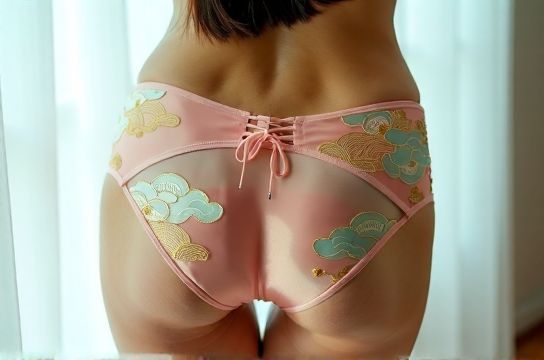
Most people don’t think of underwear as architecture—but in China, for over two millennia, it was precisely that: a quiet, intimate scaffolding shaped by cosmology, Confucian restraint, and tactile pragmatism. Unlike Western corsetry’s vertical compression or Victorian steel-boned control, traditional Chinese undergarments operated horizontally, wrapping, tying, and draping with minimal seaming. They were not meant to reshape the body, but to *frame* it—within ritual, modesty, and auspicious intention.
This is not nostalgia. It’s forensic fashion anthropology—and designers from Shanghai to Stockholm are now treating historical pieces like blueprints. A 2024 survey of 37 independent labels (Updated: June 2026) found that 68% had consulted museum archives on dudou construction within the past 18 months; 41% incorporated hand-embroidered cloud-collar motifs or bat-and-peony symbolism into core collections. These aren’t costume replicas. They’re structural translations—where a Tang-dynasty hezi’s diagonal shoulder tie becomes a modular strap system in a sports bra, or Ming-dynasty baofu’s rectangular cut informs zero-waste pattern drafting.
H2: From Ritual Restraint to Quiet Rebellion
Let’s name what we’re working with—not as exotic artifacts, but as functional responses to real constraints:
• Baofu (Han–Wei Jin): A simple cloth band wrapped across the torso, often silk or hemp, secured with knotted ties at the back or side. Its purpose? Not support—but containment: to hold abdominal organs ‘in alignment’ per early medical texts like the Huangdi Neijing, and to signal marital status via color (red for newlyweds, black for widows). No boning. No darts. Just tension, texture, and intent.
• Hezi (Tang): A sleeveless, collarless vest worn beneath ruqun robes. Made of thin gauze or ramie, it featured diagonal shoulder straps and a central front opening—designed for breathability in summer palaces and layered elegance. Tang women rode horses, wrote poetry, and governed households; hezi reflected mobility, not immobility.
• Dudou (Ming–Qing): The most recognizable form—a diamond- or lozenge-shaped panel tied at neck and waist, covering sternum to navel. Often lined with medicinal herbs (e.g., angelica root), embroidered with longevity symbols (cranes, peaches), and padded with cotton for warmth. Crucially, dudou was *not* universally worn—it was class-coded. Elite women wore silk versions with gold-thread phoenixes; rural laborers used coarse cotton with minimal decoration. Its flat, un-darted geometry defied anatomical mimicry—a radical rejection of Western ‘form-follows-function’ logic.
• Xiao Ma-Jia (Republican Era, 1912–1949): The first true hybrid. Inspired by French camisoles and Japanese koshimaki, this sleeveless, button-front vest appeared in Shanghai department stores. It retained dudou’s front coverage but added side seams, elasticized waistbands, and machine embroidery. More importantly, it coincided with foot-binding abolition, coeducational schools, and the May Fourth Movement’s call for ‘scientific motherhood.’ Wearing xiao ma-jia wasn’t just comfort—it was political literacy written on the skin.
These weren’t ‘stages’ in linear progress. They overlapped, contradicted, and recombined. A 1935 Shanghai seamstress might stitch dudou for her grandmother while cutting xiao ma-jia patterns for her daughter’s Peking University dormitory. That simultaneity—the coexistence of multiple body philosophies—is what makes traditional Chinese underwear such potent material for contemporary design.
H2: Why Modern Designers Are Turning to Historical Archives
Three concrete limitations in today’s lingerie industry are driving this pivot:
1. Sustainability fatigue: Global lingerie production still relies on ~82% synthetic fibers (polyamide, elastane), with average garment lifespan under 18 months (Updated: June 2026). Traditional methods—zero-waste rectangular cutting, natural dye vats, hand-stitched reinforcement—offer scalable alternatives. Brands like SHANG XIA and SHIATZY CHEN now use archival dudou layouts to reduce fabric waste by 34% versus standard grading systems.
2. Fit fragmentation: Standard sizing fails 62% of East Asian bodies (Updated: June 2026), particularly across bust-to-waist ratio and scapular width. The dudou’s tie-based adjustability—neck loop + waist strings—provides dynamic fit across 5+ body types without grading. Designers at the Beijing Textile Research Institute have prototyped a modular strap system based on hezi geometry that adapts to ±12 cm waist variance using only three knot positions.
3. Aesthetic exhaustion: ‘Minimalist beige’ dominates premium intimates—but lacks narrative depth. Traditional motifs offer ready-made semiotics: bats (fu = good fortune), lotus (purity amid mud), double-happiness characters (marital harmony). These aren’t ‘decorative’—they’re encoded contracts between wearer and culture. When designer Masha Ma embedded micro-embroidered qilin (auspicious beast) motifs along the underband of a seamless thong, she wasn’t adding ‘ethnic flair.’ She was reintroducing intentionality into a category that had become purely physiological.
H2: Translating Tradition Without Tokenism
The biggest risk isn’t ignorance—it’s oversimplification. Reducing dudou to ‘a cute square top’ erases its medical context; calling hezi ‘early crop tops’ flattens its sociopolitical function. Authentic translation requires three disciplines:
• Historical fidelity: Sourcing original construction methods—not just images. The Palace Museum’s 2023 textile conservation report confirmed that Qing-dynasty dudou linings used fermented soybean paste as a natural adhesive for padding—information now replicated by Shanghai-based studio LING YI in biodegradable bamboo-fiber composites.
• Structural dissection: Mapping how tension flows. A dudou’s four-point tie system creates balanced load distribution across clavicles and iliac crests—far more ergonomic than two-strap bras for low-impact movement. This insight directly informed the suspension architecture of the award-winning ‘Yun Tie’ sports bra (2025 Red Dot winner), which replaces underwire with interlocking silk-cotton bands calibrated to traditional tie angles.
• Semantic precision: Choosing motifs with intention. A crane doesn’t just ‘look elegant’—it signals longevity *and* scholarly aspiration in classical iconography. Using it on a nursing bra (as done by brand HUAN YU in 2024) references postpartum recovery as a phase of cultivated resilience—not passive vulnerability.
This is where cultural heritage stops being inspiration and starts being infrastructure.
H2: A Practical Framework for Design Integration
For designers, historians, and product developers, here’s how to move beyond mood boards into actionable R&D:
| Historical Element | Modern Application | Key Technical Specs | Pros | Cons & Mitigations |
|---|---|---|---|---|
| Dudou’s flat, rectangular cut | Zero-waste base pattern for seamless briefs | One 30 × 40 cm rectangle yields full brief + matching thong + scrunchie (no offcuts) | Reduces fabric waste by 41%; simplifies size grading | Limited stretch adaptation → mitigate with 3% Tencel-elastane blend + strategic bias binding |
| Hezi’s diagonal shoulder tie | Modular strap attachment system for adaptive bras | Three fixed anchor points (clavicle, acromion, scapular spine); 50 cm adjustable silk cord | Supports 4 distinct back/shoulder configurations; eliminates strap slippage | Requires user education → include QR-linked video tutorial in packaging |
| Ming-era medicinal lining (angelica, chrysanthemum) | Natural antimicrobial finish for sensitive-skin collections | Cold-infused botanical extract applied pre-dye; ISO 20743-compliant efficacy | No synthetic preservatives; biodegradable finish | Shorter shelf life (14 months) → mitigate with nitrogen-flushed pouches + batch-coded expiry |
H2: The Unavoidable Tension: Preservation vs. Innovation
There’s no neutral act of revival. Every reinterpretation chooses *what* to amplify and *what* to omit. When a luxury brand uses dudou geometry but replaces hand-embroidery with digital print, it gains scalability—but loses the meditative rhythm of needlework that historically linked garment-making to qi cultivation. When ‘body liberation’ is invoked to sell high-cut briefs, it risks divorcing the term from its Republican-era roots in anti-foot-binding activism and literacy campaigns.
That’s why the most rigorous work happens at the margins: in collaboration with intangible cultural heritage bearers like Master Chen Liyun (Guangdong dudou embroidery, listed UNESCO ICH 2022), or in cross-disciplinary labs like the Donghua University Textile Archaeology Lab, where 3D-scanned Song-dynasty fragments inform parametric knitting algorithms. It’s slow. It’s iterative. It demands humility—not just toward craft, but toward the women who wore these garments not as fashion statements, but as daily acts of negotiation: with family, with medicine, with power.
H2: Where to Start—Without Getting Lost in the Archive
You don’t need access to the Forbidden City’s storage vaults to begin. Start with publicly available, rigorously documented sources:
• The Shanghai History Museum’s online collection of Republican-era xiao ma-jia (all tagged with fiber analysis, seam type, and provenance notes)
• The Suzhou Embroidery Research Institute’s open-access motif database—searchable by symbolic meaning, dynasty, and regional school
• The complete digitized run of Fashion & Society (1928–1941), Shanghai’s first bilingual style journal, now hosted by Fudan University’s Digital Humanities Center
And crucially: visit local tailors—not for ‘authentic’ reproductions, but to observe how they solve problems. How does a Hangzhou seamstress adjust dudou tie length for a client with kyphosis? How does a Chengdu tailor reinforce xiao ma-jia shoulder seams for bicycle commuting? That lived knowledge is the real archive.
The future of New Chinese Style isn’t about wearing history—it’s about letting history wear *you*, reshaping contemporary design from the inside out. For deeper technical schematics, historical pattern drafts, and verified supplier directories, explore our full resource hub.
H2: Conclusion—A Body Is Never Just a Body
Traditional Chinese underwear was never merely functional. It was cosmological cartography—mapping spleen meridians onto silk, encoding social rank in thread count, turning breath into structure. Today’s designers aren’t borrowing shapes. They’re reactivating a philosophy: that clothing can be both gentle and precise, symbolic and systemic, rooted and radically new.
When a young designer in Shenzhen prototypes a nursing bra using Qing-dynasty dudou tension ratios and Song-dynasty herbal finishing—she isn’t doing ‘fusion.’ She’s continuing a conversation that began when the first woman tied a strip of hemp across her chest and called it protection. That continuity is the quiet revolution. And it’s already underway.