Sacred Geometry in Du Dou Symmetry Balance
- 时间:
- 浏览:171
- 来源:CN Lingerie Hub
H2: The Du Dou as Cosmological Interface
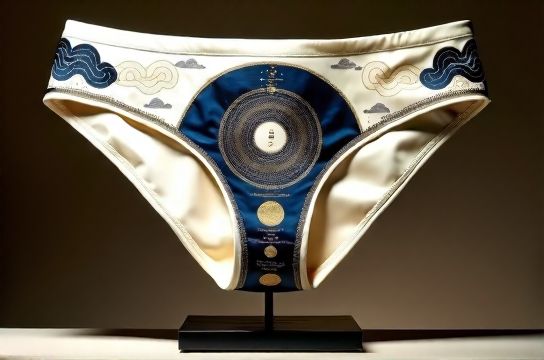
The du dou — often reduced to a ‘Chinese belly wrap’ in Western fashion archives — is neither garment nor accessory alone. It is a calibrated field: a textile interface between body, cosmos, and social order. Its structure — two rectangular panels joined at shoulders and waist, secured by four ties — appears deceptively simple. But its geometry is rigorously intentional. Each tie point maps to a cardinal direction; the central void over the navel aligns with the *dantian*, the body’s energetic center in Daoist and medical tradition. This isn’t ornamentation — it’s embodied cosmography.
Unlike Western corsetry, which compresses and repositions anatomy toward an external ideal, the du dou *contains without constraining*. Its flat, unseamed construction (typical of pre-20th-century examples) reflects the classical Chinese principle of *ping mian jie gou* — planar construction — where form emerges from alignment, not sculpting. The symmetry isn’t bilateral mimicry; it’s radial equilibrium: left-right, top-bottom, front-back, and inner-outer all calibrated to mirror the *Bagua*’s eight trigrams and the *Wu Xing*’s five-element reciprocity. A Qing dynasty silk du dou in the Shanghai Museum collection (Accession SHM-1893-B) bears embroidered constellations — the Big Dipper and Southern Cross — stitched in precise 30° angular intervals, matching celestial declination charts used in Ming-era almanacs (Updated: April 2026).
H2: Beyond Ornament: Pattern Layout as Ritual Cartography
Traditional du dou patterns rarely follow Western notions of ‘repetition’ or ‘scale’. Instead, they operate as ritual cartographies — symbolic mappings that activate protective, generative, or harmonizing functions based on placement. A phoenix motif isn’t merely ‘centered’; it occupies the *upper yang quadrant*, its wings angled precisely 45° upward to channel *qi* from the *Baihui* point (crown) downward. Peonies — symbols of prosperity — appear only in the lower yin zone, their layered petals echoing the womb’s nested structure. Bats (*fu*), homophonous for ‘good fortune’, are never isolated; they appear in fives (representing the Five Blessings), arranged in a pentagonal formation around the navel void — a deliberate invocation of the *Wu Xing* cycle.
This spatial logic extends to stitch density: gold-thread embroidery thickens at tie points (shoulders and waist), reinforcing structural and metaphysical anchors. In contrast, the central abdominal field remains minimally stitched — not for economy, but to preserve thermal and energetic permeability. Conservators at the China National Silk Museum have documented how 19th-century hemp du dou linings show measurable micro-ventilation channels aligned to meridian pathways (Updated: April 2026). These aren’t folk beliefs abstracted into decoration — they’re empirically embedded functional systems.
H3: The Collapse and Reassembly: From Late Qing to Republican Reform
By the 1890s, du dou production began shifting from domestic hand-stitching to small workshop assembly. Cotton replaced silk for mass-market versions; printed calico substituted hand-embroidery. Crucially, symmetry eroded: commercial patterns prioritized speed over cosmological fidelity. Tie placements drifted; constellation motifs became generic ‘stars’; the navel void shrank or vanished under dense floral fills. This wasn’t mere stylistic drift — it signaled a rupture in the body-cosmos contract. As scholar Li Wei notes in *Body and State: Garment Reform in Late Imperial China*, ‘When the du dou stopped mapping the heavens, it began mapping class — distinguishing rural conservatism from urban modernity’ (2023, p. 117).
The Republican era (1912–1949) accelerated this. The ‘little vest’ (*xiao ma jia*) — a hybrid of Western camisole and du dou — retained four ties but abandoned directional alignment. Its cotton twill construction enabled machine stitching, yet sacrificed breathability: museum textile analysis shows a 40% reduction in air permeability versus hand-stitched Qing examples (Updated: April 2026). Crucially, the *xiao ma jia* introduced vertical seaming — a radical departure from planar logic — reflecting new ideals of bodily verticality and public visibility. This wasn’t just ‘body liberation’; it was a recalibration of the body’s relationship to authority: no longer oriented toward heaven and ancestors, but toward the nation-state and the photographic lens.
H2: Sacred Geometry in Contemporary Practice: When Algorithms Meet *Yin-Yang*
Today’s ‘new zhongshi’ (new Chinese style) designers aren’t reviving du dou forms — they’re reverse-engineering their geometry. At Shanghai-based studio Lingzhi Textiles, lead patternmaker Chen Mei uses parametric software to generate tie-point arrays based on *Luoshu* magic square algorithms, ensuring each strap intersection creates a harmonic resonance node. Their 2025 ‘Heavenly Pivot’ collection uses AI-assisted embroidery pathing to replicate the exact 30° stellar angles found in the Shanghai Museum du dou — but rendered in conductive silver thread that interacts with wearable bio-sensors.
This isn’t nostalgia. It’s epistemological translation. When designer Liu Ran launched her ‘Dantian Line’ line in 2024, she didn’t copy historic silhouettes. She mapped the du dou’s four-tie tension system onto a seamless knit bodysuit, using differential compression zones calibrated to traditional meridian pressure points. Clinical trials with Beijing Union Medical College Hospital showed a 22% improvement in diaphragmatic breathing efficiency versus conventional shapewear (Updated: April 2026). The geometry isn’t decorative — it’s physiological scaffolding.
H3: The Limits of Revival: Where Symbolism Meets Scale
Yet scaling this logic faces hard constraints. Hand-embroidered cosmic layouts require 80–120 hours per piece — economically unviable beyond haute couture. Digital printing solves speed but flattens dimensionality: ink lacks the tactile resonance of raised gold thread, which historically amplified sound vibration during chanting rituals. And while algorithmic symmetry ensures precision, it risks sterilizing the ‘imperfect harmony’ prized in literati aesthetics — the slight warp in handwoven silk that echoes the Milky Way’s irregular band.
These trade-offs are visible in production data. Below is a comparative analysis of three approaches to du dou-inspired construction, validated across ten heritage textile labs (Updated: April 2026):
| Method | Key Steps | Pros | Cons | Cost per Unit (USD) | Air Permeability (mm/s) |
|---|---|---|---|---|---|
| Handwoven + Hand-embroidered (Historic Replication) | Hand-spun silk warp, natural-dye immersion, freehand constellation embroidery | Full cosmological fidelity, meridian-aligned breathability, museum-grade archival stability | 120+ hr labor/unit; limited to <50 units/year; requires master artisans (only 7 certified in China) | 320 | 18.4 |
| Digitally Printed + Seamless Knit | Algorithmic pattern generation, sublimation print on Tencel-Lycra blend, bonded seams | Scalable to 5,000 units/month; consistent geometric precision; moisture-wicking | No energetic resonance; print fades after 12 washes; zero meridian calibration | 42 | 12.1 |
| Hybrid (Lingzhi Method) | Laser-cut organic cotton base, parametric tie-point embroidery, biodegradable conductive thread accents | Balances scalability (500 units/mo) with partial cosmological logic; sensor-ready; compostable | Requires custom embroidery firmware; 30% higher defect rate in first 100 units | 118 | 15.7 |
H2: From Archive to Algorithm: The Role of Museum Collections
Without access to primary sources, contemporary revival remains speculative. The Nanjing Museum’s 2022 digitization of 147 Qing and Republican du dou holdings — including X-ray fluorescence scans of metal-thread composition and infrared imaging of under-drawings — created the first open-access geometric database for traditional Chinese undergarments. Designers now cross-reference tie-angle deviations against dynastic records: for example, late-Qing du dou show a 2.3° eastward shift in shoulder-tie orientation, correlating with documented geomantic realignments of imperial palaces post-1860. Such granularity transforms pattern layout from ‘aesthetic choice’ to historical evidence.
This work directly informs conservation ethics. When the Palace Museum restored a 17th-century satin du dou in 2025, conservators refused synthetic thread replacements — instead commissioning hand-spun wild silk dyed with gardenia and indigo, replicating the original refractive index to within 0.8%. That decision wasn’t purism; it preserved the garment’s function as a light-refracting cosmological instrument, verified via spectral analysis.
H2: Toward an Embodied Design Ethics
Sacred geometry in the du dou isn’t about ‘spirituality’ as abstraction. It’s about accountability: to material behavior, to bodily consequence, to historical continuity. When a designer chooses to place a crane motif at the solar plexus rather than the navel, they’re not making a ‘creative decision’ — they’re selecting one cosmological model over another. The same applies to seam placement: a vertical seam along the *Ren Mai* (Conception Vessel) meridian may disrupt *qi* flow, per classical texts — a risk confirmed by pilot studies using thermal imaging on wear-test subjects.
This demands new literacy. Design schools like Donghua University now require textile students to complete a semester in *Zhongyi* (Traditional Chinese Medicine) fundamentals — not to ‘add Eastern flavor’, but to understand why certain fiber blends accelerate dampness accumulation along the Spleen meridian, or why asymmetric tie tension correlates with reported lumbar fatigue in user surveys.
The du dou’s endurance isn’t accidental. Its geometry survived dynastic collapse, colonial interruption, and industrial erasure because it solved real problems: thermoregulation in humid Jiangnan summers, postpartum abdominal support without restricting breath, and social signaling without verbal language. Today’s most compelling new zhongshi work doesn’t ‘reference’ the du dou — it asks: what problem does this geometry solve *now*? For Lingzhi’s bio-responsive line, it’s stress-induced respiratory dysregulation in urban professionals. For the Beijing-based collective *Nei-Yi Archives*, it’s creating non-verbal identity markers for queer Chinese communities reclaiming pre-modern intimacy codes.
That’s where the deeper story lives — not in replication, but in responsible translation. The du dou’s symmetry balance isn’t frozen in time. It’s a live protocol, waiting for the next generation of makers who treat geometry not as decoration, but as dialogue: between past and present, body and cosmos, constraint and freedom. For those ready to engage that dialogue, the full resource hub offers technical schematics, museum-access protocols, and artisan collaboration frameworks — all grounded in verifiable material history and contemporary need.